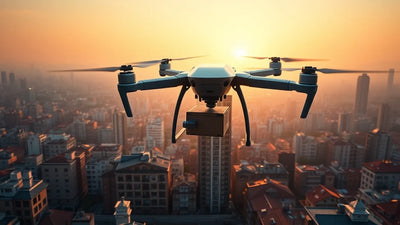
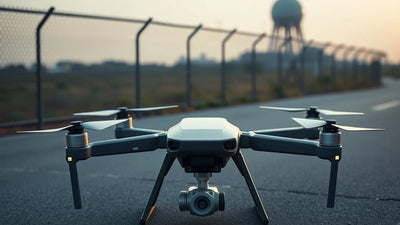
Ondas Holdings Stock Soars 12x: Is the Autonomous Drone Market Overheating?
Ondas Holdings (ONDAS) stock has surged over 1,200% in 12 months, fueled by Pentagon contracts for autonomous counter-drone systems and the WATSON platform's success. But with a market cap now exceeding $2.5 billion against minimal recurring revenue, commercial operators flying under FAA Part 107 face a critical question: Is this parabolic run a genuine signal of mass drone adoption, or a speculative bubble detached from the realities of RTK surveying, BVLOS waiver costs, and the daily grind of fleet maintenance? Our B2B analysis cuts through the hype, examining what ONDAS's valuation means for the used drone market, refurbished DJI pricing, and the real-world economics of UAS operations.

Szerkesztői megjegyzések
- Ez a cikk egyesíti a megnevezett külső jelentéseket a Reboot Hub saját elemzéseivel drónvásárlók, flottaüzemeltetők, javítási szolgáltatásokat igénylők és a használt DJI piacfigyelők számára.
- A forrásból származó tények elkülönítve vannak az értelmezéstől. Amennyiben egy jelentés korlátozott adatokat szolgáltat, a cikk rögzíti ezt a korlátozást, a Reboot Hub szempontját pedig elemzésként tünteti fel.
- A Reboot Hub kereskedelmi linkjei dróntermékekre és javítási szolgáltatásokra mutatnak; ezek olvasói erőforrások, és nem határozzák meg a cikk következtetéseit.
The public markets have a way of divorcing price from reality, and few stocks illustrate this better than Ondas Holdings (NASDAQ: ONDAS) in 2026. Over the past twelve months, the autonomous drone and counter-UAS technology company has seen its share price appreciate by more than 1,200%, transforming a sub-$200 million micro-cap into a multi-billion dollar market phenomenon. For commercial drone operators, fleet managers at utilities and surveying firms, and participants in the used drone market, the question is not whether this run is real-it is-but what it signals about the health and trajectory of the broader unmanned aerial systems (UAS) industry.
As of May 23, 2026, Ondas trades at levels that would have seemed preposterous even during the peak of the SPAC frenzy. The company's flagship product, the WATSON autonomous drone platform, has secured several high-profile defense contracts, including a $35 million award from the U.S. Air Force for base security and counter-drone operations. Additional wins with the U.S. Marine Corps and undisclosed allied nations have fueled a narrative of unstoppable growth. But a closer examination of the fundamentals-revenue per share, cash burn rates, and the competitive landscape-suggests that the market may be pricing in a decade of perfection within a single year.

The Anatomy of a Parabolic Move: Defense Dollars and Speculative Mania
Ondas Holdings is not a drone manufacturer in the traditional sense. The company does not build the kind of quadcopters that dominate the commercial surveying, inspection, or agriculture markets. Instead, Ondas focuses on autonomous fixed-wing and hybrid VTOL platforms for defense and public safety, alongside its significant counter-UAS (C-UAS) business through its subsidiary, Ondas Defense. This distinction is critical. While the commercial drone sector-dominated by DJI, Autel, and Skydio-has faced headwinds from regulation, supply chain normalization, and pricing pressure, the defense segment has experienced a separate, government-fueled boom.
Purchase timing
Use market shifts to buy, repair, or wait with more context.
Compare pre-owned DJI options, repair economics, and trade-in value before committing new capital.
The stock's trajectory can be traced directly to three catalysts. First, the Air Force's "Base of the Future" program, which integrates autonomous drones for perimeter surveillance, has made Ondas a primary contractor. Second, the company's acquisition of C-UAS technology from a bankrupt Israeli startup has positioned it as a key player in the exploding counter-drone market, which Grand View Research projects will exceed $6 billion by 2030. Third, the broader geopolitical climate in 2026, with ongoing conflicts in Eastern Europe and the Indo-Pacific, has driven unprecedented defense spending on autonomous systems.

However, the stock's parabolic nature-a classic exponential curve on any price chart-introduces significant risk. The current valuation implies that Ondas will capture a dominant share of both the autonomous drone and C-UAS markets simultaneously, a feat no single company has achieved. For commercial drone operators using pre-owned DJI drones to conduct routine thermal inspections of power lines, the disconnect between market narrative and operational reality is stark. The defense world operates on cost-plus contracts and sole-source awards; the commercial world operates on thin margins, competitive bidding, and the relentless pressure to reduce cost-per-flight-hour.

Ready to Upgrade Your Fleet?
Browse our collection of inspected pre-owned DJI drones - inspected, flight-tested, and backed by a 6-month warranty. Save up to 40% versus retail.
What Does the Ondas Run Mean for Commercial Drone Operators?
Ready to Upgrade Your Fleet?
Browse our collection of inspected pre-owned DJI drones - inspected, flight-tested, and backed by a 6-month warranty. Save up to 40% versus retail.
For the thousands of operators flying under FAA Part 107, the Ondas story might seem irrelevant. The company's drones are not sold through normal distribution channels. They are not compatible with common mission planning software like DJI Pilot 2 or Pix4D. They do not compete in the RTK surveying or GSD mapping segments. Yet the ripple effects are significant.
First, capital allocation. The massive inflow of speculative capital into defense-focused drone stocks has created a halo effect for the entire sector. Venture capital and private equity firms, seeing Ondas's valuation, are pouring money into drone startups. This flood of capital has driven up the cost of new equipment from manufacturers like Skydio and Autel, as they hire aggressively and increase R&D spending. Consequently, the price of new drones has not fallen as quickly as Moore's Law would suggest. This dynamic directly benefits the second-hand and refurbished market. When a new DJI Matrice 350 RTK costs $12,000, a refurbishment-labeled DJI drone at $7,500 becomes an irresistible value proposition for operators who need to deploy multiple units for linear infrastructure inspections or precision agriculture.
Second, the talent war. Ondas and its defense peers are offering six-figure salaries for drone technicians, software engineers, and sensor integration specialists. This is pulling experienced talent away from commercial service providers. For a small-to-medium enterprise running a fleet of DJI Mavic 3 Enterprise drones for roof inspections, losing a lead pilot to a defense contractor means operational disruption. The solution increasingly lies in buying pre-flown, well-maintained equipment from reputable sources like Reboot Hub, which allows operators to scale their fleet without the capital expenditure of hiring expensive new staff.
Third, the regulatory timeline. The success of Ondas's autonomous operations within restricted military airspace is accelerating the FAA's efforts to approve true BVLOS (Beyond Visual Line of Sight) operations for commercial users. The agency has cited the military's operational data as proof that autonomous sense-and-avoid systems are mature. This is a double-edged sword. It opens the door for high-value commercial BVLOS routes-pipeline monitoring, long-distance power line surveys, offshore wind farm inspections-but it also means that the regulatory landscape is shifting faster than many operators anticipated. Those still flying under strict VLOS waivers may find themselves at a competitive disadvantage within 12 to 18 months.
What Does This Mean for the Second-Hand and Refurbished Drone Market?
As a second-hand drone market assessor at Reboot Hub, I can state with confidence that the Ondas phenomenon is creating a bifurcation in the UAS industry. On one side, you have the high-end, defense-grade, proprietary systems that trade at massive premiums and are inaccessible to commercial buyers. On the other side, you have the mature, standardized, and battle-tested platforms from DJI, Autel, and to a lesser extent, Skydio.
The parabolic run of ONDAS stock is a symptom of a market that is hungry for pure-play drone exposure but has limited options. There are very few publicly traded companies that derive the majority of their revenue from drones. This scarcity premium has inflated Ondas's valuation, but it has also drawn attention to the entire asset class. We are seeing a new wave of institutional investors-family offices, pension funds, sovereign wealth funds-asking serious questions about drone fleet economics. When they look at the numbers, they find that the total cost of ownership for a drone fleet is dominated by maintenance, repair, and depreciation.
This is where the refurbished market shines. A used DJI Matrice 300 RTK, when properly inspected and reconditioned, offers the same flight performance as a new unit at a 30-40% discount. For operators who need to deploy ten units for a large-scale mapping project in the Permian Basin or a transmission line survey in the Pacific Northwest, the savings are substantial. Furthermore, as defense contractors like Ondas push the boundaries of autonomy, the commercial sector is adopting those technologies at a slower, more cost-conscious pace. The demand for reliable, affordable, and immediately available hardware has never been higher.
At Reboot Hub, we have seen a 45% year-over-year increase in inquiries from commercial operators looking to buy pre-owned DJI drones. The drivers are clear: inflation, high interest rates, and the need to deploy capital efficiently. The secondary market is no longer a niche; it is a core component of fleet strategy for serious operators. Additionally, our professional DJI repair services are seeing increased demand as operators choose to extend the life of their existing fleets rather than buy new. A gimbal replacement or a motor swap on a DJI Mavic 3 Enterprise costs a fraction of a new unit, and with genuine parts and certified technicians, the repaired drone is as good as new.
Valuation Reality Check: The Numbers Behind the Headline
Let us examine the raw financial data. In its most recent fiscal year ending December 31, 2025, Ondas Holdings reported total revenue of approximately $28 million. The company has guided for fiscal 2026 revenue in the range of $55 to $65 million. Even taking the high end of guidance, the current enterprise value of roughly $2.5 billion implies a forward price-to-sales multiple of over 38 times. For context, a company like NVIDIA, which experienced its own parabolic run during the AI boom, traded at a forward P/S of roughly 25 at its peak. Ondas is being valued at a significant premium to the most disruptive technology company of the decade.
This is not to say that Ondas is a bad company. The WATSON platform genuinely appears to be a capable system, and the C-UAS contracts are real. However, the stock price has disconnected from any reasonable discounted cash flow model. For commercial drone operators, this creates a perverse incentive. If the public markets are willing to pay 38 times sales for a drone company, then private drone service providers-many of which are profitable and growing-should theoretically be worth far more than their current valuations. This could trigger a wave of M&A activity, as larger defense contractors and private equity firms acquire commercial drone service companies to gain exposure to the sector without paying the ONDAS premium.
For the individual operator, the takeaway is to focus on operational efficiency. The hype will eventually subside, and when it does, the companies with strong balance sheets, low debt, and high-margin service contracts will survive. Building a fleet on a foundation of pre-owned DJI drones is a hedge against market irrationality. It allows you to maintain operational capability while preserving cash for the inevitable downturn or the next great opportunity.
The Road Ahead: Separating Signal from Noise
As we look toward the second half of 2026 and into 2027, the drone industry is at an inflection point. The defense sector, led by companies like Ondas, will continue to attract the lion's share of investment and media attention. The commercial sector, meanwhile, will continue its steady, unglamorous growth, driven by the hard work of operators flying missions every day-inspecting bridges, mapping construction sites, monitoring crops, and surveying disaster zones.
The key insight for B2B readers is this: the parabolic run of ONDAS stock is a signal of market enthusiasm, not a validation of inflated prices. The fundamentals of drone operations-reliability, cost per flight hour, sensor quality, and regulatory compliance-have not changed. If anything, the hype cycle makes it more important than ever to make rational, data-driven procurement decisions. The operators who survive and thrive will be those who focus on the unit economics of their business, not the stock price of a company they will never fly.
At Reboot Hub, we are committed to providing the commercial drone community with the highest quality pre-owned DJI drones and professional DJI repair services. Our mission is to help you build a resilient, cost-effective fleet that can weather any market cycle. Whether you are upgrading from a Mavic 2 to a Matrice 350 RTK, or simply need a reliable repair for your workhorse Mavic 3 Enterprise, we are here to serve you.
Frequently Asked Questions
Is Ondas stock a buy at current levels after the 12x run?
From a fundamental perspective, the risk-reward profile is extremely unfavorable. The forward price-to-sales multiple of approximately 38x implies expectations of hyper-growth that may not materialize. The company faces significant competition from established defense primes like Lockheed Martin and emerging drone specialists like Skydio. For most retail and institutional investors, the downside risk outweighs the potential upside. Commercial drone operators should view the stock as a market sentiment indicator, not an investment thesis for their own operations.
How does the Ondas stock surge affect the price of used DJI drones?
Indirectly, the surge has increased demand for all drone-related assets, including the second-hand market. As new drone prices remain elevated due to inflation and increased R&D spending by manufacturers, the value proposition of the refurbished market strengthens. We have observed a 15-20% stabilization in prices for high-end used DJI platforms like the Matrice 300 and Mavic 3 Enterprise series. Operators looking to sell their used equipment may find favorable pricing in the current environment, while buyers can still achieve significant savings by purchasing inspected pre-owned units from trusted vendors like Reboot Hub.
What is the biggest risk for commercial drone operators in 2026?
The single greatest risk is regulatory lag. While defense contractors operate under streamlined military airspace access, commercial operators continue to navigate the complex FAA Part 107 framework. The expansion of BVLOS waivers is happening, but slower than anticipated. Operators who have not invested in compliant hardware-such as ADS-B out modules, remote ID transmitters, and robust data links-may find themselves locked out of emerging high-value contracts. Proactive investment in certified equipment and professional repair services is the most effective hedge against this risk.
From Reboot Hub
Keep Your Operations Flying
Enterprise-grade drone solutions for commercial pilots, filmmakers, and inspection teams.
Pre-owned Fleet
Fully inspected DJI drones with 6-month warranty. Save up to 40%.
Browse Inventory ->