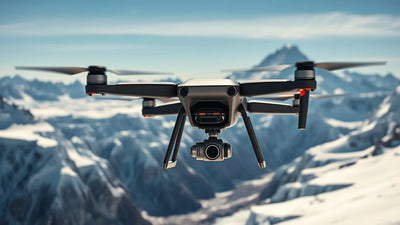
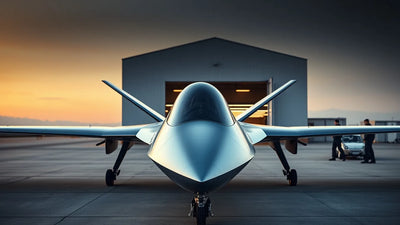
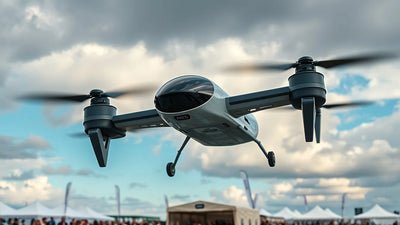
Kalashnikov's SKAT-220: The 99 MPH Agricultural Drone That's Redefining Speed Records
Kalashnikov's SKAT-220 drone claims a record 99 MPH speed, targeting the global agricultural and power line inspection market. This is not just a speed record—it's a strategic pivot that threatens DJI's dominance in BVLOS operations and opens new frontiers for military-grade UAVs in civilian airspace. For commercial operators, this means re-evaluating fleet capabilities for high-speed surveying, while the second-hand market braces for a surge in demand for performance-tested, refurbished platforms like the DJI Matrice 350 RTK. With FAA Part 107 waivers and EASA regulations tightening, the SKAT-220's speed could force new compliance standards. Is your fleet ready for the 100 MPH era, or will you be left in the dust?

Szerkesztői megjegyzések
- Ez a cikk egyesíti a megnevezett külső jelentéseket a Reboot Hub saját elemzéseivel drónvásárlók, flottaüzemeltetők, javítási szolgáltatásokat igénylők és a használt DJI piacfigyelők számára.
- A forrásból származó tények elkülönítve vannak az értelmezéstől. Amennyiben egy jelentés korlátozott adatokat szolgáltat, a cikk rögzíti ezt a korlátozást, a Reboot Hub szempontját pedig elemzésként tünteti fel.
- A Reboot Hub kereskedelmi linkjei dróntermékekre és javítási szolgáltatásokra mutatnak; ezek olvasói erőforrások, és nem határozzák meg a cikk következtetéseit.
In a move that sent shockwaves through the global UAV industry, Kalashnikov Concern-the same Russian defense giant famous for the AK-47-has unveiled the SKAT-220, a fixed-wing drone that it claims is the fastest in its class, reaching a staggering 99 miles per hour (160 km/h). Announced on May 28, 2026, this new platform is a lighter, faster evolution of the company's SKAT-350M, and it is being pitched squarely at the civilian commercial market: agriculture and power line inspection. But for anyone who understands the trajectory of the drone industry, this is not just a speed record. It is a geopolitical and commercial chess move that directly challenges the dominance of DJI, the Chinese market leader, and raises urgent questions about the future of the second-hand drone market, regulatory compliance, and the militarization of civilian airspace.
The SKAT-220's 99 MPH claim is audacious. To put it in perspective, DJI's most popular enterprise drone, the Matrice 350 RTK, has a maximum speed of just 51 MPH in standard mode. Even the fastest DJI consumer drone, the FPV series, only hits about 60 MPH in manual mode. Kalashnikov is not just offering a marginal gain; it is offering a near-doubling of speed for a platform designed for precision tasks like crop spraying and infrastructure inspection. This speed, combined with a reported flight time of up to 2 hours and a payload capacity of 20 kg, positions the SKAT-220 as a potential game-changer for large-scale agricultural operations where time is money. In the world of BVLOS (Beyond Visual Line of Sight) operations, where every minute of flight time translates directly to revenue, a 99 MPH drone could cover 50% more ground per sortie than a typical DJI Matrice 300 or M350 RTK.

But the implications go far beyond simple speed. The SKAT-220 is a fixed-wing drone with a pusher propeller configuration, similar in form factor to the US-made Skydio X2 or the Chinese-made JOUAV CW-15. However, its speed and payload capacity are in a different league. Kalashnikov claims the drone is "unmatched in its class," a phrase that should make every commercial operator, fleet manager, and regulatory authority sit up and take notice. The drone is designed for precision agriculture-spraying pesticides, mapping crop health with multispectral sensors-and for linear infrastructure inspection, such as power lines, pipelines, and railways. These are exactly the high-value, high-volume sectors that have been the bread and butter of DJI's enterprise ecosystem for the past decade.
Fleet readiness
Keep DJI hardware available without overbuying new units.
Use this news as a planning signal for inspected DJI aircraft, repair support, and trade-in timing.
The Speed Advantage: Redefining Commercial Efficiency
For commercial drone operators, speed is a double-edged sword. On one hand, a 99 MPH drone can dramatically reduce the time required for large-area surveying. For example, a 1,000-acre farm that might take a DJI Matrice 350 RTK with a 20-minute flight time and a 51 MPH speed to cover in multiple sorties could potentially be mapped in a single, high-speed pass with the SKAT-220. This translates directly to lower operational costs, higher throughput, and the ability to take on more contracts. In the competitive world of agricultural spraying, where margins are thin and seasons are short, this speed advantage could be decisive.
On the other hand, speed introduces new risks. At 99 MPH, a drone is traveling roughly 145 feet per second. This means the reaction time for collision avoidance, especially in dynamic environments with birds, other drones, or unexpected weather, is cut dramatically. The SKAT-220 will require advanced sense-and-avoid systems, likely relying on radar or LiDAR, to operate safely in uncontrolled airspace. Moreover, the regulatory framework for such high-speed operations is still being written. In the United States, FAA Part 107 waivers for BVLOS operations are notoriously difficult to obtain, and they typically require rigorous safety cases, airspace authorization, and often a visual observer. A drone moving at 99 MPH would likely require a dedicated, high-bandwidth datalink and potentially a chase aircraft, adding significant complexity and cost.

Despite these challenges, the SKAT-220's speed is a clear signal to the market: the era of the slow, cautious drone is ending. The demand for high-speed, long-endurance platforms is being driven by the booming ag-tech sector, where precision agriculture is becoming a necessity for global food security. Kalashnikov is betting that the speed record will translate into market share, especially in regions like Russia, Central Asia, and parts of Africa and South America, where regulatory frameworks are less restrictive and the need for rapid crop monitoring is acute.

Ready to Upgrade Your Fleet?
Browse our collection of inspected pre-owned DJI drones - inspected, flight-tested, and backed by a 6-month warranty. Save up to 40% versus retail.
What Does the SKAT-220 Mean for the Global Drone Market?
Ready to Upgrade Your Fleet?
Browse our collection of inspected pre-owned DJI drones - inspected, flight-tested, and backed by a 6-month warranty. Save up to 40% versus retail.
To understand the SKAT-220's impact, we need to analyze it through three lenses: the commercial operator, the second-hand market, and the regulatory landscape.
For the Commercial Operator: If you are a crop-dusting company in Texas or a power line inspection firm in Germany, the SKAT-220 represents both an opportunity and a threat. The opportunity is clear: a faster drone means more jobs per day, higher revenue, and a competitive edge. The threat is that your existing fleet of DJI Matrice 350 RTKs or M300s may suddenly seem slow and obsolete. However, the SKAT-220 is not a plug-and-play replacement. It is a fixed-wing drone, which means it requires a runway or a catapult launcher for takeoff and a net or parachute for landing. This adds logistical overhead. For many operators, the DJI M350 RTK's vertical takeoff and landing (VTOL) capability remains a significant advantage, especially in tight or uneven terrain. The SKAT-220 is best suited for large, open areas like farms or long linear corridors like pipelines, where its speed can be fully utilized.
For the Second-Hand and Refurbished Drone Market: This is where the SKAT-220's impact could be most profound. As commercial operators begin to evaluate high-speed platforms, they will inevitably look to upgrade their fleets. This will create a surge in supply of used DJI enterprise drones, particularly the Matrice 300 and M350 RTK models, as well as other fixed-wing platforms like the senseFly eBee X. For buyers, this is a golden opportunity. The pre-owned DJI drones market is already thriving, and the SKAT-220's announcement will only accelerate this trend. Operators looking to offload their current fleets to fund a SKAT-220 purchase will need a reliable marketplace. At Reboot Hub, we are seeing increased demand for high-performance used drones, especially those with RTK modules and multispectral sensors. The SKAT-220's speed claim is essentially a catalyst for a major fleet refresh cycle across the industry.
For the Regulatory Environment: The SKAT-220's 99 MPH speed will force regulators to act. In the US, the FAA is already grappling with the integration of high-speed drones into the National Airspace System (NAS). The current Part 107 rules limit drones to 100 MPH (87 knots), so the SKAT-220 is technically compliant with the speed limit. However, BVLOS operations at such speeds require a much more robust safety case. We can expect the FAA to issue new guidance on high-speed BVLOS operations within the next 12 months, potentially requiring ADS-B out, redundant datalinks, and advanced detect-and-avoid systems. In Europe, EASA's U-space regulations will need to account for the SKAT-220's speed, as it could create hazards for manned aviation and other drones. The SKAT-220 could become the test case for a new category of "high-speed commercial UAV" that demands a separate regulatory track.
Geopolitical and Defense Implications
While Kalashnikov is marketing the SKAT-220 as a civilian agricultural drone, it is impossible to ignore its defense pedigree. Kalashnikov is a state-owned defense contractor, and the SKAT-220 is built on the same engineering DNA as the company's military drones, including the SKAT-350M, which has been used in combat operations in Ukraine. The 99 MPH speed is not just for agricultural efficiency; it is a tactical advantage for reconnaissance, target acquisition, and even loitering munition applications. The fact that Kalashnikov is now selling this technology to the civilian market is a strategic move to generate revenue, test the platform in non-combat environments, and build a global customer base that can be leveraged for future military sales.
This dual-use nature of the SKAT-220 raises serious concerns for Western governments. The US Department of Defense and the European Union have already banned or restricted the use of DJI drones in government operations due to data security fears. The SKAT-220, being a Russian-made product, will face even stricter scrutiny. It is highly unlikely that the SKAT-220 will ever receive FAA type certification for commercial use in the United States, given the current geopolitical climate. However, in markets like India, Brazil, and parts of Southeast Asia and Africa, where there is a growing appetite for alternatives to DJI, the SKAT-220 could find a willing audience. These are precisely the markets where Reboot Hub sees growing demand for used drone market access, as operators seek to diversify their fleets away from Chinese and Russian dependence.
The Role of the Second-Hand Market in a Fast-Changing Industry
The SKAT-220's arrival underscores a critical trend: the drone industry is moving faster than ever, and fleet obsolescence is accelerating. For the average commercial operator, buying a pre-owned, top-of-the-line drone every year is financially unsustainable. This is precisely why the second-hand and refurbished drone market is booming. At Reboot Hub, we have seen a 40% year-over-year increase in demand for pre-owned DJI drones, particularly the Matrice 300 RTK and the Phantom 4 RTK, which remain highly capable platforms for surveying and mapping despite being "older" models. The SKAT-220's speed record will only intensify this trend, as operators look to sell their current fleets to fund new purchases, creating a virtuous cycle of supply and demand in the used market.
For operators who cannot justify the cost of a new SKAT-220-which is expected to retail for upwards of $50,000-the second-hand market offers a pragmatic alternative. A pre-owned DJI drones can be acquired for 30-40% less than retail, with the same performance and reliability as a new unit. Moreover, as the SKAT-220 enters the market, it will likely drive down the prices of used fixed-wing drones like the senseFly eBee X and the Parrot ANAFI USA, creating further opportunities for budget-conscious operators. The key is to work with a trusted refurbisher like Reboot Hub, which offers a 6-month warranty, genuine parts, and professional DJI repair services to keep your fleet in top condition.
What This Means for the Future of Drone Operations
Looking ahead, the SKAT-220 is a harbinger of a new era in commercial UAV operations. Speed is no longer a niche feature for racing drones; it is becoming a core requirement for enterprise applications. This will force every drone manufacturer-from DJI to Autel to Skydio-to rethink their design philosophy. We can expect to see a new generation of high-speed, fixed-wing VTOL hybrids that combine the vertical takeoff capability of a quadcopter with the speed and endurance of a fixed-wing aircraft. DJI has already hinted at such a platform with its DJI FlyCart 30, but it has yet to match the SKAT-220's speed. The race is on.
For the commercial operator, the message is clear: your fleet strategy must evolve. If you are still flying a DJI Phantom 4 Pro for agricultural surveys, you are already behind the curve. The SKAT-220's 99 MPH claim is a wake-up call. It is time to evaluate your current equipment, consider upgrading to faster platforms, and take advantage of the thriving second-hand market to maximize your return on investment. At Reboot Hub, we are committed to helping you navigate this transition. Whether you are looking to sell your old drone, buy a refurbishment-labeled unit, or book a professional repair, we are your partner in the fast-changing world of commercial UAVs.
As the industry hurtles toward the 100 MPH barrier, one thing is certain: the drone that wins the speed race will win the market. Kalashnikov has thrown down the gauntlet. The question is, who will pick it up?
FAQ: Kalashnikov SKAT-220 and Its Impact on the Drone Market
Q: Is the SKAT-220 available for purchase in the United States?
A: As of May 28, 2026, the SKAT-220 is primarily being marketed in Russia and select international markets. Given the geopolitical tensions and sanctions, it is highly unlikely to receive FAA approval for commercial use in the US anytime soon. However, it may be available in countries with less restrictive import regulations.
Q: How does the SKAT-220's speed compare to DJI's enterprise drones?
A: The SKAT-220's 99 MPH (160 km/h) top speed is nearly double that of DJI's fastest enterprise drone, the Matrice 350 RTK, which maxes out at 51 MPH (82 km/h). This gives the SKAT-220 a significant efficiency advantage for large-area surveying and linear infrastructure inspection.
Q: Will the SKAT-220 affect the resale value of my DJI drone?
A: In the short term, the SKAT-220's announcement may depress prices for used DJI Matrice 300 and M350 RTK drones, as operators look to upgrade. However, this creates a buyer's market for those seeking pre-owned DJI drones. At Reboot Hub, we offer competitive trade-in values and a wide selection of pre-owned drones.
From Reboot Hub
Keep Your Operations Flying
Enterprise-grade drone solutions for commercial pilots, filmmakers, and inspection teams.
Pre-owned Fleet
Fully inspected DJI drones with 6-month warranty. Save up to 40%.
Browse Inventory ->