DJI launches first eVTOL drone, targets high-altitude operations
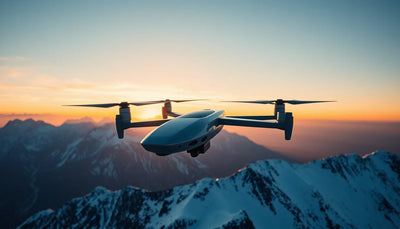
DJI has unveiled its first eVTOL aircraft, the EV50, designed for environments where conventional drones struggle. The move signals a major shift for the company and raises new questions for commercial operators and the pre-owned market.

For nearly two decades, DJI has defined what most people think of when they hear the word “drone.” From the Phantom that helped popularize aerial photography to the Mavic series that made folding camera drones mainstream, the Chinese company has dominated the global civilian quadcopter market. Now, DJI is taking its biggest step beyond that familiar formula with the launch of its first electric vertical takeoff and landing (eVTOL) drone, the EV50. The aircraft is designed to operate in environments “where few aircraft can fly,” a claim that points toward high-altitude, low-density air conditions that challenge conventional multirotors and fixed-wing UAVs alike.
This is not an incremental update to a consumer camera drone. The EV50 represents a deliberate pivot into a class of aircraft that blurs the line between large UAVs and small crewed aircraft. For commercial fleet managers, repair specialists, and the second-hand drone market, the arrival of a DJI eVTOL signals a new chapter in operational capability—and a fresh set of decisions about equipment investment, maintenance readiness, and trade-in timing.
What we know about the EV50 from the source
According to DroneDJ’s report dated July 13, 2026, the EV50 is DJI’s first eVTOL drone. The name alone suggests a fifty-kilogram-class aircraft, though no official specifications have been confirmed in the source material. What is clear is that DJI chose to highlight the aircraft’s ability to operate where “few aircraft can fly.” That phrasing strongly implies performance in high-altitude, thin-air environments—places where traditional rotorcraft lose lift, battery endurance drops sharply, and air density challenges flight stability.
DJI buying context
Match product news to hardware you can actually deploy.
Check inspected DJI aircraft, repair support, and trade-in timing before deciding whether to upgrade, repair, or wait.

eVTOL designs inherently offer VTOL capability combined with efficient forward flight, a mix that could be ideal for long-range surveys, remote cargo delivery, and infrastructure inspection in mountainous or off-grid regions. DJI’s entry into this category suggests the company sees a commercial demand that its existing Matrice or Agras platforms cannot fully address. The EV50 is likely aimed at enterprise and government customers who need to fly heavy payloads at altitude without requiring a runway.
For operators in sectors such as mining, oil and gas, telecommunications, and search and rescue, the EV50 could fill a gap that currently requires either multiple flights with smaller drones or the use of crewed helicopters. The implications for fleet planning are significant: a single EV50 might replace several smaller UAVs or supplement helicopter operations at lower cost per mission hour.
What this means for drone buyers
For anyone currently operating DJI Matrice 300/350, Mavic 3 Enterprise, or Inspire 3 fleets, the EV50 introduces a new tier in the DJI ecosystem. These smaller drones remain excellent tools for many tasks, but the EV50 represents a step-change in endurance, payload capacity, and altitude performance. Buyers considering a fleet expansion should evaluate whether their typical missions fall within the performance envelope of current platforms or if they require the expanded operational altitude that the EV50 is advertised to provide.
Fleet managers who have invested heavily in pre-owned DJI drones for lower-altitude work may see little immediate need to upgrade. However, the arrival of a flagship eVTOL often triggers price adjustments in the secondary market. As early adopters trade in older Matrice and Inspire units to fund EV50 purchases, the supply of inspected pre-owned DJI drones may increase, offering cost-effective entry points for operators who do not require the eVTOL’s extreme capabilities.
Repair shops and parts suppliers should prepare for a new airframe architecture. The EV50’s eVTOL design likely uses different motor, propeller, and flight controller components than DJI’s traditional quadcopters. Professional DJI repair services that currently focus on consumer and prosumer platforms may need to invest in training and tooling for eVTOL class maintenance. OEM spare parts availability will be a critical factor for operators planning to deploy the EV50 in remote, high-altitude environments where downtime is expensive.
A key takeaway for buyers: do not rush to sell existing fleet assets prematurely. The EV50’s real-world performance in thin air and extreme weather is unproven at scale. Wait for field data from early adopters before committing to a fleet transition. In the meantime, consider using a drone trade-in guide to benchmark the current value of your equipment, especially if you plan to consolidate platforms later this year.
Impact on the pre-owned DJI market and repair ecosystem
The DJI pre-owned market has historically been shaped by product cycles: when a new Mavic or Phantom launched, older models dropped in price, and resale volumes spiked. The EV50 launch is different because the aircraft inhabits a different market segment. It does not replace the Mavic or Matrice directly. Instead, it carves out a new niche at the higher end. This means existing pre-owned DJI drones for lower-altitude work should retain their utility and value longer, as long as they remain suitable for common mission profiles like surveying, mapping, and inspection below 3,000 meters.
Reboot Hub analysis: However, the EV50 could accelerate depreciation of older heavy-lift platforms such as the Matrice 600 or even the Matrice 300 series if operators who need altitude performance begin offloading those units. That creates an opportunity for buyers who do not need high-altitude capability to acquire capable pre-owned DJI drones at reduced prices. Repair centers should stock up on Matrice 300 and 350 parts, as increased trade-ins may lead to a wave of used units entering the market that require pre-sale inspection and reconditioning.
From a repair perspective, the EV50’s eVTOL design introduces new failure modes. Tilting rotors, transition mechanisms, and flight control software for vertical-to-forward flight are more complex than traditional multirotor systems. The supply chain for genuine OEM spare parts for this class of aircraft will take months to mature. Operators who rely on rapid turnaround for field repairs should plan for longer lead times initially. Facilities that already have experience with large UAV platforms like the Agras T-series will have a head start, but eVTOL-specific training will be necessary.
For second-hand market participants, the EV50 creates a new asset class. As early units are deployed and eventually retired, a secondary market for used eVTOL aircraft will emerge. That market will require specialized inspection criteria, battery health assessments for large lithium packs, and airframe fatigue evaluation. Repair shops that want to serve that future market should begin building knowledge now.
Strategic considerations for fleet operators and repair customers
Fleet operators should treat the EV50 as a specialized tool rather than a universal solution. Its high-altitude capability is valuable, but the aircraft’s size and likely weight will make it impractical for many everyday tasks that a Mavic or Mini can handle. A balanced fleet might include one or two EV50s for alpine or long-endurance missions, while keeping a larger number of smaller pre-owned DJI drones for lower-altitude, high-cadence work. The operational cost per flight hour for an eVTOL of this class may approach that of a small helicopter, so mission economics must be carefully analyzed.
From a maintenance perspective, operators should evaluate whether their current repair partners have the capability to service eVTOL aircraft. If not, it may be worth establishing a relationship with a repair facility that invests early, such as those offering professional DJI repair services with genuine parts. Sending a large eVTOL to a distant service center will be logistically complex. Local or regional repair capability will be a competitive advantage.
The EV50 also raises questions about training. Pilots accustomed to flying quadcopters will need time to master the transition between vertical and forward flight modes. Simulation training and structured transition courses will likely become necessary. Fleet managers should budget for training time and potential reduction in flight hours during the learning curve.
Finally, the EV50’s operating environment—high altitude, thin air—places stress on batteries and motors. Thermal management and battery degradation will be critical concerns. Operators should plan for shorter battery cycle life and consider spare battery packs as a larger share of their capital expenditure. The pre-owned battery market for high-capacity packs may also emerge, but safety screening for large lithium batteries will be essential.
FAQ: DJI EV50 eVTOL drone
What is the DJI EV50 and why is it different?
The EV50 is DJI’s first electric vertical takeoff and landing drone, designed to operate in environments where few aircraft can fly, such as high altitudes with thin air. It represents a shift from DJI’s traditional quadcopter designs into a larger, more capable aircraft class that combines VTOL convenience with fixed-wing endurance.
Should I sell my current DJI drone to buy an EV50?
Not immediately. The EV50 targets a specific niche for high-altitude and heavy-lift missions. If your typical operations are below 3,000 meters and involve standard payloads, your current pre-owned DJI drone remains highly capable. Wait for real-world performance data before making a fleet change, and consider using a drone trade-in guide to value your assets for a potential future upgrade.
How will the EV50 affect the second-hand DJI market?
Reboot Hub analysis: The EV50 is likely to increase supply of pre-owned DJI drones in the Matrice and Inspire lines as early adopters trade up. That creates buying opportunities for operators who do not need eVTOL capability. The long-term second-hand market for EV50 units will take years to develop, but repair shops should prepare now for eVTOL-specific parts and training.
Sources consulted
- DJI: Best drones, history, technology, and more - DroneDJ - primary source
- DroneDJ - Drone news and views covering DJI, Skydio, Parrot ... - primary reporting source
- DroneDJ - primary reporting source
Reboot Hub Editorial adds buyer, repair, resale, and operational analysis for drone owners. If you spot an error, contact us for correction review through our editorial policy.