Dual-Drone Night Rope Delivery Shows New Rescue Workflow
A two-drone rope delivery to a climber stranded on a narrow ledge at night highlights how multi-aircraft coordination is expanding beyond film sets into time-critical field operations, with real implications for commercial drone buyers and service providers.

Quick answer
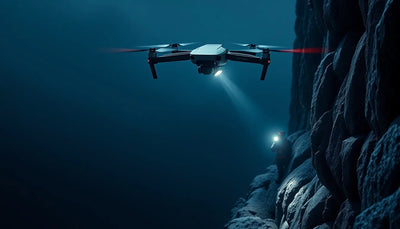
A report from DroneXL describes two drones flying a rope to a climber stranded on a 10-inch ledge at night, demonstrating a coordinated multi-aircraft workflow in a time-critical rescue scenario.
- Two drones worked together to deliver a rope to a climber on a narrow ledge at night
- The operation highlights multi-drone coordination beyond single-aircraft missions
- The report comes from DroneXL via Google News DJI and is source-limited
- Commercial operators may see rising interest in paired-drone workflows for field services
A report published by DroneXL and surfaced through Google News DJI describes a night operation in which two drones flew a rope to a climber stranded on a 10-inch ledge. The scenario is striking on its own, but the commercial signal is even more interesting: it shows coordinated multi-aircraft workflows moving beyond controlled film sets and survey grids into urgent, unstructured field conditions.
Market context
Turn market news into a buy, repair, or trade-in decision.
Compare pre-owned availability, resale timing, and repair economics before the market moves again.

For commercial operators, fleet managers, and buyers evaluating what their next aircraft purchase should support, the reported operation raises a practical question. If two drones can hold position, manage a shared payload line, and complete a delivery in darkness on a vertical rock face, what does that mean for the way mission planning, pilot training, and equipment procurement are evolving across the broader UAV services market?
What the source actually reports
The central report, attributed to DroneXL, describes two drones flying a rope to a climber positioned on a 10-inch ledge at night. The source summary is brief and does not specify aircraft models, operator identity, location, regulatory jurisdiction, or the exact flight configuration. Because this is a source-limited report, Reboot Hub is not treating the event as a confirmed agency operation or an officially documented rescue with verified technical parameters.
What the report does establish is a credible narrative of coordinated multi-drone use in a high-stakes, time-sensitive environment. Two aircraft working together to move a single payload line requires synchronized positioning, clear communication between pilots or between a pilot and an automated hold, and enough confidence in the aircraft to operate near a person in distress after dark. Those are not trivial operational requirements, and they are not the default behavior of consumer camera drones flown recreationally.
Reboot Hub analysis: the commercial significance is less about this single rescue and more about the workflow it represents. Multi-drone coordination has been growing in agricultural spraying, infrastructure inspection, and entertainment, but a rope delivery to a human subject on a cliff face at night pushes the conversation toward emergency services, industrial access teams, and specialized field contractors.
Why coordinated multi-drone missions matter commercially
Single-aircraft missions dominate most commercial UAV work today. A mapping job, a roof inspection, a tower survey, or a search flight typically involves one drone, one operator, and one defined task. The reported rope delivery breaks that pattern. Two aircraft shared a physical payload line, which implies either two pilots coordinating closely or a lead aircraft and a support aircraft operating under a shared mission plan.
For service providers, this changes the math on fleet composition. A company that previously justified one high-end aircraft per crew may now need to consider whether paired aircraft with complementary roles offer a faster or safer path for certain jobs. The second aircraft does not need to be identical to the first. In many field workflows, a lighter support drone can carry a line, a beacon, a sensor, or a communication relay while a primary aircraft performs the main task.
Buyers evaluating pre-owned DJI drones should pay attention to this shift. A fleet built around a single flagship model is straightforward to maintain, but a mixed fleet with one primary aircraft and one or two lighter support units can unlock coordinated workflows without doubling the capital cost. Pristine pre-owned DJI airframes that are no longer the newest release can still serve as capable secondary or support aircraft in paired missions, especially when the support role does not demand the latest camera or obstacle-sensing features.
The reported night rescue also underscores the value of reliable positioning and lighting. Operating near a cliff edge after dark places enormous pressure on the pilot's situational awareness. Aircraft with dependable hover stability, visible orientation lighting, and predictable battery behavior become more important than raw camera resolution or top speed. That is a useful filter for any buyer comparing models for field service work.
What this means for drone owners and the market
The most immediate market implication is that demand for multi-aircraft coordination is no longer confined to large enterprise programs or defense budgets. A rescue scenario involving two drones and a rope suggests that smaller teams, volunteer groups, and specialized contractors are experimenting with paired workflows. That expands the addressable market for training, mission planning software, and spare aircraft that can be deployed quickly when a primary unit is unavailable or when a second perspective is needed.
For repair customers and fleet planners, the operational lesson is straightforward: downtime on any single aircraft becomes more costly when missions depend on two or more units working together. A grounded support drone can delay a job just as effectively as a grounded primary drone. Operators who rely on coordinated workflows should think about spare parts availability and repair turnaround for every aircraft in the pairing, not just the flagship. Genuine OEM spare parts and professional DJI repair support become more relevant when a mixed fleet must stay mission-ready across multiple airframes. For readers evaluating how to keep paired aircraft operational, the Drone Wiki offers a reference point for understanding common maintenance and repair considerations across DJI platforms. For owners evaluating service and lifecycle risk, Drone Wiki explains the relevant repair, parts, resale, or operational path.
There is also a resale angle. As multi-drone workflows spread, the pre-owned market may see stronger demand for reliable mid-tier and older flagship models that are no longer sold new but still perform well in support roles. A buyer who needs a second aircraft for line delivery, observation, or backup does not necessarily need the latest release. That could firm up pricing for inspected pre-owned DJI drones that hold position well, fly predictably, and have a healthy supply of OEM-pulled parts available.
Finally, the report is a reminder that commercial drone value is shifting from what a single aircraft can capture to what a coordinated system can accomplish. Buyers who evaluate drones only on camera specs or flight time may miss the operational factors that matter most in time-critical work: stability, reliability, lighting, spare parts access, and the ability to integrate into a multi-aircraft plan.
What operators should watch next
The source report does not identify the operator, the aircraft, or the regulatory framework under which the night rope delivery occurred. That leaves several open questions for commercial buyers and service providers. Was the operation conducted under a waiver or within a jurisdiction with more flexible night flight rules? Were the drones manually piloted by two people, or did one aircraft hold position autonomously while the other adjusted the line? Was the rope pre-rigged for drone delivery, or was it improvised on site?
These details matter because they determine whether the workflow is repeatable and commercially viable, or whether it was a one-off effort under unusual conditions. Operators interested in similar missions should watch for follow-up reporting that clarifies the aircraft types, the training involved, and any regulatory approvals. Until those details are confirmed, the event should be treated as a strong signal of interest rather than a proven standard operating procedure.
For now, the practical takeaway for a buyer, pilot, repair customer, or fleet manager is to evaluate whether their current equipment and maintenance plan can support paired-aircraft missions. If the answer is no, the gap may be more about fleet composition and spare parts readiness than about buying the newest model. A second reliable aircraft, a clear maintenance schedule, and access to genuine OEM spare parts may deliver more operational flexibility than a single flagship upgrade.
FAQ
Frequently asked questions
Was this a confirmed official rescue operation?
The report is attributed to DroneXL and surfaced through Google News DJI. The source summary does not name an agency, operator, or official confirmation, so Reboot Hub is treating the event as a source-limited report rather than a verified official operation.
What does this mean for commercial drone buyers?
It suggests growing interest in multi-drone coordination for time-critical field work. Buyers may benefit from evaluating fleet composition, backup aircraft availability, and spare parts readiness rather than focusing only on single-aircraft camera or flight specs.
Does this affect the pre-owned DJI market?
Potentially, yes. If paired-drone workflows spread, older reliable models could see stronger demand as support or backup aircraft. Inspected pre-owned DJI drones with stable flight characteristics and accessible OEM-pulled parts may become more attractive for operators building mixed fleets.
Which sources support this update?
The article distinguishes reported information from analysis and does not present an unverified source as official confirmation.
What remains subject to change?
Retail pricing, availability, product bundles and regulatory timelines can change. Readers should verify the latest terms with the named retailer, manufacturer or regulator before acting.
How should buyers or operators use this analysis?
Use the verified facts as a starting point, then compare mission fit, lifecycle support, maintenance needs and current procurement terms before making a purchase or fleet decision.
Sources consulted
- DroneXL via Google News - primary source
Additional official documentation was not available at publication time.
Reboot Hub Editorial adds buyer, repair, resale, and operational analysis for drone owners. If you spot an error, contact us for correction review through our editorial policy.