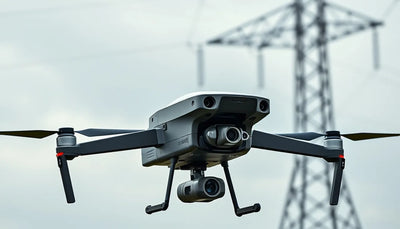
DHS Addendum Scores DJI Matrice Models Above Skydio X10D
A DHS addendum marked For Official Use Only reportedly scores DJI's Matrice 4T at 4.6 and Matrice 30T at 4.3, compared with 3.7 for the Skydio X10D at Hudson Yards. The gap matters for commercial buyers weighing enterprise drone performance.

Quick answer
A DHS addendum marked For Official Use Only reportedly scores the DJI Matrice 4T at 4.6 and Matrice 30T at 4.3 at Hudson Yards, compared with 3.7 for the Skydio X10D.
- The scores come from a DHS addendum reported by DroneXL.co on October 1, 2026.
- The Matrice 4T leads at 4.6, followed by the Matrice 30T at 4.3.
- The Skydio X10D scored 3.7 in the same Hudson Yards evaluation.
- The addendum was marked For Official Use Only and was not included in the public Blue UAS report.
Evidence: DroneXL.co · DIU Blue UAS
DJI buying context
Match product news to hardware you can actually deploy.
Check inspected DJI aircraft, repair support, and trade-in timing before deciding whether to upgrade, repair, or wait.

Verified facts
What the available evidence confirms
| Model | Reported Score | Evaluation Location |
|---|---|---|
| DJI Matrice 4T | 4.6 | Hudson Yards |
| DJI Matrice 30T | 4.3 | Hudson Yards |
| Skydio X10D | 3.7 | Hudson Yards |
A Department of Homeland Security addendum marked For Official Use Only reportedly scores DJI's Matrice 4T at 4.6 and the Matrice 30T at 4.3 in an evaluation at Hudson Yards, according to reporting by DroneXL.co published on October 1, 2026. The same addendum places the Skydio X10D at 3.7, a gap that has drawn attention from commercial operators and fleet planners who track how government testing reflects real-world enterprise drone performance.
The scores were not included in the public version of the Blue UAS report, which is why the addendum's contents carry weight for buyers who rely on government evaluations as one signal among several when selecting airframes. While the addendum itself is not publicly available, the reported figures offer a rare comparative data point between two DJI Matrice models and a U.S.-built enterprise platform evaluated under the same conditions.
What the reported scores show
According to the DroneXL.co report, the DJI Matrice 4T received a 4.6 score and the Matrice 30T received a 4.3 score at Hudson Yards. The Skydio X10D, by contrast, scored 3.7 in the same setting. The addendum was marked For Official Use Only, meaning the figures were not intended for public release in the main Blue UAS documentation.
For commercial operators, the spread between 4.6 and 3.7 is more than a rounding difference. It suggests that evaluators observed meaningful variation in how these aircraft performed in the specific conditions at Hudson Yards. The Matrice 4T and Matrice 30T are both widely used in inspection, public safety, and industrial survey roles, so any comparative scoring against a U.S. enterprise competitor is operationally relevant even when the evaluation criteria remain undisclosed.
Reboot Hub analysis: the reported scores should be read as one controlled evaluation, not a universal ranking. Buyers still need to weigh payload compatibility, data security requirements, spare parts availability, and repair support before committing to a fleet decision.
Why government scoring matters to commercial buyers
Government drone evaluations influence more than federal procurement. When agencies test platforms in demanding urban environments, the results often filter into state and local purchasing conversations, insurance underwriting assumptions, and enterprise vendor shortlists. A reported 4.6 for the Matrice 4T reinforces the model's standing among operators who already run DJI enterprise hardware in inspection and security workflows.
The Skydio X10D's 3.7 score does not mean the aircraft is unsuitable for commercial work. It means that in this particular Hudson Yards evaluation, the platform did not match the reported performance of the two DJI Matrice models. Operators who prioritize domestic manufacturing or data sovereignty may still choose Skydio for reasons unrelated to raw evaluation scores.
For fleet managers, the practical takeaway is to ask vendors for evaluation context. A score without criteria is a directional signal, not a procurement decision. The reported addendum is useful because it names specific models and a specific location, which is more concrete than vague claims about enterprise readiness.
What this means for drone owners and the market
The reported scores arrive at a moment when commercial operators are increasingly weighing total cost of ownership against platform performance. DJI's Matrice series has a deep installed base, which supports a healthy secondary market for inspected pre-owned units and genuine OEM spare parts. When government testing appears to favor Matrice models, it can reinforce demand for those airframes in the pre-owned DJI market, where buyers often seek enterprise capability at lower entry cost.
That dynamic matters for repair customers as well. A larger active fleet of Matrice 4T and Matrice 30T aircraft means more demand for professional DJI repair, OEM-pulled parts, and maintenance support. Operators who already own these models may find that reported government scores strengthen their resale position, while buyers in the pre-owned market may see the addendum as one more reason to consider a Matrice airframe over a less widely supported alternative. For those evaluating options, the Drone Wiki provides model-level context that can help clarify how different DJI platforms fit into inspection, security, and survey workflows. For owners evaluating service and lifecycle risk, Drone Wiki explains the relevant repair, parts, resale, or operational path.
The Skydio X10D's lower reported score does not erase its advantages in autonomy and U.S. manufacturing, but it may pressure resale expectations for operators who need to rotate fleet assets. Buyers who prioritize domestic supply chains will still evaluate Skydio on its own terms, while cost-conscious operators may see the Matrice scoring gap as a reason to hold or acquire DJI hardware.
What operators should watch next
The most important open question is whether DHS or another agency releases the full evaluation criteria behind these scores. Without knowing what was measured, operators cannot tell whether the 4.6-to-3.7 spread reflects sensor quality, flight stability, autonomy, thermal imaging, or some combination of factors. DroneXL.co's reporting indicates the addendum exists but does not detail the scoring rubric.
Commercial buyers should also watch whether these reported figures influence state and local procurement language. If agencies begin citing the Hudson Yards scores in requests for proposals, the practical effect could be felt across the enterprise drone market. For now, the addendum remains a reported document, not a published regulation or procurement directive.
Operators who fly Matrice 4T or Matrice 30T aircraft should document their own performance data. Independent operational logs, maintenance records, and mission outcomes are more useful for internal fleet decisions than any single government score. The reported addendum is a useful external reference, but it cannot replace evidence gathered in your own operating environment.
FAQ
Frequently asked questions
What did the DHS addendum reportedly score?
According to DroneXL.co, a DHS addendum marked For Official Use Only scored the DJI Matrice 4T at 4.6, the Matrice 30T at 4.3, and the Skydio X10D at 3.7 in an evaluation at Hudson Yards.
Why were the DJI scores left out of the public Blue UAS report?
The addendum containing the DJI scores was marked For Official Use Only, which means it was not intended for public release alongside the main Blue UAS documentation. The scores only became visible through DroneXL.co's reporting.
Should commercial operators change fleet decisions based on these scores?
Not on the scores alone. The reported figures are one controlled evaluation without publicly available criteria. Operators should weigh them alongside payload needs, data security requirements, repair support, spare parts availability, and their own mission performance data.
Which sources support this update?
The visible evidence links identify DroneXL.co and DIU Blue UAS; each source is used only for the claim it directly supports.
What remains subject to change?
Retail pricing, availability, product bundles and regulatory timelines can change. Readers should verify the latest terms with the named retailer, manufacturer or regulator before acting.
How should buyers or operators use this analysis?
Use the verified facts as a starting point, then compare mission fit, lifecycle support, maintenance needs and current procurement terms before making a purchase or fleet decision.
Sources consulted
- DroneXL.co - primary source
- DIU Blue UAS - official government source
Reboot Hub Editorial adds buyer, repair, resale, and operational analysis for drone owners. If you spot an error, contact us for correction review through our editorial policy.