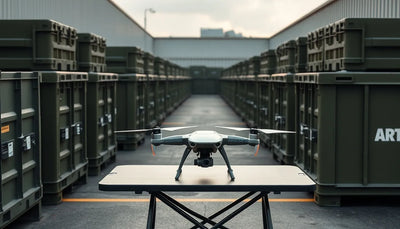
Archer's Anduril Drone to Begin Full-Scale Flight Tests in 2027
Archer Aviation's defense drone program with Anduril is set to begin full-scale flight tests in 2027, according to a new investor analysis. The move signals a strategic diversification away from air taxis while commercial certification remains unresolved.

Quick answer
Archer Aviation's defense drone developed with Anduril is expected to begin full-scale flight tests in 2027, according to a Motley Fool analysis cited by Yahoo Finance.
- Full-scale flight testing is projected for 2027
- The defense program diversifies Archer beyond its commercial air-taxi business
- Commercial air-taxi operations still await FAA certification
- Defense revenue could eventually exceed air-taxi revenue
Evidence: Source material · FAA UAS official guidance · Defense.gov official source
Fleet readiness
Keep DJI hardware available without overbuying new units.
Use defense and fleet news as a planning signal for repair support, inspected pre-owned aircraft, and replacement timing.

Verified facts
What the available evidence confirms
| Business line | Status | Key dependency |
|---|---|---|
| Defense drone with Anduril | Full-scale flight tests expected in 2027 | Defense procurement pipeline |
| Commercial air taxi | Awaiting FAA certification | Regulatory approval |
Archer Aviation's defense drone program, developed in partnership with Anduril, is expected to enter full-scale flight testing in 2027, according to a November 22 analysis published by The Motley Fool and syndicated through Yahoo Finance. The report frames the defense effort as a potentially larger long-term revenue opportunity than Archer's commercial air-taxi business, which remains anchored to Federal Aviation Administration certification milestones.
The timing matters for commercial drone operators, fleet buyers, and repair-focused businesses because it signals where high-value aerospace capital is flowing while traditional commercial certification timelines stretch. Archer has not yet secured the regulatory approvals required to launch passenger air-taxi operations, and the defense track offers a parallel path that can generate revenue and engineering credibility without waiting on civilian aviation authorities.
Why the defense program is drawing investor attention
The Motley Fool analysis, as carried by Yahoo Finance under the ACHR ticker coverage, argues that defense could be worth more than air taxis over time. The reasoning is straightforward: defense procurement cycles, while complex, are not bound to the same passenger-carrying certification hurdles as commercial air-taxi service. A defense drone that can be tested, refined, and delivered to a government customer represents a more direct route to contracted revenue.
For the broader commercial UAV market, this is a useful signal about where aerospace engineering talent and capital are concentrating. When a company like Archer commits serious resources to a defense platform alongside Anduril, it reinforces the pattern that defense and dual-use programs are becoming the most reliable near-term revenue engines in advanced aviation. Fleet operators watching the market should read this as evidence that defense-adjacent technology development will continue to outpace civilian air-taxi commercialization.
What the FAA certification timeline means for the air-taxi side
Archer's commercial air-taxi business remains in a holding pattern pending FAA certification. The source summary is explicit that the defense push helps diversify while the commercial business awaits that approval. No specific certification date or regulatory milestone is provided in the source material, and Reboot Hub analysis should not infer one. What is clear is that the company is not treating air-taxi certification as the sole path to commercial viability.
Reboot Hub analysis: This dual-track approach has implications for procurement planning across the drone sector. Buyers and operators who have been watching advanced air mobility as a future service category should recognize that certification timelines for passenger-carrying aircraft are long and uncertain. Meanwhile, defense and uncrewed military platforms can move through testing and fielding on a different schedule. The practical takeaway is that near-term commercial opportunities in advanced aviation are more likely to appear in defense-adjacent, inspection, logistics, and uncrewed cargo roles than in passenger transport.
What this means for drone owners and the market
For commercial drone owners, repair customers, and fleet managers, the Archer-Anduril development is not a direct product event. It does not change DJI firmware, OEM spare parts availability, or pre-owned DJI pricing overnight. But it does shape the investment climate that funds drone infrastructure, counter-UAS systems, and enterprise aviation services. When defense aerospace attracts capital, adjacent commercial segments often benefit through shared components, sensors, and maintenance networks. For owners evaluating service and lifecycle risk, Drone Wiki explains the relevant repair, parts, resale, or operational path.
The more immediate operator-facing question is whether defense-driven demand will tighten the supply of specialized components, engineering talent, or testing capacity that commercial drone programs also need. Reboot Hub analysis suggests that operators with mixed fleets should monitor defense procurement announcements closely, because they can signal future component shortages or price shifts in adjacent commercial categories. For those managing pre-owned DJI fleets or planning professional DJI repair budgets, the relevant reference point is the Drone Wiki, which tracks how market shifts affect ownership, maintenance, and resale decisions.
What should a buyer or fleet manager do differently after reading this? The most defensible move is to treat defense aerospace momentum as a leading indicator for enterprise drone services, not as a reason to change consumer or commercial drone purchasing plans immediately. If defense testing accelerates in 2027, watch for secondary effects on sensor supply, battery cell allocation, and skilled technician availability. Those are the channels through which a program like Archer's can influence the broader drone economy.
Defense versus air taxi: a structural comparison
The source supports a clean comparison between Archer's two business lines, and the table below summarizes the structural difference. The defense program has a stated testing milestone in 2027, while the air-taxi business remains dependent on FAA certification with no timeline specified in the source material.
| Business line | Status | Key dependency |
|---|---|---|
| Defense drone with Anduril | Full-scale flight tests expected in 2027 | Defense procurement pipeline |
| Commercial air taxi | Awaiting FAA certification | Regulatory approval |
This comparison underscores why investors and industry observers are paying attention to the defense track. A testing milestone is a concrete, observable event. Certification is a process with uncertain duration. For commercial operators who plan fleet investments years in advance, that distinction matters. Programs with defined testing and delivery milestones are easier to model than programs waiting on regulatory decisions.
The broader implication for the pre-owned DJI market and commercial repair services is indirect but real. Defense aerospace growth tends to raise the floor for professional drone services, because it normalizes uncrewed aircraft in more operational environments. That normalization can increase demand for trained pilots, maintenance providers, and spare parts channels across both defense and civilian segments. Reboot Hub analysis views this as a long-term positive for the commercial drone service economy, even if the immediate impact on consumer drone pricing is negligible.
FAQ
Frequently asked questions
What did the source actually report about Archer and Anduril?
The Motley Fool analysis, syndicated by Yahoo Finance, reported that Archer's defense drone developed with Anduril is expected to begin full-scale flight tests in 2027. The report also argued that the defense business could eventually be worth more than Archer's commercial air-taxi operations.
Does this change anything for DJI drone owners or repair customers?
Not directly. The Archer-Anduril program is a defense aerospace development and does not affect DJI firmware, OEM spare parts, or pre-owned DJI drone pricing in the near term. The relevant impact is longer-term and flows through component supply, technician availability, and broader market confidence in commercial drone services.
Should fleet managers change procurement plans based on this news?
No immediate change is warranted. Fleet managers should treat the 2027 defense testing milestone as a signal to monitor defense procurement activity and its secondary effects on component supply and service capacity. Commercial drone purchasing decisions should still be based on operational requirements, maintenance costs, and existing fleet performance.
Which sources support this update?
The visible evidence links identify Source material and FAA UAS official guidance and Defense.gov official source; each source is used only for the claim it directly supports.
What remains subject to change?
Retail pricing, availability, product bundles and regulatory timelines can change. Readers should verify the latest terms with the named retailer, manufacturer or regulator before acting.
How should buyers or operators use this analysis?
Use the verified facts as a starting point, then compare mission fit, lifecycle support, maintenance needs and current procurement terms before making a purchase or fleet decision.
Sources consulted
- Source material - primary source
- FAA UAS official guidance - official regulator source
- Defense.gov official source - official government source
Reboot Hub Editorial adds buyer, repair, resale, and operational analysis for drone owners. If you spot an error, contact us for correction review through our editorial policy.