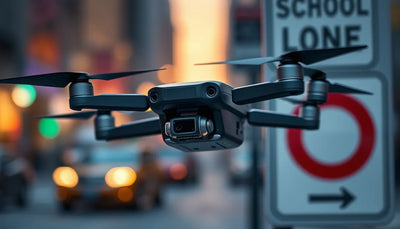
Amazon Declines to Answer MK30 Safety Questions Before 500-City Push
DroneXL reports that Amazon Prime Air did not answer eight written safety questions about its 83-pound MK30 drone before a stated deadline. The silence arrives as Amazon plans service across 500 cities, leaving commercial operators and repair customers with open questions about operational risk, maintenance expectations, and market direction.

Quick answer
DroneXL sent Amazon Prime Air eight written safety questions about the 83-pound MK30 drone, and Amazon did not answer before Saturday's deadline as it plans expansion to 500 cities.
- DroneXL submitted eight written MK30 safety questions to Amazon Prime Air
- Saturday's response deadline passed with no answers from Amazon
- The MK30 is reported as an 83-pound delivery drone
- Amazon is planning service across 500 cities
- The reporting comes from DroneXL.co
Evidence: DroneXL.co
Market context
Turn market news into a buy, repair, or trade-in decision.
Compare pre-owned availability, resale timing, and repair economics before the market moves again.

Amazon Prime Air's MK30 delivery drone is moving toward a much larger operational footprint, but the company has not answered a set of written safety questions about the aircraft. According to reporting from DroneXL.co, the outlet sent Amazon Prime Air eight specific questions about the 83-pound MK30 and gave the company a Saturday deadline to respond. That deadline passed with no answers provided.
The unanswered questions arrive at a commercially significant moment. Amazon has signaled plans to expand Prime Air service across 500 cities, a scale that would move drone delivery from limited pilot programs into a broader logistics footprint. For commercial operators, fleet buyers, and repair customers, the absence of public safety detail is not just a public relations gap. It is an information gap that affects how the market evaluates heavy-lift delivery drones, maintenance risk, and the long-term viability of autonomous last-mile operations.
What the reporting actually shows
DroneXL's report is specific about the process. The outlet submitted eight written questions to Amazon Prime Air concerning the MK30's safety profile. The aircraft is described in the source as weighing 83 pounds, which places it well above the small consumer drones that dominate the pre-owned market and closer to industrial or logistics-class systems. The Saturday deadline came and went without a response from Amazon, according to the source.
What the questions covered is not fully detailed in the available reporting, but the framing is clear: DroneXL sought answers about safety, and Amazon did not provide them within the stated window. Reboot Hub analysis should treat this as a source-limited development. There is no indication in the source data that Amazon issued a formal refusal, a delay notice, or any explanatory statement. The company simply did not answer before the deadline described by the reporting outlet.
For readers evaluating this story, the distinction matters. A missed media deadline is not the same as a regulatory finding or an operational incident. But in a market where delivery drone operators are trying to build public trust and procurement confidence, silence can carry its own commercial weight. Buyers and fleet planners often read unanswered safety questions as a signal to slow down due diligence rather than accelerate it.
Why heavy-lift delivery drones raise different market questions
The MK30's reported 83-pound weight is the most concrete spec in the source data, and it has real operational implications. Drones in this weight class operate under different regulatory and maintenance expectations than sub-250-gram consumer models or even typical commercial camera drones. Heavier aircraft carry more kinetic energy, require more robust propulsion and battery systems, and typically demand more rigorous inspection cycles.
For the pre-owned DJI market, the MK30 is not a direct competitor. DJI's commercial and enterprise lineup serves inspection, mapping, public safety, and cinematography use cases, not autonomous package delivery at Amazon's scale. But the MK30 story still matters to pre-owned buyers because it shapes broader perceptions of drone reliability, safety disclosure, and manufacturer transparency. When a high-profile operator declines to answer safety questions, it can reinforce buyer caution across adjacent segments.
Repair customers and fleet managers should also note the maintenance angle. An 83-pound delivery drone operating in dense urban or suburban environments will require a steady supply of genuine OEM spare parts, structured inspection schedules, and clear service documentation. The source data does not provide details on Amazon's maintenance program or parts availability, so Reboot Hub cannot verify how Prime Air handles repairs. But the absence of public safety answers makes it harder for independent service providers and parts suppliers to understand what the operational standard should be.
What this means for drone owners and the market
The most immediate takeaway for commercial operators is that safety transparency is becoming a competitive differentiator in the drone market. Buyers who evaluate aircraft for fleet deployment increasingly want documented answers about weight, redundancy, failure modes, and maintenance intervals. When a major player like Amazon does not answer written safety questions, it creates a reference point for what insufficient disclosure looks like. Procurement teams may start asking harder questions of every vendor, including those selling pre-owned and inspected aircraft.
For individual drone owners and small fleet operators, the practical step is to demand documentation before purchase. Whether buying a new enterprise drone or an inspected pre-owned DJI unit, the buyer should ask for maintenance history, battery health records, and any available safety or incident documentation. If a seller cannot or will not provide that information, the buyer should treat the gap as a risk factor. This is where resources like the Drone Wiki can help operators understand what documentation and inspection standards to expect before committing to a purchase or repair decision.
The second implication is market timing. Amazon's push toward 500 cities suggests that drone delivery is moving from experimental to operational. That shift will likely increase demand for maintenance infrastructure, certified technicians, and reliable parts supply chains. Operators who service or resell commercial drones should watch how Amazon handles safety disclosure because it may set expectations for the entire logistics drone category. If Amazon eventually publishes detailed safety information, it could raise the bar for every manufacturer. If it does not, buyers may learn to price that opacity into their decisions. For owners evaluating service and lifecycle risk, Drone Wiki explains the relevant repair, parts, resale, or operational path.
The broader commercial signal for drone operators
Amazon's silence on MK30 safety questions is not proof of a specific technical problem. The source data does not identify a crash, a malfunction, or a regulatory action. What it does show is that one of the largest companies in the drone delivery space did not engage with a direct safety inquiry within a stated deadline. For a market that is still building trust with regulators, insurers, and the public, that is a meaningful data point.
Commercial operators should read this as a reminder that safety documentation is a core part of asset value. A drone with clear maintenance records, verified flight history, and documented inspections holds value better than one with gaps. That principle applies to heavy logistics drones like the MK30 and to pre-owned DJI aircraft alike. The market is moving toward greater scrutiny, and buyers who insist on documentation will be better positioned as delivery operations scale.
Fleet managers evaluating any drone platform should also consider the cost of unanswered questions. If a manufacturer or operator cannot provide safety details before purchase, the buyer may face higher insurance costs, longer approval timelines, or unexpected maintenance burdens after deployment. The MK30 story is a useful case study in how information gaps create friction, even when no specific failure has been reported.
FAQ
Frequently asked questions
Did Amazon refuse to answer the MK30 safety questions?
According to DroneXL.co, Amazon did not answer eight written safety questions about the MK30 before the Saturday deadline. The source does not report a formal refusal or an official statement from Amazon explaining the silence.
How heavy is the Amazon MK30 drone?
The DroneXL report describes the MK30 as an 83-pound drone. That weight places it in a heavier logistics class than typical consumer or commercial camera drones.
Should drone buyers be concerned about Amazon's silence?
The unanswered questions do not indicate a specific technical failure, but they do highlight the importance of safety documentation in drone purchasing. Buyers and fleet managers should treat missing safety information as a risk factor and request maintenance and inspection records before any acquisition.
Which sources support this update?
The visible evidence links identify DroneXL.co; each source is used only for the claim it directly supports.
What remains subject to change?
Retail pricing, availability, product bundles and regulatory timelines can change. Readers should verify the latest terms with the named retailer, manufacturer or regulator before acting.
How should buyers or operators use this analysis?
Use the verified facts as a starting point, then compare mission fit, lifecycle support, maintenance needs and current procurement terms before making a purchase or fleet decision.
Sources consulted
- DroneXL.co - primary source
- DIU Blue UAS - official government source
Reboot Hub Editorial adds buyer, repair, resale, and operational analysis for drone owners. If you spot an error, contact us for correction review through our editorial policy.