Urban Ray’s Automated Medical Hub: What the Operational Chain Means for Drone Fleets
Urban Ray completed a fully automated hub-to-hub medical drone flight in Essen, Germany. The real breakthrough is not the flight itself but the operational chain. Fleet operators must rethink ground handling, maintenance, and pre-owned equipment reliability.

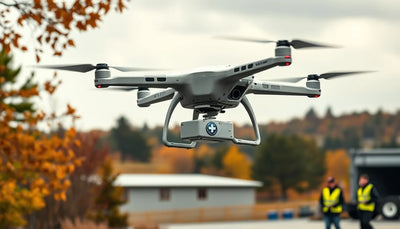
Urban Ray has pushed medical drone logistics forward with a real-world demonstration in Essen, Germany. Samples flew from St. Josef Hospital to the Medical Care Center for Laboratory Medicine and Microbiology Ruhr through a fully automated hub-to-hub process. On the surface, this looks like another routine drone flight. But the useful part is what the demonstration reveals about the real bottleneck in drone logistics: it has never been the flight alone. It has been the operational chain — the handoffs, the ground infrastructure, the integration with existing workflows.
For drone buyers, fleet operators, repair customers, and anyone involved in the pre-owned DJI market, this shift in focus is commercially important. The drone that flies is only one link in a longer chain. Understanding how that chain works — and where it can break — will shape purchasing decisions, maintenance routines, and fleet planning for the next several years.
The operational chain bottleneck

The headline event from Urban Ray is the automated hub-to-hub transfer. But the company’s own messaging, as reported by DroneXL.co, emphasises that the flight itself is not the hard part. The true bottleneck in medical drone logistics has always been the operational chain: how packages are loaded, how the handoff between air and ground works, how the receiving site accepts the payload without human intervention, and how the entire system maintains reliability across dozens or hundreds of daily cycles.
Industrial drone procurement
Source a brand-new industrial drone for this mission.
Discuss mission fit, aircraft model, quantities, configuration, pickup, and lifecycle support with Reboot Hub.
In Essen, Urban Ray solved that by automating both hubs. At St. Josef Hospital, the drone landed on a designated pad, the payload was automatically transferred to a ground-based logistics system, and the drone was prepared for its next mission without a human touching it. At the laboratory, the process reversed. This eliminates the most error-prone phase of drone logistics — the manual loading and unloading that slows turnaround and introduces variability.
For fleet managers, the implication is clear: buying a capable airframe is no longer enough. You must also invest in ground infrastructure, standard operating procedures, and integration software. A drone that cannot interface with an automated hub will be less valuable in a medical logistics context, even if its flight performance is excellent.
What this means for drone buyers

If you are evaluating drones for logistics applications — medical or otherwise — the Urban Ray demonstration shifts the criteria. Flight time, payload capacity, and camera quality still matter, but the ability to integrate with automated ground systems is now a first-order requirement. Buyers should look for aircraft with robust payload release mechanisms, easy-to-service interface ports, and a track record of reliable automation partnerships.
This is also relevant for the pre-owned DJI market. Many used drones in excellent condition can still perform admirably in logistics roles, provided they have been maintained with genuine OEM parts and have a documented service history. A pre-owned DJI drone that has been professionally inspected and repaired can offer a lower entry point into automated logistics, especially for operators who are testing the feasibility of hub-to-hub operations before scaling up. The key is to ensure that the drone’s payload interface and firmware support the automation requirements. That is where professional DJI repair services become critical — an experienced repair shop can verify compatibility, update firmware, and replace any worn components with OEM parts to restore reliability.
For fleet operators who already own drones, the takeaway is different. You may not need a new airframe. Instead, you may need to invest in ground automation hardware and software. The drone itself can be a commodity; the operational chain is where the competitive advantage lies.
Implications for fleet operators and repair customers

Fleet operators who manage multiple drones for logistics should use the Urban Ray case as a blueprint for evaluating their own workflows. Ask yourself: How much manual handling is involved between flight segments? Can your ground team keep up with a high-frequency operation? If the answer involves multiple human touchpoints, you are likely to encounter scaling problems similar to those that Urban Ray’s automation is designed to solve.
Preventive maintenance schedules become more important in an automated chain. A single drone that fails to land precisely on the hub pad, or that has a sticky payload release mechanism, can bring the entire operation to a halt. Repair customers should insist on genuine OEM spare parts for any component that affects automation — landing gear, payload mounts, battery contacts, and communication modules. Using aftermarket parts introduces variability that an automated system may not tolerate.
The pre-owned market will feel this shift as well. Drones with clean accident records, documented logbooks, and recent professional repair work will command premium prices because they can be trusted in a tightly choreographed operation. Conversely, drones with unknown repair history or non-OEM components will be harder to sell to logistics operators who cannot afford downtime.
How the pre-owned and repair markets respond

As medical drone logistics expands — and Urban Ray’s demonstration is a strong signal that it will — the demand for reliable, hub-compatible airframes will grow. This creates an opportunity for the pre-owned DJI market. Many older models that are still in pristine condition can be repurposed for logistics if they are properly serviced and upgraded with the correct payload interfaces. Buyers should look for aircraft that have been inspected by a reputable repair center and fitted with genuine OEM parts.
Fleet operators who are considering a shift to logistics operations may also benefit from trading in older, less specialised drones to upgrade to models with better automation support. The drone trade-in guide can help you understand how to value your current equipment and plan a multi-year fleet transition. Trade-in programs reduce the upfront cost of acquiring newer airframes while ensuring that your outgoing drones find a second life in less demanding roles.
For repair services, the Urban Ray approach underscores the need to specialise in automation-era repairs. Technicians must understand not just how to fix a motor or a camera gimbal, but also how to calibrate landing sensors, test payload mechanism timing, and verify communication protocols between drone and hub. Repair shops that develop this expertise will be indispensable to logistics operators.
What was the key takeaway from Urban Ray’s Essen flight?
The key takeaway is that the operational chain, not the flight itself, is the real bottleneck in drone logistics. Urban Ray demonstrated a fully automated hub-to-hub process that eliminates manual handoffs, showing that infrastructure and integration matter as much as airframe performance.
How can I prepare my drone fleet for automated logistics?
Start by auditing your current manual handling steps. Invest in ground automation hardware and software. Ensure your drones have compatible payload mechanisms and reliable landing accuracy. Work with a repair service that uses genuine OEM parts to maintain consistency across your fleet.
Should I buy a new or pre-owned drone for medical logistics?
Both options can work. A pre-owned DJI drone with documented service history and professional repair can be cost-effective for testing logistics operations. New drones offer the latest automation interfaces and firmware support. The decision depends on your budget, tolerance for integration risk, and whether you need immediate scale or are validating the concept first.