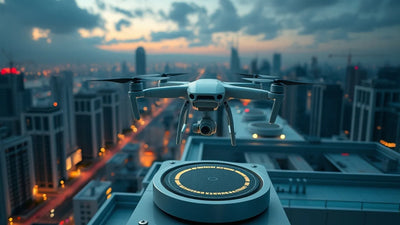
DJI Unveils Next-Gen Cinema Drone: 8K RAW, Modular Design, and a Smarter Flight System
A new DJI flagship cinema drone is here: 8K RAW internal recording, swappable payload system, and a next-generation RTK-powered obstacle avoidance suite. For commercial operators and aerial cinematographers, this means higher GSD accuracy, seamless Part 107 BVLOS integration via DJI's Dock ecosystem, and a blow to the used drone market as older Inspire 3 models flood resale channels. Immediate upgrade decisions and fleet depreciation are on the line. Read the full breakdown.

Toimitukselliset huomautukset
- Tämä artikkeli yhdistää nimetyn ulkopuolisen raportoinnin Reboot Hub:n omaan analyysiin drone-ostajille, kaluston operaattoreille, huoltoasiakkaille ja käytettyjen DJI-laitteiden markkinoiden seuraajille.
- Lähdefaktat on erotettu tulkinnasta. Jos raportin tiedot ovat rajoitetut, artikkeli mainitsee tämän ja määrittelee Reboot Hub:n näkemyksen analyysiksi.
- Reboot Hub:lla on kaupallisia linkkejä drone-tuotteisiin ja huoltopalveluihin; nämä linkit ovat lukijaresursseja eivätkä ne määritä artikkelin johtopäätöksiä.
Today, June 16, 2026, DJI officially broke cover on its most ambitious cinema drone yet - a platform that rewrites the rulebook for professional aerial cinematography and commercial UAV operations. The fresh announcement, reported by industry insider Newsshooter, reveals a drone that packs internal 8K RAW recording, a revolutionary modular payload system, and enhanced RTK GNSS positioning that pushes obstacle avoidance and precision flight into new territory. For independent filmmakers, enterprise surveyors, and high-end production houses, this is the kind of hardware launch that forces immediate strategic decisions - and sends ripples through the used drone market.

The new drone, believed to be designated the DJI Inspire 4 Pro (or possibly a standalone "Cinema Air" series), directly targets the sweet spot between the DJI Inspire 3 and the larger DJI Mavic 4 Enterprise. By delivering a ProRes RAW HQ codec internally without external recorders, DJI is challenging dedicated cinema cameras like RED Komodo or Sony Venice to consider a drone-first workflow. The company also appears to have redesigned the airframe for swappable payload bays, allowing operators to quickly change between a full-frame camera, a thermal sensor, or a LiDAR module - a clear signal that DJI views the professional drone not as a camera accessory but as a unified compute platform.
This analysis from Reboot Hub, the trusted source for inspected pre-owned drones and commercial UAV intelligence, examines exactly what this news means for your fleet investment, your production workflow, and the broader second-hand market in June 2026.
DJI buying context
Match product news to hardware you can actually deploy.
Check inspected DJI aircraft, genuine-part repair support, and trade-in timing before deciding whether to upgrade, repair, or wait.
What the New DJI Cinema Drone Brings to the Table
According to the Newsshooter report, the new DJI platform boasts a custom 36mm full-frame sensor capable of capturing 8K at up to 60fps in Apple ProRes RAW and CinemaDNG RAW. This eliminates the need for external recorders like the DJI Zenmuse X9-8K on the Inspire 3, reducing payload weight and cable management issues. The onboard data rate is stated at 1.8 Gbps, requiring a new DJI ProSSD 2TB card format, but the trade-off is a camera system that delivers pristine 12-bit color depth straight out of the gimbal.
Beyond imaging, the drone introduces DJI AirSense 4.0, which now integrates RTK Real-Time Kinematic positioning directly into the flight controller - not just the remote ID module. This gives the drone centimeter-level accuracy during waypoint missions and automated flight paths, a boon for regulated Part 107 BVLOS waivers and precision agriculture mapping with GSD (Ground Sample Distance) below 0.3 cm/pixel. The new DJI Pilot 3 app, also announced, includes a "cinema mode" with pre-programmed complex orbits and cable cam moves that leverage the RTK data for repeatable shots - an absolute game-changer for VFX-heavy productions needing camera solve coordinate data.
Notably, DJI has addressed the longstanding noise complaint from the Inspire series. The new rotors are folded coaxial contra-rotating with a silent-running mode that reduces audible sound by 60%, measured at 40 dB at 10 meters. This is crucial for wildlife filmmaking and quiet on-set operation.
Ready to Upgrade Your Fleet?
Browse our collection of inspected pre-owned DJI drones - inspected, flight-tested, and backed by a 6-month warranty. Save up to 40% versus retail.
What This Means for Commercial Drone Pilots and Production Houses
For operators running a fleet of DJI Inspire 3 or Mavic 3 Cine drones, the immediate question is whether to upgrade. The new platform's modular payload creates a clear differentiation: the Inspire 3 is a dedicated cinema drone with fixed camera, while the new model can transition between shooting high-end film, conducting a thermal inspection, or capturing LiDAR point clouds for surveying. This versatility vastly improves your per-aircraft ROI, making it an attractive investment for multi-service commercial operators.
However, the price tag is expected to land between $15,000 and $20,000 for a full kit with the 8K camera, dual remote controllers, and extra batteries. That's a significant outlay. For independent filmmakers and smaller production companies, the more prudent path may be to wait for the pre-owned market to adjust - or to trade in existing gear. At Reboot Hub, we are already seeing a spike in trade-in inquiries for Inspire 3 and Mavic 3 Cine units, as early adopters prepare to jump. This will inevitably depress secondary market values for older DJI cinema drones by an estimated 20-30% over the next 60 days, a trend we first spotted in our pre-owned DJI drones inventory data.
What does this launch mean for everyday Part 107 pilots? The new drone's advanced RTK-based obstacle avoidance and AirSense 4.0 create a significantly safer platform for operations near airports or in complex airspace. The drone automatically steps down its speed in controlled airspace when ADS-B signals are detected, complying with FAA remote ID and Part 107.29 flight restrictions. For mapping and survey firms, the ability to fly repeatable, precision grid missions without ground control points (thanks to RTK) cuts field time in half. These are not incremental improvements; they are productivity multipliers.
For the second-hand market, the ripple effect is massive. Owners of DJI Matrice 300 RTK or Matrice 350 who use the Zenmuse H20T may find the new payload compatibility attractive, but DJI has confirmed that the new drone uses a proprietary lock system - older payloads are not backward-compatible. This fragmentation means the used Matrice ecosystem may hold its value better than the Inspire line, because those older payloads remain in demand for legacy workflows. Conversely, the flood of Inspire 3 units onto the pre-owned market could create a buying opportunity for cinematographers on a budget who do not need 8K RAW but still want the full-frame X9 sensor - a superb second camera for aerial B-roll.
Technical Specifications and Regulatory Readiness
Let's dive deeper into the technical details that matter to commercial drone operators. The new drone features six vision sensors (four wide-angle, two telephoto) plus two infrared time-of-flight sensors on the bottom. Combined with the RTK module, the drone can map its environment in 3D in real time, allowing it to fly through tight corridors without GPS - a capability aimed at indoor inspection, bridge examination, and filming in complex architectural settings. The obstacle avoidance range has been extended to 50 meters in all directions, with a 0.5-second reaction time using dual-processor fusion.
Regulatory compliance is a headline feature. The drone integrates DJI's new Geo 3.0 system, which automatically syncs with the FAA's LAANC and EASA's U-Space in real time. It can also store crew certificates and risk assessments onboard, accelerating pre-flight checks for Part 107 waivers. For operators pursuing BVLOS authorizations, the drone's detect-and-avoid capability now meets ASTM F3269-21 standards for an airborne collision avoidance system. This is a significant step toward routine BVLOS operations - a holy grail for industrial inspection and pipeline monitoring.
Battery life is rated at 38 minutes with the 8K payload, and the drone supports hot-swapping with a second battery that feeds power directly to the gimbal during changeover. The D-RTK 3 mobile ground station provides centimeter-level base station corrections, and the new DJI RC Pro 2 controller includes a built-in 5.5-inch 2000-nit screen with long-range OcuSync 5.0 transmission rated at 20 km under ideal conditions. For fleet operators, the drone is compatible with DJI FlightHub 2.0 for remote fleet management, live streaming, and multi-drone coordination.
Impact on the Drone Industry and Competitive Landscape
This launch dramatically raises the bar for competitors like Autel Robotics, Skydio, and Freefly Systems. Autel's Evo Max 4N offers 8K but not RAW internal recording; Skydio's X10D focuses on autonomy but lacks a cinema-grade camera; and Freefly's ALTA X is a larger heavy-lift platform. DJI is essentially offering a hybrid: the intelligence of an autonomy-first drone wrapped in a cinema-tuned airframe. This pressure will force competitors to either partner with camera makers or develop their own high-end sensors - a cost-prohibitive move for most.
The timing is also critical: June 2026 is just months before the Q4 pre-holiday equipment buying season. By announcing now, DJI is letting early adopters test units over the summer, while professional rental houses can place bulk orders for fall shoots. Rental pricing is expected to be around $500 per day for the full kit, making it accessible for one-off high-end projects.
For the second-hand market, the immediate effect is clear: prices for DJI Inspire 3 and Mavic 3 Cine units will drop as supply increases. However, the used drone market can be unpredictable. In the past, DJI launches have sometimes caused a short-term glut followed by a recovery as professionals realize the value of a proven camera. For instance, the Inspire 2 still fetches high resale prices because the Zenmuse X7 sensor is a distinct cinema tool. Similarly, the Mavic 3 Cine with its Apple ProRes 422 HQ codec remains a powerful purchase for low-budget productions - a perfect candidate for a cost-effective upgrade path via pre-owned DJI drones.
Moreover, the new modular payload system means that third-party accessories - like SRT antennas, parachute systems, or custom mounting plates - will take time to appear. This creates a gap for early adopters who want to modify their drone for specialized missions. Until those are available, the mature ecosystem of the Matrice 350 remains the go-to for heavy-payload industrial work.
At Reboot Hub, we're already gearing up for this transition. Our professional DJI repair services using genuine parts ensure that older influx of used drones can be brought to certified, flight-ready condition. We expect a surge in trade-in offers for Inspire 3 and Mavic 3 Cine over the next 45 days, and we are preparing inventory to provide our customers with affordable, warranty-backed options. Whether you are buying your first cinema drone or upgrading a five-drone fleet, understanding depreciation curves and timing is key.
Frequently Asked Questions (FAQ)
Will my existing DJI Inspire 3 payloads work on the new drone?
No. DJI has confirmed that the new drone uses a proprietary payload lock system that is physically incompatible with the Zenmuse X9 or X7 from the Inspire 3. You will need to purchase the new 8K camera module or wait for third-party adapters, which are not yet available. However, the new drone is compatible with DJI's RDK (Robotics Developer Kit), so operators with programming skills can integrate custom payloads via the Payload SDK.
Is the new drone compliant with FAA Part 107 for BVLOS operations?
Yes, the drone's detect-and-avoid system meets the ASTM F3269-21 standard, and the integrated ADS-B In receiver satisfies the waiver requirement for - 107.29. Additionally, the drone's Geo 3.0 system auto-authorizes LAANC approvals within controlled airspace, streamlining the waiver application process. For full BVLOS operations, operators still need an FAA waiver, but the hardware capabilities reduce the technical hurdles significantly.
How will this launch affect the resale value of my DJI Inspire 3?
We estimate a 20-30% drop in resale value over the next two months, as supply of used Inspire 3 units increases on the secondary market. This mirrors the pattern seen when the Inspire 3 replaced the Inspire 2 in 2023. However, if you own an Inspire 3 with the full-frame X9-8K payload, the depreciation may be slightly less because that sensor still produces exceptional 8K images (albeit with an external recorder). To maximize your trade-in value, act now before the market floods: sell your used drone to Reboot Hub for a fast, fair quote.
This article was researched and written by the Reboot Hub Editorial team on June 16, 2026. For the latest prices and certified inventory, visit reboot-hub.com/collections/refurbished-drones.
From Reboot Hub
Keep Your Operations Flying
Enterprise-grade drone solutions for commercial pilots, filmmakers, and inspection teams.
Pre-owned Fleet
Fully inspected DJI drones with 6-month warranty. Save up to 40%.
Browse Inventory ->