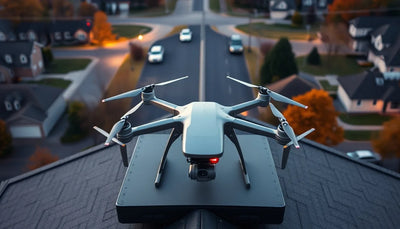
High-Rise Firefighting Drone Claimed to Reach Over 200 Meters in China
A Chinese industry report claims a firefighting drone can extinguish fires in buildings above 200 meters, framing it as a breakthrough for Zhuzhou's low-altitude economy. The development signals growing commercial demand for specialized heavy-lift UAV platforms and support ecosystems.

Quick answer
A Chinese industry report claims a firefighting drone developed in Zhuzhou can extinguish fires in high-rise buildings exceeding 200 meters, positioning it as a breakthrough for the region's low-altitude economy.
- The report frames high-rise firefighting as a long-standing operational challenge now being addressed by drone technology.
- The development is tied to Zhuzhou's broader low-altitude industry push rather than a single manufacturer announcement.
- No verified technical specifications, production volume, or commercial pricing were included in the source data.
- For commercial UAV operators, the story signals rising interest in specialized public-safety and industrial drone platforms.
A new industry report from Oriental Fortune, a Chinese financial and market publication, claims that a firefighting drone developed in Zhuzhou can extinguish fires in high-rise buildings exceeding 200 meters. The report frames the development as a solution to what it calls the "world's problem" of high-rise firefighting and positions the platform as a breakthrough for the region's low-altitude economy. The claim has circulated through Google News RSS channels and is drawing attention from commercial UAV analysts who track specialized industrial drone demand.
Market context
Turn market news into a buy, repair, or trade-in decision.
Compare pre-owned availability, resale timing, and repair economics before the market moves again.

The report does not name a specific manufacturer, model, or certification body, and no verified technical specifications were included in the source data. That matters for fleet buyers and procurement teams. A high-rise firefighting claim of this scale would normally require supporting evidence around payload capacity, hose lift capability, flight endurance, wind tolerance, and regulatory approval. In this case, the source provides a market-level narrative rather than a product-level specification sheet.
What the Zhuzhou report actually claims
According to the Oriental Fortune report, the firefighting drone is presented as a practical answer to high-rise fires above 200 meters, a height range that has historically strained ground-based ladder trucks and aerial firefighting equipment. The report ties the development directly to Zhuzhou's broader push into the low-altitude economy, a term Chinese policymakers use to describe commercial drone operations, urban air mobility, and related industrial infrastructure.
The source frames the firefighting drone as evidence that regional low-altitude industry clusters are moving beyond consumer drones and small inspection platforms into heavy-lift, mission-critical applications. Reboot Hub analysis suggests this is the most commercially significant element of the story: the signal that specialized public-safety drone categories are becoming visible enough to attract mainstream financial media coverage in China.
What the report does not provide is equally important. There are no stated flight times, no hose diameter or water flow rates, no manufacturer name, no production timeline, and no mention of regulatory approval from Chinese aviation or firefighting authorities. For operators evaluating whether this represents a real procurement opportunity or an early-stage industrial policy narrative, the absence of those details means the development should be tracked as a market trend rather than treated as a purchasable platform.
Why specialized firefighting drones are a market signal
High-rise firefighting has long been identified as a difficult operational problem. Ground ladders have physical height limits, helicopter water drops are weather-dependent and expensive, and interior firefighting in tall buildings carries significant risk. A drone platform capable of delivering water or suppressant to upper floors would change the cost structure for municipal fire services and industrial facility operators.
The Zhuzhou report matters to commercial UAV operators because it shows where industrial drone investment is heading. Heavy-lift platforms, tethered power systems, high-pressure hose delivery, and thermal imaging integration are all categories that require specialized maintenance, spare parts planning, and operator training. If firefighting drones move from demonstration projects to deployed fleets, the support ecosystem around them will need to scale quickly.
For pre-owned DJI market participants, the connection is indirect but real. DJI's enterprise line, including the Matrice series, already supports public-safety workflows such as thermal inspection, scene mapping, and incident command support. As specialized firefighting platforms emerge, many agencies will still rely on smaller inspection and coordination drones for situational awareness. That keeps demand for inspected pre-owned DJI enterprise units and genuine OEM spare parts relevant even as new heavy-lift categories develop.
What this means for drone owners and the market
The most practical takeaway for a fleet manager or procurement officer is that public-safety drone demand is broadening beyond surveillance and inspection. A reported firefighting platform in Zhuzhou may not be immediately available to buyers outside China, but it signals that municipal and industrial budgets are beginning to consider drones for direct intervention tasks, not just observation. That shift could reshape how service providers position their fleets, train their pilots, and plan their maintenance programs.
For operators who already run enterprise drone programs, the report is a reminder that specialized platforms create specialized support needs. Heavy-lift airframes, high-capacity batteries, tethering systems, and firefighting payloads all require disciplined parts sourcing and repair planning. Teams that understand their current platform's maintenance profile will be better positioned to evaluate new categories when they reach commercial maturity. Reboot Hub's Drone Wiki provides reference material for operators tracking how different UAV categories affect repair and parts decisions. For owners evaluating service and lifecycle risk, Drone Wiki explains the relevant repair, parts, resale, or operational path.
Buyers in the pre-owned market should also note the broader trend. When a new industrial category gains media attention, it often produces a secondary effect: agencies and companies refresh their existing fleets, releasing inspected pre-owned DJI enterprise units into the resale channel. That can create favorable buying conditions for smaller operators who need capable platforms without the full retail cost. The Zhuzhou story is not a DJI product announcement, but it is the kind of market development that can shift fleet composition over time.
What to watch next in the low-altitude firefighting segment
The next meaningful data points will be whether a named manufacturer emerges, whether Chinese aviation or firefighting authorities publish certification or trial results, and whether any municipal procurement contract is announced. Those would move the story from industrial policy narrative to verifiable commercial development. Until then, the report should be read as an early indicator of where Chinese low-altitude investment is concentrating.
For international operators, the relevant question is not whether this specific Zhuzhou platform will be exported. The more useful question is whether the underlying operational concept, using drones for direct fire suppression in tall structures, gains regulatory and budgetary traction in other markets. If it does, the demand for heavy-lift platforms, specialized training, and reliable repair infrastructure will follow. Operators who track these signals early will have more time to plan their fleet and parts strategies before procurement cycles accelerate.
FAQ
Frequently asked questions
Does the report name a specific firefighting drone manufacturer?
No. The Oriental Fortune report describes the firefighting drone as a development within Zhuzhou's low-altitude industry push but does not name a manufacturer, model, or certification body.
Is this firefighting drone available for purchase now?
The source does not indicate commercial availability, pricing, production volume, or export plans. It should be treated as an early market signal rather than a purchasable platform.
How does this affect pre-owned DJI drone buyers?
Specialized firefighting platforms may eventually complement rather than replace existing enterprise drones used for scene assessment and coordination. Fleet refresh cycles tied to new public-safety investments can also release inspected pre-owned DJI units into the resale market.
Which sources support this update?
The article distinguishes reported information from analysis and does not present an unverified source as official confirmation.
What remains subject to change?
Retail pricing, availability, product bundles and regulatory timelines can change. Readers should verify the latest terms with the named retailer, manufacturer or regulator before acting.
How should buyers or operators use this analysis?
Use the verified facts as a starting point, then compare mission fit, lifecycle support, maintenance needs and current procurement terms before making a purchase or fleet decision.
Konsultierte Quellen
Zum Zeitpunkt der Veröffentlichung waren keine weiteren offiziellen Dokumentationen verfügbar.
Die Redaktion von Reboot Hub liefert Käufer-, Reparatur-, Wiederverkaufs- und Betriebsanalysen für Drohnenbesitzer. Sollten Sie einen Fehler finden, kontaktieren Sie uns für eine Korrekturprüfung gemäß unseren Redaktionsrichtlinien.