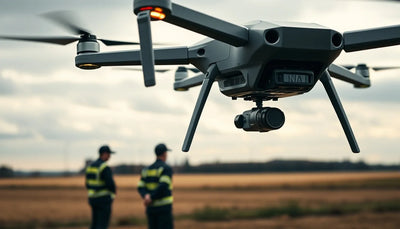
Heavy-Lift Drones Move From Farm Fields to Oyster Bed Restoration
DRONELIFE reports that heavy-lift agricultural drones are being used to seed oyster beds in Texas and Florida, opening a new coastal restoration market for the same airframes that spread seed and fertilizer on farmland.

Quick answer
Heavy-lift agricultural drones are being deployed to seed oyster beds in Texas and Florida, extending their use beyond farm fields into aquaculture and coastal restoration.
- DRONELIFE reports the new use case from projects in Texas and Florida
- The same material-spreading UAVs used for seed, insecticide, and fertilizer are being adapted for oyster bed work
- The development points to new commercial demand for heavy-lift airframes and related services
- Operators with agricultural drone experience may see adjacent coastal and restoration opportunities
Evidence: DRONELIFE
Market context
Turn market news into a buy, repair, or trade-in decision.
Compare pre-owned availability, resale timing, and repair economics before the market moves again.

Heavy-lift agricultural drones have spent years proving themselves over row crops, spreading seed, insecticide, and fertilizer with repeatable precision. Now, according to reporting from DRONELIFE Features Editor Jim Magill, the same category of material-spreading UAVs is finding a new application over shallow coastal water: seeding oyster beds. Projects in Texas and Florida are demonstrating how these airframes can move from farm fields to aquaculture and coastal restoration work, a shift that matters for commercial operators watching where demand for heavy-lift drone services is heading.
The development is notable because it does not require a new airframe category or a fundamentally different payload system. Instead, it extends an existing agricultural workflow into an adjacent market. For drone buyers and fleet operators, that is the kind of signal worth tracking: when a proven platform crosses into a new commercial segment, it tends to create secondary demand for service providers, spare parts, and training without waiting for a brand-new product launch.
What the Texas and Florida projects show
The DRONELIFE report centers on early demonstrations in Texas and Florida, where operators have used heavy-lift agricultural drones to distribute oyster seed across designated beds. The core advantage is speed and coverage. A drone can traverse shallow water and uneven coastal terrain more quickly than ground crews or manual spreading methods, which is especially useful in tidal zones where access windows are short. The reporting frames this as an extension of the same material-spreading capability that agricultural operators already use for dry seed, granular fertilizer, and crop protection products.
For a commercial operator, the practical implication is that payload capacity and reliable dispersal mechanisms are becoming the binding constraint across multiple industries. A platform that can carry and release granular material over farmland may be just as relevant over a coastal lease. That does not mean every agricultural drone is automatically suited for saltwater environments, but it does mean the market is testing how far existing hardware can stretch before specialized marine variants become necessary.
Why aquaculture is a meaningful adjacent market
Aquaculture and coastal restoration have historically relied on labor-intensive methods, small vessels, and manual distribution. The Texas and Florida projects suggest that drone-based seeding could compress the time required to treat a given area, while also reducing the need to put workers into soft sediment or moving water. That is an operational efficiency argument, not just an environmental one, and it is the same argument that helped agricultural drones gain traction against ground rigs and manned aircraft in farming.
Reboot Hub analysis: the commercial logic here is that coastal restoration budgets, oyster lease operators, and environmental contractors may begin evaluating drone service providers on the same criteria farmers already use, including payload consistency, dispersal uniformity, and per-acre cost. Operators who already own heavy-lift agricultural airframes may find that their equipment has a second revenue season, while buyers evaluating a first heavy-lift purchase should consider whether coastal or aquaculture work exists in their region before committing to a crop-only business plan.
What this means for drone owners and the market
The most immediate effect is on demand visibility. When a new use case appears for an existing platform category, it strengthens the resale and service market for that equipment. A heavy-lift agricultural drone is no longer tied exclusively to planting and spraying calendars; it may hold value for coastal contractors, restoration firms, and government-funded habitat projects. That broader buyer pool can support pricing in the pre-owned market and make fleet investment decisions less risky for operators who serve multiple industries.
For owners of pre-owned DJI drones and other commercial airframes, the lesson is less about this specific payload category and more about how platform versatility drives long-term value. A drone that can be re-tasked across crop work, coastal seeding, or inspection keeps earning after one niche cools. Reboot Hub analysis suggests that buyers should evaluate airframe condition, payload compatibility, and spare parts availability with an eye toward multi-use deployments rather than single-crop seasons. When a platform category expands into a new market, genuine OEM spare parts and professional repair support become more important, because downtime now means missing work in two sectors instead of one. For more on platform-specific maintenance and market context, the Drone Wiki offers reference material for operators evaluating repair and ownership decisions. For owners evaluating service and lifecycle risk, Drone Wiki explains the relevant repair, parts, resale, or operational path.
The Texas and Florida projects are early, and DRONELIFE does not present them as a fully scaled commercial market yet. But the direction is clear enough for fleet planners to note. Heavy-lift agricultural drones are no longer just farm equipment. They are becoming general-purpose material distribution tools, and that shift changes how operators should think about buying, maintaining, and reselling them.
What operators should watch next
The next signal to monitor is whether coastal seeding moves from demonstration projects to repeat contracts. If oyster lease operators, state restoration programs, or environmental engineering firms begin issuing recurring bids for drone seeding services, that would confirm a durable demand channel rather than a one-off pilot. Operators should also watch for any discussion of corrosion resistance, saltwater maintenance intervals, or payload modifications, because those details will determine whether existing agricultural airframes need additional service support or whether new configurations emerge.
For a buyer or fleet manager, the immediate action is simple: do not assume that an agricultural drone purchase is limited to crop cycles. Look at the platform's payload capacity, dispersal system, and maintenance history, and consider whether coastal or environmental work could be part of the utilization plan. A drone that can serve two markets is easier to justify on a per-flight-hour basis, and it holds its value better when one market slows. The Texas and Florida oyster bed projects are an early but concrete sign that the heavy-lift agricultural category is broadening, and commercial operators who plan for that flexibility will be better positioned than those who treat the farm gate as the only boundary.
FAQ
Frequently asked questions
What is the new use for agricultural drones reported by DRONELIFE?
DRONELIFE reports that heavy-lift agricultural drones are being used to seed oyster beds in Texas and Florida, extending their material-spreading capability from farm fields into aquaculture and coastal restoration.
Does this require new drone hardware?
The reporting indicates that the projects use the same category of material-spreading agricultural drones already used for seed, insecticide, and fertilizer, although operators should watch for future details on saltwater maintenance and payload modifications.
Why should drone buyers and fleet operators care?
A new use case for an existing platform category can broaden the buyer pool, support pre-owned equipment values, and create additional revenue opportunities for operators who already own heavy-lift agricultural airframes.
Which sources support this update?
The visible evidence links identify DRONELIFE; each source is used only for the claim it directly supports.
What remains subject to change?
Retail pricing, availability, product bundles and regulatory timelines can change. Readers should verify the latest terms with the named retailer, manufacturer or regulator before acting.
How should buyers or operators use this analysis?
Use the verified facts as a starting point, then compare mission fit, lifecycle support, maintenance needs and current procurement terms before making a purchase or fleet decision.
Konsultierte Quellen
- DRONELIFE - primary source
Zum Zeitpunkt der Veröffentlichung waren keine weiteren offiziellen Dokumentationen verfügbar.
Die Redaktion von Reboot Hub liefert Käufer-, Reparatur-, Wiederverkaufs- und Betriebsanalysen für Drohnenbesitzer. Sollten Sie einen Fehler finden, kontaktieren Sie uns für eine Korrekturprüfung gemäß unseren Redaktionsrichtlinien.