Emergency Robot Competition in Guangzhou Tests Firefighting Drones and Robot Dogs
A Guangzhou emergency robot competition put robot dogs and firefighting drones through realistic rescue drills, signaling how Chinese public-safety agencies are evaluating autonomous response platforms for real deployment and procurement.

Quick answer
A Guangzhou emergency robot competition featured robot dogs and firefighting drones performing realistic rescue drills, showing how Chinese public-safety agencies are testing autonomous response platforms.
- The event took place in Guangzhou, China, according to the Low-Altitude Economy Resource Network.
- Robot dogs and firefighting drones took turns performing real-life rescue drills.
- The competition suggests growing public-safety interest in multi-robot emergency response systems.
- Commercial drone operators and repair providers should watch public-safety procurement signals from such events.
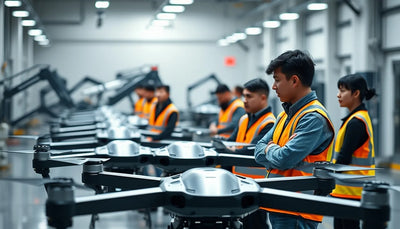
The Low-Altitude Economy Resource Network reports that an emergency robot competition has landed in Guangzhou, bringing robot dogs and firefighting drones into staged rescue scenarios designed to mimic real-world disaster response. The event placed autonomous ground robots and aerial firefighting platforms side by side, with each system taking turns performing drills that simulated the pressures of live emergency operations.
Market context
Turn market news into a buy, repair, or trade-in decision.
Compare pre-owned availability, resale timing, and repair economics before the market moves again.

The competition is a market signal as much as a technical showcase. Chinese public-safety agencies, municipal emergency bureaus, and low-altitude economy planners have been moving from pilot demonstrations toward structured evaluation of unmanned systems. When a city like Guangzhou hosts a dedicated emergency robot event, it indicates that procurement teams are comparing platform categories, response workflows, and operational reliability before committing budget.
What the Guangzhou event actually showed
According to the Low-Altitude Economy Resource Network, the competition featured robot dogs and firefighting drones performing realistic rescue drills in turn. The format matters. Rather than a static exhibition, the event placed machines into simulated emergency conditions, testing how ground and aerial units handle tasks such as scene assessment, payload delivery, or fire suppression support.
For commercial observers, the key detail is the pairing of ground robotics with firefighting drones. This reflects a broader shift in emergency response planning toward multi-domain unmanned teams. A firefighting drone may provide aerial visibility, thermal observation, or suppression payloads, while a robot dog can enter confined or unstable areas where wheeled vehicles struggle. The Guangzhou competition suggests that agencies are evaluating these systems as complementary layers rather than competing purchases.
Why public-safety drone testing matters to the commercial market
Public-safety procurement has become one of the most consistent demand drivers for enterprise drone hardware, spare parts, and repair services. Fire departments, emergency management bureaus, and municipal responders operate in high-wear environments. Drones used in smoke, heat, water spray, and rough landings require more frequent maintenance than consumer units flown in clean conditions.
Events like the Guangzhou competition help shape which platforms and payloads become standard in emergency fleets. When a city evaluates firefighting drones in realistic drills, it is also evaluating the support ecosystem around those drones: battery availability, propeller and motor wear, sensor calibration, and rapid turnaround repair. Commercial operators watching this segment should read the event as an early indicator of which public-safety configurations may scale across multiple cities.
What this means for drone owners and the market
For independent operators and small fleet managers, the Guangzhou event reinforces a practical point: emergency and inspection work is moving toward specialized, mission-configured drones rather than general-purpose consumer models. A firefighting drone may carry thermal payloads, suppression canisters, or high-intensity lighting that a standard commercial quadcopter cannot support. This does not make consumer or prosumer platforms obsolete, but it does sharpen the distinction between casual aerial work and public-safety mission hardware.
Reboot Hub analysis: The pre-owned DJI market is likely to feel this shift in two ways. First, as agencies and contractors upgrade to specialized firefighting or multi-robot platforms, older enterprise units may enter the secondary market. Second, operators who need reliable backup aircraft for emergency-adjacent work often look for inspected pre-owned DJI drones as cost-controlled fleet additions. For those buyers, the priority is not the newest release but a platform with documented condition, genuine OEM spare parts, and service history. Reboot Hub analysis suggests that public-safety adjacent operators can use resources like the Drone Wiki to compare platform roles before committing to a mission-specific purchase. For owners evaluating service and lifecycle risk, Drone Wiki explains the relevant repair, parts, resale, or operational path.
Repair behavior also changes when drones are used in emergency drills. Smoke residue, heat exposure, and rapid battery cycling accelerate wear on motors, gimbals, and connectors. A drone that survives a realistic firefighting drill may still need immediate post-event inspection. Operators who treat public-safety demonstrations as stress tests will plan maintenance differently than those flying routine mapping or photography missions.
What operators should watch next
The Guangzhou competition is one data point, but it aligns with a visible pattern in China's low-altitude economy push. Municipal governments are funding drone infrastructure, emergency response networks, and unmanned system evaluations at a pace that commercial operators in other markets rarely see. The Low-Altitude Economy Resource Network's coverage frames the event as part of that broader policy and procurement environment.
For fleet managers, the practical takeaway is to monitor which platforms and payload categories appear repeatedly in public-safety demonstrations. Repeated appearances usually precede standardized procurement lists. Once a firefighting drone configuration becomes a municipal standard, demand for compatible batteries, propellers, and repair expertise follows quickly. Operators who service public-safety clients should treat these demonstrations as early procurement intelligence rather than isolated publicity events.
FAQ
Frequently asked questions
What happened at the Guangzhou emergency robot competition?
According to the Low-Altitude Economy Resource Network, an emergency robot competition in Guangzhou featured robot dogs and firefighting drones taking turns performing realistic rescue drills.
Why should commercial drone operators care about this event?
The event signals that public-safety agencies are evaluating specialized firefighting drones and ground robots for real deployment, which can shape future procurement, fleet standards, and repair demand.
Does this affect the pre-owned drone market?
As agencies adopt specialized mission hardware, older enterprise drones may enter the secondary market, and cost-conscious operators may seek inspected pre-owned DJI units as backup or training aircraft.
Which sources support this update?
The article distinguishes reported information from analysis and does not present an unverified source as official confirmation.
What remains subject to change?
Retail pricing, availability, product bundles and regulatory timelines can change. Readers should verify the latest terms with the named retailer, manufacturer or regulator before acting.
How should buyers or operators use this analysis?
Use the verified facts as a starting point, then compare mission fit, lifecycle support, maintenance needs and current procurement terms before making a purchase or fleet decision.
Konsultierte Quellen
- Source material - primary source
Zum Zeitpunkt der Veröffentlichung waren keine weiteren offiziellen Dokumentationen verfügbar.
Die Redaktion von Reboot Hub liefert Käufer-, Reparatur-, Wiederverkaufs- und Betriebsanalysen für Drohnenbesitzer. Sollten Sie einen Fehler finden, kontaktieren Sie uns für eine Korrekturprüfung gemäß unseren Redaktionsrichtlinien.