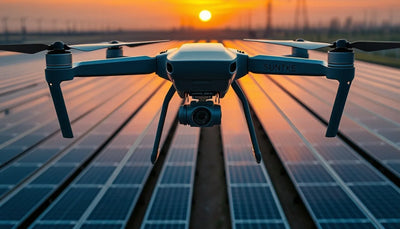
DJI Advances Battery-Swapping Unattended Platform and AI Roadmap
DJI has released a new-generation battery-swapping unattended platform and signaled a shift toward individual and swarm intelligence. The announcement, reported by China Fund News, points to longer autonomous operations and a changing support footprint for commercial drone fleets.

Quick answer
DJI has released a new-generation battery-swapping unattended platform and is advancing AI applications toward individual intelligence and swarm intelligence, according to China Fund News.
- The platform enables unattended battery swapping for extended autonomous operations
- DJI continues to advance AI applications across its product ecosystem
- The company's stated direction includes evolution toward individual and swarm intelligence
- The report comes from China Fund News, a Chinese financial media outlet
DJI has released a new-generation battery-swapping unattended platform, a development that extends the company's push into autonomous drone infrastructure and signals a deeper integration of artificial intelligence across its commercial ecosystem. The announcement, reported by China Fund News, frames the launch as part of a broader trajectory in which DJI systems will evolve from single-unit autonomy toward what the company describes as individual intelligence and swarm intelligence.
DJI buying context
Match product news to hardware you can actually deploy.
Check inspected DJI aircraft, repair support, and trade-in timing before deciding whether to upgrade, repair, or wait.

The report does not provide detailed technical specifications, pricing, or regional availability for the new platform. What it does establish is directional: DJI is investing in hardware that removes the human bottleneck from battery replacement, and it is pairing that hardware with AI capabilities that could change how commercial operators plan, deploy, and maintain drone fleets. For buyers, fleet managers, and repair customers, the announcement is less about a single product and more about where the DJI commercial ecosystem is heading.
The battery-swapping platform and autonomous operations
Battery swapping has long been a friction point in unattended drone operations. Traditional charging docks require a drone to remain grounded while its battery recharges, which limits mission frequency and creates thermal and wear considerations. A battery-swapping unattended platform, as reported by China Fund News, addresses that constraint by replacing a depleted battery with a charged one, allowing the aircraft to return to service more quickly.
For commercial operators running inspection, security, or mapping missions, this shift has practical consequences. A fleet that can cycle batteries without on-site personnel can sustain longer operational windows, reduce labor costs associated with manual battery changes, and maintain more consistent coverage across remote or distributed sites. The operational logic is straightforward: fewer human interventions per flight hour means lower marginal cost per mission and more predictable uptime.
Reboot Hub analysis suggests that this kind of infrastructure also changes the support profile for commercial drones. Battery modules in high-cycle unattended operations will experience more frequent charge and discharge cycles, which places greater importance on battery health monitoring, genuine OEM spare parts, and professional diagnostic practices. Operators who adopt unattended platforms should expect battery modules to become a more significant consumable line item over the life of the system.
AI direction: individual intelligence and swarm intelligence
Reboot Hub analysis: The China Fund News report highlights DJI's stated intention to evolve toward individual intelligence and swarm intelligence. Individual intelligence refers to a single aircraft's ability to perceive, decide, and act with greater autonomy, while swarm intelligence involves coordinated behavior across multiple aircraft working toward a shared objective. Neither concept is new in the broader robotics field, but DJI's explicit framing matters for commercial operators because it signals where product development resources are likely to concentrate.
For a fleet manager, the distinction between individual and swarm intelligence is not academic. Individual intelligence affects how a single drone handles obstacle avoidance, subject tracking, and mission adaptation without operator input. Swarm intelligence affects how multiple drones divide tasks, avoid collisions, and share data in real time. Both directions reduce the cognitive load on human operators and shift the value proposition of a drone from a remotely piloted tool to an autonomous node in a larger system.
The report does not specify which DJI platforms will receive these AI capabilities first, nor does it provide timelines. Reboot Hub analysis suggests that enterprise and infrastructure-focused product lines are the most likely near-term beneficiaries, given that unattended operations and multi-drone coordination are most valuable in industrial inspection, security, and large-area mapping contexts. Consumer and prosumer products may see trickle-down features, but the commercial logic points toward enterprise deployment first.
What this means for drone owners and the market
The announcement carries several implications for current and prospective DJI owners. First, the emphasis on unattended platforms and AI suggests that DJI's commercial product roadmap is increasingly oriented toward institutional buyers rather than individual pilots. That does not diminish the value of existing consumer and prosumer models, but it does mean that the most significant new capabilities may arrive in product categories that individual owners do not purchase directly.
Second, the pre-owned DJI market may see a gradual shift in what buyers prioritize. As new enterprise platforms emphasize battery-swapping infrastructure and AI-driven autonomy, older models that lack these capabilities may still hold value for operators who need reliable, manually managed flight operations without the overhead of unattended infrastructure. The key for pre-owned buyers is to assess whether a given model's feature set aligns with their actual mission profile rather than chasing the newest capabilities. For operators who do invest in newer platforms, maintaining battery health and using genuine OEM spare parts becomes even more important, which is why professional DJI repair and diagnostic support remains a relevant consideration for fleet planning.
Third, the repair and support ecosystem will need to adapt. Unattended platforms introduce more complex electromechanical systems, including battery-swapping mechanisms, docking hardware, and environmental sealing. These components require specialized diagnostic attention that differs from traditional airframe and gimbal repair. Operators evaluating unattended platforms should factor in serviceability, parts availability, and diagnostic support as part of their total cost of ownership calculation. For owners evaluating service and lifecycle risk, DJI drone repair service explains the relevant repair, parts, resale, or operational path.
Reading the announcement with appropriate caution
The China Fund News report is a source-limited account. It confirms that DJI has released the platform and that the company is advancing AI applications toward individual and swarm intelligence, but it does not provide independent verification of performance claims, deployment timelines, or market availability. Operators should treat the announcement as a directional signal rather than a procurement-ready specification sheet.
That caution matters because unattended drone infrastructure involves significant capital investment and operational integration. A battery-swapping platform is only as useful as the software that manages battery inventory, the reliability of the swapping mechanism, and the compatibility of the platform with specific aircraft models. None of those details are present in the source data, and Reboot Hub does not infer them. Buyers should wait for official DJI documentation or verified third-party testing before making purchasing decisions based on this announcement.
For fleet managers, the practical takeaway is to monitor DJI's enterprise product announcements closely and to evaluate any unattended platform investment against a clear operational use case. If a mission profile requires continuous coverage across long shifts or remote locations, battery-swapping infrastructure may justify its cost. If a fleet operates intermittently with personnel on site, traditional charging workflows may remain sufficient. The right answer depends on mission economics, not on the novelty of the technology.
FAQ
Frequently asked questions
What did DJI announce?
DJI released a new-generation battery-swapping unattended platform and confirmed that it is advancing AI applications toward individual intelligence and swarm intelligence, according to a China Fund News report.
How does a battery-swapping unattended platform help commercial operators?
It allows a drone to exchange a depleted battery for a charged one without human intervention, which can reduce downtime between missions, extend autonomous operational windows, and lower labor costs for distributed or remote fleet deployments.
Should drone buyers change their purchasing plans based on this announcement?
Not immediately. The report lacks verified specifications, pricing, and compatibility details. Buyers and fleet managers should treat the announcement as a directional signal and wait for official DJI documentation before making procurement decisions.
Which sources support this update?
The article distinguishes reported information from analysis and does not present an unverified source as official confirmation.
What remains subject to change?
Retail pricing, availability, product bundles and regulatory timelines can change. Readers should verify the latest terms with the named retailer, manufacturer or regulator before acting.
How should buyers or operators use this analysis?
Use the verified facts as a starting point, then compare mission fit, lifecycle support, maintenance needs and current procurement terms before making a purchase or fleet decision.
Konsultierte Quellen
- Source material - primary source
Zum Zeitpunkt der Veröffentlichung waren keine weiteren offiziellen Dokumentationen verfügbar.
Die Redaktion von Reboot Hub liefert Käufer-, Reparatur-, Wiederverkaufs- und Betriebsanalysen für Drohnenbesitzer. Sollten Sie einen Fehler finden, kontaktieren Sie uns für eine Korrekturprüfung gemäß unseren Redaktionsrichtlinien.