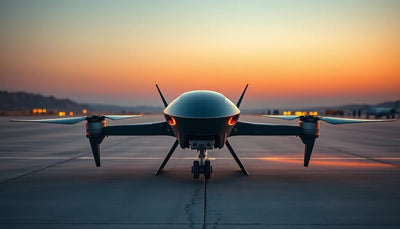
Commercial Drone Market Projected to Reach $18.01 Billion by 2031
A new industry forecast puts the global commercial drone market at $18.01 billion by 2031. The projection signals durable demand across inspection, logistics, and enterprise fleets, with direct implications for procurement, maintenance, and pre-owned DJI equipment.

Quick answer
MarketsandMarkets projects the global commercial drone market will reach $18.01 billion by 2031, according to a report distributed by PR Newswire.
- The forecast points to sustained commercial demand across inspection, logistics, and enterprise drone segments.
- Fleet operators should treat maintenance, spare parts, and pre-owned equipment as core cost planning areas.
- The projection supports a growing secondary market for inspected pre-owned DJI drones as fleets scale.
- Buyers evaluating enterprise UAV programs can use the long-range outlook to justify multi-year procurement and repair budgets.
A new market forecast from MarketsandMarkets, distributed through PR Newswire, projects that the global commercial drone market will reach $18.01 billion by 2031. The figure frames a decade-long expansion path for enterprise UAV adoption, spanning inspection, logistics, agriculture, public safety, and other commercial applications. For operators and buyers, the headline number is less important than what it implies about fleet scale, maintenance volume, and the growing role of pre-owned equipment in cost management.
Market context
Turn market news into a buy, repair, or trade-in decision.
Compare pre-owned availability, resale timing, and repair economics before the market moves again.

The projection arrives at a moment when commercial drone programs are moving from pilot projects into routine operational infrastructure. As fleets expand, procurement decisions increasingly involve not just new aircraft, but also spare parts availability, repair turnaround, and the question of whether inspected pre-owned DJI drones can serve as reliable secondary or backup units. Reboot Hub analysis suggests that long-range growth forecasts like this one tend to reinforce the business case for treating drone maintenance and replacement planning as a standing budget line rather than an afterthought.
What the forecast actually says
According to the report distributed by PR Newswire, MarketsandMarkets expects the commercial drone market to reach $18.01 billion by 2031. The source summary does not provide a base-year figure, compound annual growth rate, or segment-level breakdown in the available material. That limits the depth of comparison, but the directional signal remains clear: commercial UAV demand is expected to keep rising through the end of the decade.
The absence of segment detail in the source means operators should avoid drawing conclusions about which specific commercial vertical will grow fastest. What the forecast does support is a general expectation of larger installed fleets, more flight hours, and therefore more wear on airframes, batteries, gimbals, and propulsion systems. For repair customers, that translates into higher demand for genuine OEM spare parts and professional DJI repair capacity across the commercial ecosystem.
Why fleet operators should read this as a maintenance signal
A larger commercial drone market does not simply mean more aircraft sold. It means more aircraft in service, more cycles on components, and more unscheduled maintenance events. Enterprises running inspection, mapping, or delivery programs typically operate multiple units with overlapping duty cycles. As those fleets grow, the cost of downtime becomes more visible, and the value of rapid repair access increases.
For fleet managers, the practical takeaway is to evaluate repair and spare parts sourcing before a failure occurs. Waiting until a primary aircraft is grounded to locate a replacement gimbal, arm, or battery can extend operational gaps. Operators who maintain a small reserve of OEM-pulled parts or a vetted repair channel are better positioned to keep mission schedules intact. The projected market expansion makes this planning more relevant, not less.
What this means for drone owners and the market
The long-range forecast also has implications for the pre-owned DJI market. As commercial adoption grows, a portion of the fleet will inevitably cycle out of primary service due to upgrades, program changes, or insurance replacements. That creates a steady supply of inspected pre-owned DJI drones that can serve as cost-effective entry points for smaller operators, backup units for established fleets, or donor platforms for OEM-pulled parts. Reboot Hub analysis views this secondary market as a structural feature of a maturing commercial UAV industry, not a temporary trend.
Buyers considering a pre-owned DJI drone should still apply the same discipline they would to any commercial asset purchase. Confirm the unit's operational history, inspect the airframe and battery health, and verify that replacement parts are available through a professional DJI repair channel. The growth forecast does not change the fundamentals of due diligence, but it does suggest that demand for well-maintained pre-owned equipment will remain strong as more operators enter the market. For those evaluating repair versus replacement, resources like the Drone Wiki can provide useful context on DJI platforms and maintenance considerations. For owners evaluating service and lifecycle risk, Drone Wiki explains the relevant repair, parts, resale, or operational path.
The commercial planning angle
For procurement teams and business owners, the $18.01 billion projection offers a reference point for multi-year budgeting. A growing market implies competitive pressure on service providers, but also sustained investment in airframes, sensors, and support infrastructure. Operators who lock in reliable maintenance relationships and spare parts sourcing now may avoid cost escalation later as demand for repair capacity rises alongside fleet counts.
The forecast should not be read as a guarantee of any specific outcome. Market projections carry uncertainty, and the available source material does not include the assumptions behind the estimate. Still, the direction aligns with observable commercial behavior: enterprises are using drones for more tasks, in more locations, and with greater operational dependence. That dependence makes maintenance, parts availability, and pre-owned equipment strategy central to long-term fleet planning.
FAQ
Frequently asked questions
What is the projected size of the commercial drone market by 2031?
MarketsandMarkets projects the global commercial drone market will reach $18.01 billion by 2031, according to a report distributed by PR Newswire.
How does this forecast affect pre-owned DJI drone demand?
Reboot Hub analysis: As commercial fleets expand and cycle equipment, a steady supply of inspected pre-owned DJI drones is likely to enter the secondary market, supporting demand for cost-effective backup units and OEM-pulled parts.
What should fleet managers do differently after this forecast?
Fleet managers should treat repair access, genuine OEM spare parts, and pre-owned backup aircraft as standing budget items rather than reactive purchases, especially as installed fleet size and flight hours increase.
Which sources support this update?
The article distinguishes reported information from analysis and does not present an unverified source as official confirmation.
What remains subject to change?
Retail pricing, availability, product bundles and regulatory timelines can change. Readers should verify the latest terms with the named retailer, manufacturer or regulator before acting.
How should buyers or operators use this analysis?
Use the verified facts as a starting point, then compare mission fit, lifecycle support, maintenance needs and current procurement terms before making a purchase or fleet decision.
Konsultierte Quellen
- PR Newswire via Google News - primary source
Zum Zeitpunkt der Veröffentlichung waren keine weiteren offiziellen Dokumentationen verfügbar.
Die Redaktion von Reboot Hub liefert Käufer-, Reparatur-, Wiederverkaufs- und Betriebsanalysen für Drohnenbesitzer. Sollten Sie einen Fehler finden, kontaktieren Sie uns für eine Korrekturprüfung gemäß unseren Redaktionsrichtlinien.