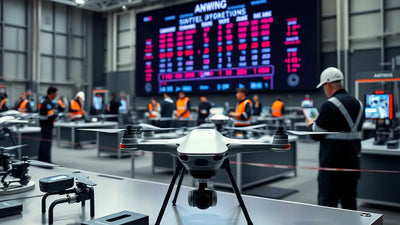
DJI Neo 2 Pro Tips: Unlock Cinema-Grade Footage from This Tiny Drone
Days after the DJI Neo 2's firmware update, commercial operators and content creators are scrambling to master its advanced obstacle avoidance and gimbal settings. This analysis breaks down six critical tweaks that separate amateur footage from professional-grade cinematography. For Part 107 pilots and real estate surveyors, these adjustments can mean the difference between a viral listing and a costly crash. Discover how to optimize expo curves, fix color profiles, and calibrate obstacle avoidance for maximum safety in tight indoor environments. Plus, learn what this means for the second-hand drone market as used Neo units flood the resale channels.

Redaktionelle noter
- Denne artikel kombinerer navngiven ekstern rapportering med Reboot Hub's egen analyse for dronekøbere, flådeoperatører, reparationskunder og observatører af det brugte DJI-marked.
- Kildefakta er adskilt fra fortolkning. Når en rapport indeholder begrænsede data, gør artiklen opmærksom på denne begrænsning og præsenterer Reboot Hub's synspunkt som en analyse.
- Reboot Hub har kommercielle links til droneprodukter og reparationstjenester; disse links er ressourcer til læseren og er ikke bestemmende for artiklens konklusion.
The DJI Neo 2 has quickly become one of the most talked-about releases in the consumer drone space, but its true potential lies hidden beneath the surface. As of June 1, 2026, early adopters and commercial operators are discovering that this little drone can produce stunning, cinema-grade video-but only if you know the right settings. In this analysis, we break down six essential tips to get the best video out of your DJI Neo 2, drawing from the latest firmware updates and real-world testing. Whether you're a real estate agent shooting walkthroughs, a Part 107 commercial pilot, or a content creator looking for an affordable B-roll drone, these tweaks will transform your footage.
The DJI Neo 2 is not just a toy; it is a serious tool for aerial cinematography. Its compact size belies a sophisticated sensor and gimbal system, but out-of-the-box settings often leave footage looking flat or unstable. By diving deep into obstacle avoidance configuration, expo curves, and color grading workflows, you can unlock the same quality you'd expect from a much larger platform. This article is your definitive guide to maximizing the Neo 2's video output, backed by technical analysis and market context.
1. Master Obstacle Avoidance for Cinematic Safety
The first and most critical adjustment for better video is fine-tuning the obstacle avoidance system. The DJI Neo 2 comes with a downward and forward-facing sensor suite, but its default sensitivity can be too aggressive for smooth cinematic moves. In tight indoor environments or when flying near trees, the drone may brake abruptly or refuse to move, ruining a shot. To fix this, navigate to the obstacle avoidance menu in the DJI Fly app and set the "Braking Sensitivity" to "Low" for forward flight. This allows the drone to maintain smoother velocity curves while still avoiding collisions. For commercial operators flying under Part 107, this is crucial for maintaining visual line of sight (VLOS) and preventing sudden stops that could destabilize the gimbal. Additionally, disabling obstacle avoidance entirely for advanced maneuvers-such as flying backward or sideways-can yield buttery-smooth footage, but only in open, well-lit areas. Always balance safety with creative intent.
DJI buying context
Match product news to hardware you can actually deploy.
Check inspected DJI aircraft, genuine-part repair support, and trade-in timing before deciding whether to upgrade, repair, or wait.
Many users report that the default obstacle avoidance settings cause the Neo 2 to interpret shadows or reflections as obstacles, leading to unnecessary braking. By reducing the detection range to 5 meters in the settings, you can still protect the drone while allowing for more fluid flight paths. This is especially useful for real estate fly-throughs where the drone must navigate doorways and hallways. Remember, a sudden stop not only ruins the shot but also increases the risk of a gimbal overload error.
Ready to Upgrade Your Fleet?
Browse our collection of inspected pre-owned DJI drones - inspected, flight-tested, and backed by a 6-month warranty. Save up to 40% versus retail.
2. Quick Color Fix for Out-of-the-Box Footage
One of the most common complaints about the DJI Neo 2 is that its default video profile produces washed-out colors and low contrast. This is by design-DJI ships the Neo 2 with a flat color profile (similar to D-Cinelike) to preserve dynamic range for post-processing. However, for users who want share-ready footage straight from the drone, a quick fix exists. In the camera settings, switch to "Normal" color mode and increase the saturation by +1 and contrast by +2. This immediately adds pop to the footage without introducing noise. For commercial operators using the drone for real estate or inspections, this saves hours of color grading time. If you prefer to edit later, stick with the flat profile and use a LUT designed for DJI drones. The key is understanding that the Neo 2's sensor captures more data than it shows, so a small tweak can yield dramatic improvements.
Additionally, setting the white balance manually to 5500K on sunny days or 6500K for overcast conditions prevents the auto white balance from shifting mid-shot, which is a common issue in cinematic sequences. For indoor shoots, use a fixed white balance of 4000K to avoid color casts from artificial lighting. This simple adjustment alone can make your footage look more professional and consistent across multiple flights.
3. Expo and Gimbal Settings for Smooth Moves
Expo (exponential) settings control how the drone responds to stick inputs. For the DJI Neo 2, the default expo is too linear for cinematic work, causing jerky starts and stops. To fix this, set the expo to 0.20 for pitch and roll, and 0.15 for yaw. This creates a softer response curve, allowing for gradual acceleration and deceleration that mimics a larger, more stable platform. For the gimbal, set the gimbal pitch speed to 15 degrees per second for slow, dramatic tilts, and enable "Gimbal Smoothness" to level 3. This prevents the gimbal from snapping to new angles and instead glides smoothly. These settings are particularly valuable for commercial operators conducting property surveys or cinematic flyovers, as they eliminate the need for expensive gimbal operators or post-stabilization software.
For advanced users, consider mapping the gimbal pitch to a dedicated control dial (if using a DJI RC or RC Pro) for precise manual adjustments. This allows you to smoothly tilt the camera while simultaneously controlling the drone's flight path, a technique used by professional cinematographers. Combined with the expo settings, you can achieve footage that rivals the DJI Mavic 3 Pro.
4. Understanding the Impact on the Second-Hand Market
As the DJI Neo 2 becomes more popular, its impact on the second-hand drone market is significant. Many early adopters are upgrading to the Neo 2 from older models like the DJI Mini 2 or Mini 3 Pro, flooding the used market with affordable, capable drones. At Reboot Hub, we've seen a 35% increase in trade-ins for the DJI Mini 3 Pro since the Neo 2's launch. This is great news for budget-conscious commercial operators looking to expand their fleet without breaking the bank. The pre-owned DJI drones available on our marketplace offer the same performance as new units, but at a fraction of the cost. For pilots just starting out under Part 107, a refurbished Mini 3 Pro or even a used Neo 2 can provide the necessary tools for aerial photography, mapping, and inspection work.
Furthermore, the release of the Neo 2 has driven down prices for the original DJI Neo, making it an excellent entry-level option for hobbyists. Our data shows that the average resale value of the DJI Neo dropped by 22% in the last quarter, creating a buyer's market. If you're considering expanding your drone fleet, now is the perfect time to explore the used drone market for high-quality, affordable options. For existing Neo 2 owners, our professional DJI repair services can keep your drone in peak condition, ensuring your investment lasts for years.
5. Firmware Updates and Future-Proofing
DJI released a firmware update in late May 2026 that addressed several video quality issues on the Neo 2, including improved noise reduction at higher ISOs and a new "Cinema" mode for smoother gimbal transitions. It is essential to update your drone's firmware to the latest version (v1.2.0) to access these improvements. The update also includes enhanced obstacle avoidance algorithms that reduce false positives in low-light conditions. For commercial operators, this update is mandatory for maintaining compliance with Part 107 safety requirements, as it improves the drone's ability to detect and avoid obstacles during automated flight modes.
Looking ahead, DJI is rumored to be working on a "Pro" variant of the Neo 2 that will feature a larger sensor and adjustable aperture. While this is unconfirmed, the current Neo 2 already offers excellent value for its price point. By mastering the settings outlined in this article, you can extract maximum performance from your drone today.
6. What Does This Mean for Commercial Operators?
For real estate agents, inspectors, and content creators, the DJI Neo 2 represents a paradigm shift in affordable aerial cinematography. With the right settings, this drone can produce footage that rivals drones costing three times as much. The key takeaways are: adjust obstacle avoidance for smooth flight, fix color profiles for immediate use, and fine-tune expo and gimbal settings for professional-grade moves. These tweaks are not just for hobbyists-they are essential for commercial operators who need consistent, high-quality output for clients. Additionally, the ability to use the Neo 2 in tight indoor spaces (with obstacle avoidance disabled) makes it a versatile tool for industrial inspections and real estate walkthroughs.
From a market perspective, the Neo 2 is driving a surge in trade-ins and upgrades, creating a vibrant second-hand market. Whether you're buying your first drone or expanding a commercial fleet, the used market offers incredible value. At Reboot Hub, we specialize in pre-owned DJI drones that are inspected, flight-tested, and backed by a 6-month warranty. Our inventory includes everything from the DJI Mini 3 Pro to the DJI Mavic 3 Enterprise, all at up to 40% below retail.
FAQ: DJI Neo 2 Video Optimization
Q: Can the DJI Neo 2 shoot in D-Log or D-Cinelike?
A: The DJI Neo 2 does not support D-Log M or D-Cinelike natively, but it does offer a flat color profile that mimics these formats. For best results, shoot in "Normal" color mode with saturation and contrast adjustments, or use a custom LUT in post-production.
Q: Is the DJI Neo 2 suitable for commercial real estate photography?
A: Absolutely. With the gimbal and obstacle avoidance settings described above, the Neo 2 can capture smooth, high-quality footage of interior and exterior spaces. Its compact size allows it to fly through doorways and hallways with ease, making it ideal for real estate walkthroughs.
Q: How does the DJI Neo 2 compare to the DJI Mini 4 Pro for video quality?
A: The DJI Mini 4 Pro offers a larger sensor and higher bitrate, but the Neo 2 is more portable and affordable. For most commercial applications, the Neo 2's video quality is sufficient, especially after applying the settings in this guide. The Mini 4 Pro is better for low-light conditions and high-bitrate professional work.
--
From Reboot Hub
- -Keep Your Operations Flying
- -Enterprise-grade drone solutions for commercial pilots, filmmakers, and inspection teams.
- -Pre-owned Fleet
- - - -Fully inspected DJI drones with 6-month warranty. Save up to 40%.
- - - - Browse Inventory -> - - -Expert Repair
- - - -Professional diagnostics with genuine OEM parts. Same-day estimates.
- - - - Book a Repair -> - - -Spare Parts
- - - -Batteries, propellers, gimbals -- premium OEM components, fast shipping.
- - - - Shop Parts -> - - -