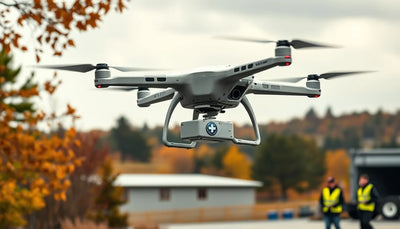
uAvionix and Airwise Partner to Bring Real-Time Aircraft Tracking to Drone Ops
A new partnership between uAvionix and Airwise Solutions is bringing real-time crewed aircraft tracking to the Airwise drone operations platform. The integration targets a core pain point for beyond-visual-line-of-sight operators: knowing what else is in the air before and during a mission.

Quick answer
uAvionix and Airwise Solutions announced a partnership to integrate real-time crewed aircraft tracking into the Airwise drone operations platform, targeting safer beyond-visual-line-of-sight operations.
- The integration aims to give drone operators a clearer real-time picture of crewed aircraft in shared airspace
- The development addresses a key challenge for BVLOS drone operations across industries
- DroneDJ reported the partnership on August 21, 2026
- Specific technical details, pricing, and availability were not disclosed in the source report
Evidence: DroneDJ
Operator checklist
Turn policy news into a safer fleet decision.
Before changing aircraft, compare repair paths, available DJI inventory, and trade-in timing against the rule change.

Drone operations beyond a pilot's visual line of sight are becoming more common across industries, but safely sharing airspace with crewed aircraft remains one of the biggest operational and regulatory challenges. A new partnership between uAvionix and Airwise Solutions, reported by DroneDJ on August 21, 2026, aims to tackle that problem by giving drone operators a much clearer picture of what is happening in the skies in real time.
The announcement signals a meaningful step for commercial operators who have been waiting for practical airspace awareness tools that work inside the platforms they already use. Rather than introducing a standalone system, the integration brings aircraft tracking directly into the Airwise drone operations environment, which could reduce friction for fleet managers and pilots who currently juggle multiple screens and data sources during mission planning and execution.
The partnership and what it targets
According to the DroneDJ report, the collaboration between uAvionix and Airwise Solutions is focused on delivering real-time aircraft tracking capability within the Airwise platform. uAvionix brings expertise in aviation surveillance and communication technology, while Airwise provides drone operations software used by commercial teams. The stated goal is to help drone operators understand what crewed aircraft are doing in the surrounding airspace, particularly during beyond-visual-line-of-sight, or BVLOS, missions.
The core problem this addresses is not new. Commercial drone operators working on infrastructure inspection, surveying, agriculture, and logistics have long faced the challenge of detecting and avoiding crewed aircraft when the pilot cannot physically see the drone or the surrounding sky. Traditional visual observers help in some scenarios, but they do not scale well for long-range or automated operations. A real-time tracking feed inside the operations platform could reduce reliance on manual observation and improve situational awareness at the planning stage and during flight.
Reboot Hub analysis: the partnership is best understood as a software integration play rather than a hardware announcement. The source report does not specify new hardware products, pricing, or rollout timelines. What it does suggest is that drone operations platforms are maturing to the point where third-party airspace data can be embedded directly into the workflow, which is a meaningful shift for operators who have historically had to assemble their own stack of tools.
Why airspace awareness matters for BVLOS operations
Beyond-visual-line-of-sight operations are expanding across sectors such as powerline inspection, pipeline monitoring, search and rescue, and drone delivery. In each of these use cases, the operator cannot rely on direct visual contact with the aircraft. That makes reliable, real-time information about nearby crewed aircraft a safety-critical requirement, not a convenience feature.
The DroneDJ report frames the uAvionix and Airwise integration as a response to this exact challenge. By bringing real-time aircraft tracking into the platform operators already use for mission management, the partnership could lower the barrier to safer BVLOS workflows. For fleet managers, this means fewer external tools to monitor and less chance that critical airspace information is missed because it lives in a separate application.
From a regulatory perspective, the development also aligns with broader industry movement toward unmanned traffic management, or UTM, frameworks. Regulators in multiple regions have signaled that reliable situational awareness is a precondition for expanded BVLOS approvals. While the source report does not claim any specific regulatory certification or approval tied to this integration, the general direction is consistent with what commercial operators should expect from compliance-focused platforms.
What this means for drone owners and the market
For individual drone owners and small commercial operators, the immediate impact of this announcement is limited in practical terms. The integration is aimed at the Airwise platform ecosystem, and the source report does not indicate whether the capability will be available to hobbyists or casual users. However, the broader signal matters. As real-time airspace awareness becomes a standard feature in professional drone operations software, the expectation for safer, more compliant operations will gradually filter down to smaller operators and enterprise buyers alike.
For fleet managers and procurement teams evaluating drone platforms, this kind of integration should influence software selection criteria. A platform that can ingest real-time aircraft tracking data from a specialist provider like uAvionix reduces the need for separate situational awareness tools and can simplify training, compliance documentation, and mission planning. Operators who are currently evaluating operations software may want to ask vendors directly whether real-time airspace data is available or on the roadmap.
For the pre-owned DJI market, the connection is indirect but worth noting. Many commercial operators run DJI airframes alongside third-party operations software. As platforms like Airwise add deeper airspace awareness capabilities, the value of a well-maintained, inspected pre-owned DJI drone does not diminish; if anything, the software layer becomes the differentiator while the aircraft remains a reliable, replaceable asset. Buyers considering pre-owned DJI drones for commercial work should factor in the cost and capability of the operations platform they will pair with the aircraft, since airspace awareness tools are increasingly part of the compliance picture. For operators planning fleet expansion or replacement cycles, understanding how software integrations affect total cost of ownership is becoming as important as the airframe itself, and resources like the Drone Wiki can help buyers understand how platform choices interact with hardware decisions.
Repair and maintenance providers may also see a subtle shift. As more commercial flights occur under BVLOS conditions with real-time tracking, the operational pressure on airframes, batteries, and sensors increases. Longer missions and more frequent flights translate into faster wear on components. Operators who invest in airspace awareness software should also plan for more disciplined maintenance schedules and a reliable source of genuine OEM spare parts to keep inspected pre-owned aircraft in mission-ready condition. For owners evaluating service and lifecycle risk, Drone Wiki explains the relevant repair, parts, resale, or operational path.
What operators should watch next
The DroneDJ report leaves several important questions unanswered, including specific technical details, availability dates, and whether the integration will be offered as a standard feature or a premium add-on. Operators who are interested in the Airwise platform should monitor official announcements from both companies for rollout specifics. In the meantime, the practical takeaway is clear: real-time aircraft tracking is moving from a specialized, standalone capability into mainstream drone operations software.
For commercial teams planning BVLOS missions in the near term, the actionable step is to evaluate whether current operations software provides adequate airspace awareness or whether a platform with integrated tracking would reduce operational risk and administrative burden. Fleet managers should also consider how software capabilities affect hardware planning, including whether existing airframes remain suitable for longer, more data-intensive missions.
The broader market implication is that airspace awareness is becoming a competitive feature in the drone operations software space. As more platforms integrate real-time tracking from specialist providers, operators will have more options to choose from, and the baseline expectation for safe BVLOS operations will continue to rise.
FAQ
Frequently asked questions
What did uAvionix and Airwise Solutions announce?
According to DroneDJ, the two companies announced a partnership to integrate real-time crewed aircraft tracking into the Airwise drone operations platform, with the goal of improving situational awareness for beyond-visual-line-of-sight drone operations.
Is this integration available to all drone operators right now?
The source report did not specify availability dates, pricing, or whether the feature will be standard or premium. Operators interested in the capability should monitor official announcements from uAvionix and Airwise Solutions for rollout details.
How does this affect buyers of pre-owned DJI drones?
The announcement does not directly change the pre-owned DJI market, but it reinforces that operations software and airspace awareness tools are becoming key differentiators for commercial work. Buyers should evaluate the full software and hardware stack, including maintenance and spare parts planning, when building or expanding a fleet.
Which sources support this update?
The visible evidence links identify DroneDJ; each source is used only for the claim it directly supports.
What remains subject to change?
Retail pricing, availability, product bundles and regulatory timelines can change. Readers should verify the latest terms with the named retailer, manufacturer or regulator before acting.
How should buyers or operators use this analysis?
Use the verified facts as a starting point, then compare mission fit, lifecycle support, maintenance needs and current procurement terms before making a purchase or fleet decision.
Sources consulted
- DroneDJ - primary source
Additional official documentation was not available at publication time.
Reboot Hub Editorial adds buyer, repair, resale, and operational analysis for drone owners. If you spot an error, contact us for correction review through our editorial policy.