Skydio X10 Rescues Three in Illinois River: Why It Matters for Operators
Cherry Valley PD used a Skydio X10 with thermal, spotlight, and speaker to rescue three people from the Kishwaukee River. The mission shows how advanced payloads and autonomous flight reduce risk and response time. Drone buyers should note the capabilities that matter most for search and rescue.

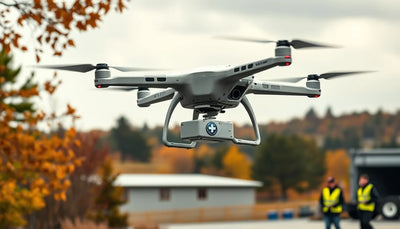
On the night of June 25, 2026, the Cherry Valley Police Department in Illinois deployed a Skydio X10 to locate and guide three stranded individuals out of the Kishwaukee River. According to a report from DroneXL.co, the drone was equipped with thermal imaging, a spotlight, and a speaker payload. All three people were unhurt after the Cherry Valley Fire Protection District took them to safety. The operation, performed by a small municipal department, offers a clear example of how integrated payloads and autonomous flight can dramatically improve outcome speed and safety in water rescue scenarios.
The operational value of multi-payload drones in rescue
The Skydio X10 used in this mission carried three specific payloads: a thermal camera for night detection, a spotlight for visual guidance and illumination, and a speaker for verbal direction. This combination allowed officers to first find the stranded people using thermal contrast, then keep them lit and verbally guide them while waiting for fire-rescue personnel to wade in. The speaker payload is particularly instructive for fleet operators. In noisy river environments or during poor visibility, a loudspeaker can provide immediate, reassuring instructions that radios or shouting cannot match. For commercial drone buyers evaluating new aircraft or adding payloads to existing fleets, this case reinforces that multi-payload capability—especially the integration of thermal, lighting, and audio—is not a luxury but a practical necessity for emergency response applications. Operators in public safety, security, or industrial inspection should ensure their drone of choice can simultaneously support at least two of these payloads without significant flight-time tradeoffs.
The Winnebago County scenario also highlights the importance of low-light autonomy. The Skydio X10’s ability to hold position and track subjects in the dark without pilot micro-adjustments allowed the operator to focus on communication with ground teams rather than stick control. For drone repair customers and fleet managers, this implies that autopilot reliability and obstacle avoidance in night conditions are becoming baseline requirements, not premium add-ons. When sourcing pre-owned DJI drones for rescue work, for example, buyers should prioritize models with proven night-capable obstacle sensors and robust autonomous modes.
Fleet readiness
Keep DJI hardware available without overbuying new units.
Use defense and fleet news as a planning signal for repair support, inspected pre-owned aircraft, and replacement timing.

What this means for drone buyers
This single mission offers several practical takeaways for anyone purchasing a drone for search and rescue, public safety, or critical infrastructure monitoring. First, payload integration should drive the buying decision more than raw flight time or camera resolution. The Skydio X10’s thermal spotter and spotlight were the decisive tools. For drone buyers considering a new fleet or upgrading existing units, verify that your chosen platform can carry a thermal camera, a bright searchlight, and a speaker simultaneously—or at least allow quick hot-swapping between missions.
Second, autonomy matters. In the Cherry Valley operation, the drone likely used automated tracking or position hold to keep the subjects illuminated without constant joystick input. Buyers evaluating both new and pre-owned DJI drones should check for reliable Visual Positioning Systems, downward sensors, and subject-tracking modes that work at night. A drone that can loiter over a moving subject frees the pilot to coordinate with rescue teams.
Third, secondary market value for drones with verified payload compatibility may rise. Public safety agencies that later upgrade to newer models often sell their used drones. For budget-conscious operators, the pre-owned DJI drones market can provide access to platforms like the Matrice 300 RTK or M30T, which also support thermal and spotlight payloads. However, buyers should confirm that the specific payload modules are still supported and that the drone’s firmware allows third-party accessory control.
Fleet planning and repair implications from the rescue
For fleet operators and repair managers, this incident underlines the need to maintain payloads as carefully as the airframe. A thermal camera that drifts out of calibration or a speaker that crackles under load can be the difference between a successful rescue and a failed one. Regular inspection of all attached payloads, especially after missions involving water or fog, should be part of any preventive maintenance schedule.
If your fleet includes pre-owned drones, parts availability for older payloads becomes a concern. Many agencies keep drones in service for years, and OEM-pulled parts for thermal gimbals or speaker mounts can be hard to source. For that reason, operators should develop relationships with repair providers that stock genuine OEM spare parts. For professional DJI repair services, the ability to replace a damaged thermal camera module or a spotlight bracket with original components can keep a mission-ready aircraft flying without lengthy manufacturer wait times.
Additionally, the rescue demonstrates the value of loudspeaker payloads for two-way communication. Any fleet that does not currently carry a speaker should consider adding one, as it can reduce the need for ground personnel to enter dangerous zones. When evaluating used drones from the secondary market, check whether the speaker payload is included or whether it can be purchased separately and mounted without custom wiring.
Finally, battery management for night operations with multiple payloads draws more current than standard daylight flights. In the Cherry Valley mission, the drone likely used extra power for the spotlight and speaker. Fleet managers should log flight times under heavy payload conditions and ensure they have enough batteries to cover extended search patterns without swapping mid-mission. This also affects trade-in decisions: a drone with heavily cycled batteries may have reduced value, so consult a drone trade-in guide to get an accurate estimate before selling or upgrading.
Cost-benefit lessons for public safety drone programs
The Cherry Valley Police Department is a relatively small agency. Their ability to deploy a high-end drone like the Skydio X10 suggests that even modest budgets can justify the investment when the alternative is risking first responders in fast-moving water. For departments evaluating a new drone program, the cost of a fully configured rescue drone (including thermal, spotlight, and speaker) is often less than one month of overtime for a water rescue team. The mission also avoided the need for a helicopter, which would have been significantly more expensive and slower to arrive.
This has direct implications for drone buyers in the pre-owned market. As agencies upgrade from first-generation thermal drones to newer models like the Skydio X10 or DJI Matrice 350 RTK, they frequently offload perfectly functional drones with thermal and speaker payloads. Inspected pre-owned units can provide 90% of the operational capability at 50% of the cost. However, buyers must verify that the drone’s battery health, gimbal condition, and firmware support for speaker payloads are all intact.
Another cost lesson: modularity saves money. The Skydio X10’s payload system allows quick changes between searchlight, speaker, and LIDAR. For departments that share drones between traffic surveillance and rescue missions, a modular payload bay reduces the need for multiple airframes. In the pre-owned market, drones with broken payload quick-release mechanisms are common, so careful inspection is critical before purchase.
From a repair perspective, water rescue operations inevitably expose drones to splash and humidity. Even if the aircraft does not crash, condensation inside electronics can cause long-term corrosion. Operators should schedule corrosion checks after any mission over water. For those relying on professional DJI repair services, it is wise to ask about conformal coating or moisture-resistant treatments available during repairs.
What payloads did the Skydio X10 use in the Illinois rescue?
According to the source report, the Skydio X10 carried a thermal imaging camera, a spotlight, and a speaker payload. These three components allowed the operator to locate the stranded people in the dark, keep them illuminated, and verbally direct them to safety while rescue personnel approached.
Should small police departments buy a Skydio X10 or consider pre-owned DJI drones?
The choice depends on budget and mission profile. The Skydio X10 offers strong autonomy and multi-payload integration out of the box. However, pre-owned DJI drones like the Matrice 300 RTK or M30T can also support thermal and speaker payloads at a lower entry cost. Buyers should compare payload compatibility, battery availability, and repair support before deciding.
How can operators maintain rescue drones after water missions?
After any flight over water, operators should dry the aircraft thoroughly, check for moisture in connectors and gimbal motors, and run a full system check. Regular firmware updates and payload calibration are essential. For drones already in the pre-owned market, verify that corrosion prevention measures were taken by the previous owner.