Pratt & Whitney's BARB Robot Signals Change for Drone Assembly
Pratt & Whitney’s new assembly robot, BARB, eliminates downtime and human error on jet engine lines. The same automation principles are already reshaping how drone OEMs build and repair UAVs, with direct implications for pre-owned DJI buyers and fleet operators.

Pratt & Whitney has added a new laborer to its jet engine assembly line, and it will never ask for a vacation day. The robot, called BARB, offers a glimpse at how aerospace manufacturing is being transformed by advanced automation—a shift that carries direct implications for the drone industry, from how DJI and other OEMs build airframes to how repair shops handle precision repairs. For commercial drone buyers, fleet operators, and participants in the second-hand market, understanding this trend is becoming as important as reading a spec sheet.
The War Zone reported on BARB as a signal of future jet engine assembly. The robot performs complex, repetitive tasks with consistency that human hands cannot match over long shifts. But the same logic is already racing through the drone supply chain. As automation deepens, it changes the quality of new drones, the reliability of genuine OEM spare parts, and the calculus for buying pre-owned DJI drones.
The rise of aerospace automation and its drone footprint
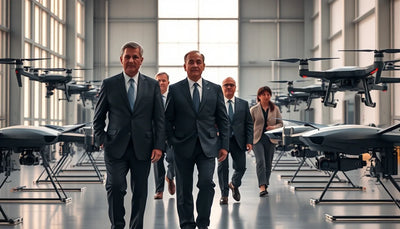
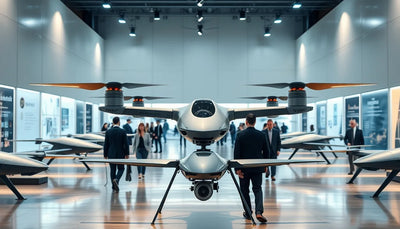
BARB is not a drone, but it belongs to the same aerospace-robotics ecosystem. Pratt & Whitney’s robot works on a jet engine production floor—a controlled environment where fit tolerances are measured in thousandths of an inch. The lesson for drone manufacturing is clear: automated assembly reduces variability, lowers defect rates, and allows OEMs to maintain tighter quality standards across high-volume production runs.
DJI buying context
Match product news to hardware you can actually deploy.
Check inspected DJI aircraft, repair support, and trade-in timing before deciding whether to upgrade, repair, or wait.

Major drone manufacturers such as DJI already use robotic arms for motor winding, gimbal calibration, and frame bonding. The trend accelerates as labor markets tighten and customers demand consistent flight performance. For a fleet operator running 50 Matrice 300s, the difference between a robot-assembled motor and a hand-assembled one shows up in vibration signatures after 1,000 hours of use. Automation reduces the probability of early failures.
That matters for the pre-owned market. When a drone is built with robot precision, its components tend to wear more uniformly, making it a better candidate for later inspection and resale. A drone that spent its first life on an automated production line often retains higher structural integrity than one assembled in less controlled conditions. Buyers of pre-owned DJI drones should look for units from newer, more automated production batches—they tend to have fewer hidden asymmetries.
What this means for drone buyers
For individual buyers and small fleet operators, the BARB story is a reminder that the drone you purchase today embodies the manufacturing technology that built it. Automated assembly lines yield drones with more predictable flight characteristics and longer service intervals. That directly affects total cost of ownership.
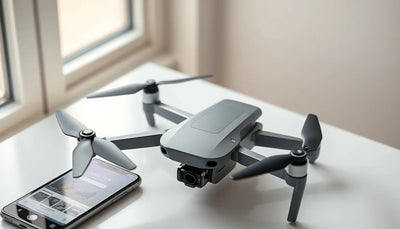
When automation reduces defect rates, the delta between a new drone and a pre-owned drone can narrow—but only if the pre-owned unit was built to the same standard. Buyers should prioritize drones whose OEMs publish transparent manufacturing process details. DJI, for instance, has invested heavily in robotic assembly for its Matrice and Mavic lines. A pre-owned Mavic 3 built in 2025 likely benefits from more automation than an earlier variant, which may translate into better gimbal alignment and motor balance.
Additionally, the same automation principles are entering drone repair. Shops that use robotic alignment tools and automated soldering stations produce repairs that approach factory tolerances. If you are considering a repair for a damaged unit, look for a facility that employs such equipment. Many operators now send their drones to professional DJI repair services that use OEM-sourced parts and automated calibration rigs, ensuring the repair does not shorten the drone's remaining useful life.
Supply chain and spare parts implications
Reboot Hub analysis: Automation does not stop at the factory gate. It ripples through the entire spare parts ecosystem. When BARB-type robots assemble jet engines, the resulting consistency means that every replacement part fits exactly as designed. The same logic applies to drone spare parts: a robotically assembled motor or ESC module is more likely to be a drop-in replacement with no need for manual shimming or adjustment.
For fleet operators, this reduces repair turnaround time and lowers labor costs. Instead of spending 30 minutes fitting a replacement arm, a technician can swap a pre-assembled module in minutes. The reliability of genuine OEM spare parts becomes more predictable, and operators can hold smaller safety stocks because they trust the fit.
Reboot Hub analysis: In the pre-owned market, drones that have been repaired with robotically matched OEM parts command higher resale values. A buyer evaluating a used Inspire 3 is more likely to pay a premium if the flight logs show a recent repair at a facility that uses automated alignment. Conversely, drones repaired with hand-fitted parts may accumulate subtle inconsistencies that affect flight dynamics over time. This asymmetry is something second-hand market participants should factor into their pricing models.
The second-hand market perspective
The growing use of automation in drone manufacturing and repair directly influences the value of pre-owned equipment. Drones built with higher assembly precision tend to suffer fewer structural fatigue failures, which means they can safely fly more cycles before retirement. That extends the economic life of the aircraft and supports stronger residual values.
For sellers, this is a strong argument to document the provenance of pre-owned units. A history that includes "manufactured on a robotic assembly line" or "repaired with automated calibration" can justify a higher asking price. For buyers, it means that a well-maintained, automation-built pre-owned drone can be a better value than a discounted new unit from a less automated production run.
Reboot Hub’s drone trade-in guide highlights how condition and manufacturing era affect trade-in offers. As automation becomes standard, the gap between older, manually assembled models and newer robotic-era drones will widen. Operators planning fleet refreshes should time their trades to capture maximum value before older units depreciate further.
How does robotic assembly like BARB affect drone repair costs?
Robotic assembly reduces part-to-part variation, so replacement components fit more precisely without manual adjustment. That cuts repair labor time and lowers the overall cost of fixing a drone. For fleet operators, the savings add up quickly across multiple units.
Should I buy a pre-owned drone built on an automated line versus one that was hand-assembled?
All else being equal, a drone from an automated production line will likely have more consistent flight characteristics and fewer hidden defects. If you can verify the manufacturing date and line type from the OEM, the automated-built unit offers better long-term value, especially for commercial use.
Does automation make genuine OEM spare parts more reliable for repair shops?
Yes. When OEMs use robots to assemble parts, the dimensional consistency of each component improves. Repair shops that use such genuine OEM spare parts can perform swaps with confidence that everything aligns correctly, reducing the need for trial-and-error fitting and improving the final repair quality.
Sources consulted
- Air | Page 76 of 96 - primary source
- The War Zone - primary reporting source
Reboot Hub Editorial adds buyer, repair, resale, and operational analysis for drone owners. If you spot an error, contact us for correction review through our editorial policy.