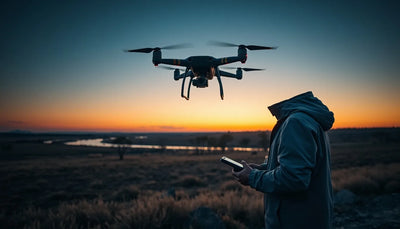
New global focus on human factors reshapes drone operator training
Regulators worldwide are adding human factors requirements to drone certification. Fleet operators should prepare for new training, crew resource management, and interface design standards that could affect procurement and resale decisions.

As commercial drone operations scale beyond visual line of sight (BVLOS) and into increasingly complex airspace, regulators in Europe, North America, and Asia-Pacific are turning their attention to a safety element that has long been the domain of manned aviation: the human operator. A new report published July 28, 2026 from DRONELIFE, part of an exclusive series titled “The Human Edge: People, Perception, and the Future of Drone Operations,” details how international authorities are moving beyond aircraft hardware and airspace design to codify human factors—training standards, crew resource management, automation interface requirements, and decision-making protocols. For drone buyers, fleet operators, and repair customers, this regulatory shift may be the most consequential operational change of the decade.
Global regulatory shift toward human factors
The DRONELIFE analysis notes that while much of the regulatory focus over the past five years has been on aircraft performance, remote identification, and airspace integration, the next frontier is the operator’s cognitive load and situational awareness. Regulators from the European Union Aviation Safety Agency (EASA), the U.S. Federal Aviation Administration (FAA), and civil aviation authorities in Japan and Australia are now embedding explicit human factors criteria into certification frameworks for commercial drone systems. This includes mandated crew training on automation failure modes, standard operating procedures for handoff between remote pilots and visual observers, and usability standards for ground control station software.
The practical implication is immediate: any fleet operator planning to acquire new industrial drones in 2027 or beyond should verify that the aircraft’s ground control software and training syllabus already align with emerging human factors regulations. The same applies to the second-hand market. A drone model that lacks documented compliance with human factors standards—or whose original pilot training package does not cover crew resource management—may depreciate faster as operators require newer systems to meet regulatory deadlines.
Industrial drone procurement
Source a brand-new industrial drone for this mission.
Discuss mission fit, aircraft model, quantities, configuration, pickup, and lifecycle support with Reboot Hub.

Operational implications for drone fleets
The report underscores that human factors regulation is not merely a paperwork exercise. It directly affects how fleets are deployed, how pilots are scheduled, and how maintenance downtime is planned. For example, if a regulator requires a two-person crew for certain BVLOS missions—a pilot in command and a sensor operator with separate responsibilities—then a fleet that previously deployed a single pilot per mission must double its trained headcount. That raises personnel costs and may require additional ground control equipment. For professional DJI repair services, this shift creates demand for hardware modifications such as dual-joystick interfaces or secondary displays that support a crew configuration.
Additionally, human factors rules often mandate recurrent training intervals—annual or semiannual—rather than one-time certification. That will increase the total cost of ownership for any drone model, but it also makes the choice of OEM more strategic. Aircraft with intuitive automation and well-documented training materials reduce the burden on the operator. Conversely, a drone with poorly designed ground control software may become a liability if regulators assess it as non-compliant with usability standards.
What this means for enterprise operators
Enterprise operators who fly large rotary-wing or fixed-wing drones for surveying, inspection, or logistics should treat this regulatory trend as a trigger to review their entire fleet lifecycle plan. The most immediate next step is to audit existing ground control station interfaces and pilot training records against the most advanced human factors criteria published by EASA or the FAA, even if local adoption is still pending. Operators who wait until enforcement begins risk grounding portions of their fleet during the retrofit window.
For brand-new industrial drone procurement, the decision should now include a human factors compliance checklist. Ask the manufacturer for documentation of usability testing, crew resource management integration, and any simulator-based training modules that replicate high-stress scenarios. If the OEM cannot provide such documentation, the aircraft may have a shorter operational lifespan before regulatory upgrades are required. Enterprise buyers should also factor in the cost of mandatory recurrent training when comparing total cost of ownership between competing platforms. In some cases, it may be more economical to acquire a newer model with native human factors compliance than to retrofit an older airframe.
Fleet managers should also consider the trade-in value of existing drones. As regulatory requirements tighten, the second-hand market will increasingly favor aircraft with proven human factors compliance. For operators looking to upgrade, a proactive trade-in strategy—while current models still hold value—becomes a practical financial move. Buyers in the pre-owned DJI drone market will want to verify that any used aircraft’s original documentation includes crew training records and software version history. For teams translating this development into remote-operations, dock, and aircraft requirements, Reboot Hub's B2B drone procurement service can help scope configuration, fleet quantity, maintenance planning, and lifecycle support before a quotation.
Market and resale considerations
The regulatory shift also carries implications for the global market in pre-owned DJI drones and OEM spare parts. When new certification requirements are published, they often include a grandfathering period for existing systems. But that period is finite. Operators who hold older models—particularly those without the latest ground control software or with limited joystick/switch customization—may find resale value eroding once the grace period expires. Repair shops should expect to see more requests for software re-flashing, controller upgrades, and display retrofits to bring legacy airframes into human factors compliance.
For buyers on the second-hand market, the responsible approach is to request a copy of the original operator manual, any training completion certificates, and a log of firmware updates that affect the human-machine interface. Drone models that cannot run the latest ground control software versions may become difficult to insure or operate under evolving rules. Sellers who can provide clear documentation of human factors readiness will command a premium. The long-term lesson from the DRONELIFE analysis is that human factors regulation is not a one-off announcement; it is the beginning of a permanent shift that will touch every part of the drone ecosystem—from cockpit design to pilot licensing to the value of every used aircraft on the market.
How soon do operators need to comply with new human factors regulations?
The timeline varies by jurisdiction. Some regions are in a consultation phase, while others have already begun amending certification documents. Fleet operators should monitor their local aviation authority notices and plan to have crew training and software updates completed within 18 months of a final rule.
Will human factors rules affect the value of my existing drone?
Yes. When regulators mandate specific ground control software usability standards or crew configuration requirements, drones that cannot be upgraded to meet those standards will lose value in both the operational and resale markets. Documenting compliance readiness now can help preserve asset value.
What should I do if I am planning to buy a pre-owned drone today?
Request full documentation of the original factory training materials, ground control software version history, and any hardware modifications. Prioritize listings where the seller can demonstrate that the drone’s human-machine interface has not been altered in a way that reduces usability. For further guidance, consult a drone trade-in guide to understand how regulatory factors affect valuation.
Sources consulted
- DRONELIFE - primary source
- DJI official product information - official company source
- FAA UAS official guidance - official regulator source
- EASA drones and urban air mobility - official regulator source
- Reboot Hub professional DJI repair services - official service context
- DJI Support - official support source
Reboot Hub Editorial adds buyer, repair, resale, and operational analysis for drone owners. If you spot an error, contact us for correction review through our editorial policy.