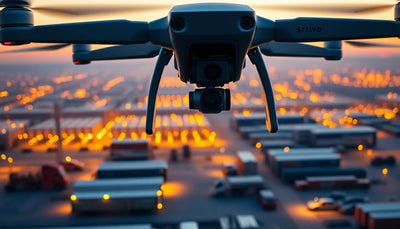
Flock Camera Controversy Holds a Policy Warning for Public Safety Drones
The Flock Safety automated license plate reader controversy shows why agencies adopting powerful public safety technology need clear oversight. Drone operators and fleet buyers should watch how the debate shapes procurement, data retention, and accountability expectations for aerial surveillance tools.

Quick answer
DRONELIFE reports that recent controversies involving Flock Safety automated license plate readers illustrate the need for strong guardrails when public safety agencies adopt increasingly capable technology, with direct lessons for drone programs.
- Flock Safety automated license plate readers help law enforcement locate stolen vehicles, find missing people, and develop leads.
- Recent Flock camera controversies demonstrate the need for strong oversight of public safety technology.
- The lesson extends to public safety drones, where data retention and access controls are becoming procurement concerns.
- Fleet buyers and operators should expect accountability and transparency requirements to influence future drone acquisitions.
Evidence: DRONELIFE
Industrial drone procurement
Source a brand-new industrial drone for this mission.
Discuss mission fit, aircraft model, quantities, configuration, pickup, and lifecycle support with Reboot Hub.

DRONELIFE reported on August 14, 2026, that recent controversies involving Flock Safety automated license plate readers carry a broader lesson for public safety agencies adopting increasingly capable technology, including drones. The report frames the issue as a governance challenge rather than a hardware problem: powerful surveillance tools can deliver real operational value, but they also create new accountability questions that agencies and vendors must address before public trust erodes.
Automated license plate readers, or ALPRs, help law enforcement locate stolen vehicles, find missing people, and develop leads in criminal investigations. Flock Safety has built a substantial presence in this market by offering networked camera systems to municipalities and law enforcement agencies. Yet the DRONELIFE analysis notes that recent cases involving misuse of these systems have sparked public debate about who can access the data, how long it is retained, and what safeguards prevent abuse. That debate is not confined to ground-based cameras.
For commercial drone operators, public safety fleet managers, and procurement teams, the Flock controversy is a signal worth reading carefully. Public safety drones generate similar types of location-rich, time-stamped data. A drone conducting a search operation, monitoring a public event, or supporting an investigation can capture imagery that raises the same privacy and retention questions as a fixed ALPR camera. The difference is that drones are mobile, can be deployed rapidly, and often operate under less mature policy frameworks than fixed camera networks.
What the Flock controversy actually involves
The DRONELIFE report does not detail specific penalties, court rulings, or agency sanctions. Instead, it describes a pattern: automated license plate readers have become widely adopted because they solve real problems, but recent misuse cases have demonstrated that adoption without strong guardrails creates risk. The source frames this as a lesson for public safety technology broadly, with drones explicitly named as a technology category that should absorb the same caution.
What matters for the commercial drone market is the direction of the policy conversation. When a widely deployed public safety technology faces public scrutiny, the response typically moves in predictable directions: agencies tighten access controls, vendors add audit logging, procurement documents begin to specify data retention limits, and elected officials introduce oversight requirements. Each of those responses has commercial consequences for drone manufacturers, software providers, and fleet operators.
Reboot Hub analysis: the Flock situation suggests that public safety drone programs should expect similar scrutiny as they scale. An agency that buys a drone today may face different data governance expectations in twelve or twenty-four months. Fleet planning should account for that trajectory rather than assuming current policies will remain stable.
What this means for enterprise operators
Enterprise and public safety drone operators should treat the Flock camera debate as an early indicator of procurement requirements that may soon appear in drone RFPs and agency policies. If ALPR systems are being pushed toward stronger access controls, audit trails, and retention limits, drone programs operating in the same public safety context will likely face parallel demands. Operators who build those safeguards into their workflows now will be better positioned when formal requirements arrive.
The practical implication is straightforward: a buyer or fleet manager evaluating a public safety drone platform should ask how the system handles data retention, who can access flight logs and imagery, and whether the vendor provides audit capabilities. These are not abstract policy questions. They affect total cost of ownership, training burden, and the risk that an agency will need to retrofit policies or replace systems after a public controversy.
For commercial operators working alongside public safety agencies, the same questions apply to data-sharing arrangements. A contractor flying a drone for a municipal client may find that the agency's data governance obligations extend to the contractor's operations. Understanding those obligations before signing a contract is cheaper than discovering them after an incident. For organizations managing mixed fleets or evaluating pre-owned DJI drones for public safety support roles, governance compatibility should be assessed alongside hardware condition and airframe history. Reboot Hub provides enterprise drone procurement support for buyers who need to align hardware decisions with evolving operational and policy requirements. For teams translating this development into fleet planning, Enterprise drone procurement support helps scope mission fit, unit quantity, maintenance coverage, and lifecycle support.
Why data governance is becoming a procurement factor
The DRONELIFE report positions the Flock controversy as part of a larger pattern: public safety agencies are adopting capable technology faster than they are adopting the governance structures that make that technology sustainable. This is a familiar cycle in the drone industry. Early adoption focuses on capability and cost. Later adoption focuses on accountability, data handling, and public acceptance. The Flock situation suggests the accountability phase is arriving for location-tracking and surveillance tools, and drones are in the same category.
For drone buyers, this means procurement decisions should now include a governance review alongside the traditional evaluation of airframe performance, sensor quality, and price. A platform that lacks robust access controls or audit logging may be operationally excellent today but commercially risky tomorrow. The cost of replacing or retrofitting a fleet for compliance reasons can exceed the initial savings from choosing a lower-cost or less transparent platform.
The pre-owned DJI market is relevant here. Agencies and commercial operators often evaluate inspected pre-owned DJI drones as a way to stretch procurement budgets. That remains a sound approach when the hardware is sourced through a reliable channel and the airframe history is documented. But hardware cost is only one part of the equation. A pre-owned airframe paired with a governance-weak software workflow still carries the same policy risk as a new unit. Buyers should evaluate the full stack, not just the aircraft.
What operators should do differently now
The operator-facing takeaway from the Flock camera debate is to treat data governance as a core fleet requirement, not a post-purchase afterthought. Before acquiring a drone for public safety or enterprise use, document how imagery and flight data will be stored, who can access it, how long it will be retained, and how those decisions will be audited. If the answers are not clear, the acquisition is not ready.
Fleet managers should also review existing programs against the same questions. A drone program that has operated for years under informal data practices may be exposed to the same type of scrutiny that has affected ALPR deployments. Formalizing those practices now is inexpensive compared to responding to a public controversy or an oversight inquiry later.
The broader market signal is that public safety technology adoption is entering a more mature phase. Vendors that provide transparent data controls, clear audit trails, and documented retention options will have a competitive advantage. Operators who evaluate those features seriously will build fleets that are more resilient to policy change. The Flock controversy may be about cameras on poles, but the lesson applies directly to aircraft in the air.
FAQ
Frequently asked questions
What did DRONELIFE report about Flock Safety cameras?
DRONELIFE reported that recent controversies involving Flock Safety automated license plate readers demonstrate the need for strong guardrails when public safety agencies adopt increasingly capable technology. The report notes that ALPRs help law enforcement find stolen vehicles, locate missing people, and develop leads, but that misuse cases have raised governance concerns.
How does the Flock camera debate affect drone buyers?
Reboot Hub analysis: Drone buyers should expect data governance requirements to become a larger part of public safety and enterprise procurement. Access controls, audit logging, and data retention policies are likely to be specified more formally in future RFPs and agency policies, which affects total cost of ownership and platform selection.
Should fleet managers change how they evaluate pre-owned DJI drones?
Fleet managers should continue to evaluate inspected pre-owned DJI drones for cost-effective procurement, but they should assess the full operational stack, including data governance and software workflows, rather than focusing only on airframe condition and price. Hardware savings do not reduce policy risk if the supporting systems lack proper controls.
Which sources support this update?
The visible evidence links identify DRONELIFE; each source is used only for the claim it directly supports.
What remains subject to change?
Retail pricing, availability, product bundles and regulatory timelines can change. Readers should verify the latest terms with the named retailer, manufacturer or regulator before acting.
How should buyers or operators use this analysis?
Use the verified facts as a starting point, then compare mission fit, lifecycle support, maintenance needs and current procurement terms before making a purchase or fleet decision.
Sources consulted
- DRONELIFE - primary source
Additional official documentation was not available at publication time.
Reboot Hub Editorial adds buyer, repair, resale, and operational analysis for drone owners. If you spot an error, contact us for correction review through our editorial policy.