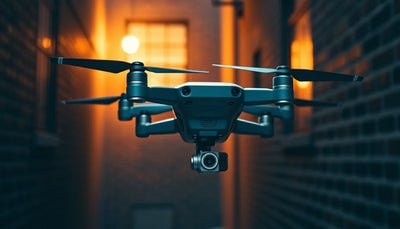
DARPA’s $6.5M Heavy-Lift Drone Challenge Reshapes Cargo UAVs
DARPA launches a $6.5 million challenge to reinvent heavy-lift drones, pushing beyond current payload limits. For commercial fleet operators and pre-owned DJI drone buyers, the program signals a shift toward larger cargo platforms and new repair standards.

The Defense Advanced Research Projects Agency (DARPA) has launched a $6.5 million challenge aimed at reinventing heavy-lift drones, according to a report from Dronelife. The competition, which targets payload capacities well beyond what current commercial multirotors can carry, is set to accelerate the development of cargo-class unmanned aircraft. For commercial fleet operators, drone buyers, and the pre-owned DJI market, the ripple effects could reshape how heavy-lift missions are planned, funded, and serviced over the next few years.
While the challenge is defense-funded, its outcomes will inevitably influence the broader heavy-lift drone ecosystem. DARPA’s participation signals that the U.S. government sees a critical gap in existing drone cargo capabilities—and is willing to invest real money to close it. Fleet managers who rely on platforms like the DJI Matrice series for medium-lift tasks should pay close attention, as the program may set new benchmarks for payload-to-weight ratios, endurance, and reliability that will eventually trickle down to commercial and second-hand markets.
What DARPA’s challenge actually targets
The $6.5 million prize pool is designed to incentivize breakthroughs in heavy-lift drone architecture. According to the source, the challenge focuses on “reinventing” how drones approach lifting substantial payloads—likely in the range of hundreds of pounds—over tactically relevant distances. The agency is not just looking for incremental improvements; it wants new propulsion, structural, or hybrid designs that can carry loads that current multirotors simply cannot handle without becoming too large or inefficient.
Fleet readiness
Keep DJI hardware available without overbuying new units.
Use defense and fleet news as a planning signal for repair support, inspected pre-owned aircraft, and replacement timing.

For commercial operators, this matters because the same fundamental limitations apply to civilian logistics: package delivery, agricultural spraying, industrial equipment transport, and disaster relief all need higher payload capacity without sacrificing flight time or reliability. If DARPA-backed teams succeed, the resulting technology—whether novel rotor configurations, hybrid-electric powertrains, or advanced composite airframes—will likely be adapted for non-defense use. That means future enterprise drones could carry heavier sensors, more batteries, or larger cargo loads, changing the calculation for fleet buyers who are currently maxed out at 15–25 kg payloads.
The challenge also signals that the government is open to working with non-traditional vendors, including startups and small engineering firms. This could diversify the heavy-lift supply chain, reducing reliance on a few dominant players (including DJI) and creating more options for pre-owned and aftermarket parts. For repair shops, new designs may require different tooling and spare part inventories, but the overall trend points to more robust, serviceable aircraft.
What this means for drone buyers
If you are a commercial operator evaluating a heavy-lift purchase today, the DARPA challenge introduces a strategic timing consideration. Buying a current-generation heavy-lift drone—such as a DJI Matrice 600 series or an Agras T40—still makes sense for immediate needs. But the challenge suggests that within 18–36 months, significantly more capable platforms could enter the market, potentially at lower per-kg costs due to competition and new manufacturing techniques.
For buyers of pre-owned DJI drones, the secondary market could see price softening on older heavy-lift models as newer, DARPA-inspired designs emerge. However, that transition will be gradual; military-grade payloads require certifications and testing that take years. In the near term, well-maintained pre-owned heavy-lift platforms remain a cost-effective way to enter cargo operations without betting on unproven technology. Buyers should prioritize platforms with documented repair histories and OEM-pulled spare parts availability.
Fleet managers should also consider that future heavy-lift drones may have different maintenance profiles. If DARPA succeeds in developing simpler, more modular airframes, repair costs could drop compared to today’s complex multirotor systems. That would make professional DJI repair services even more valuable for keeping current fleets profitable while waiting for the next generation.
Implications for the pre-owned DJI market and repair ecosystem
The heavy-lift segment is a stronghold for DJI’s Matrice and Agras lines. Many older DJI models—like the M600 Pro or earlier A3-based platforms—already circulate on the second-hand market, often used for crop spraying or industrial inspection. The DARPA challenge does not directly target these products, but it does accelerate the technological race. When new heavy-lift designs start appearing in commercial catalogs, the resale value of current DJI heavy-lift drones will likely decline, at least in absolute terms.
That is not necessarily bad news for buyers focused on value. A drone that could lift 20 kg five years ago is still capable of that same payload today. For tasks that do not require cutting-edge payload capacity, a well-inspected pre-owned DJI heavy-lift drone can be a smart purchase—especially if the original owner maintained it with genuine OEM spare parts. The repair ecosystem for these models is mature, with a robust supply of OEM-pulled components and experienced technicians.
Operators who already own heavy-lift DJI drones should take note: as new cargo platforms approach, the demand for repair services on legacy models may shift. Parts that are hard to find now could become scarcer if manufacturers stop production. Proactive maintenance—using the pre-owned DJI drones market to acquire spare units for parts, or investing in professional DJI repair services that use genuine components—can extend fleet life and maximize return on existing investments.
How operators should adjust their fleet planning
The DARPA heavy-lift challenge is a multi-year program. Immediate changes are unlikely, but fleet planning should begin factoring in the possibility of a new generation of cargo drones within three to five years. For operators whose business depends on lifting medium payloads (under 50 kg) over moderate distances, the current crop of heavy-lift drones—whether from DJI, Autel, or other brands—will remain viable. However, those planning long-term capital investments may want to consider leasing or exploring drone trade-in guide programs to retain flexibility.
For agricultural, construction, and logistics operators, the challenge’s emphasis on “reinvention” suggests that future heavy-lift drones could be fundamentally different in form factor. That might mean larger single-rotor designs, hybrid systems, or multi-rotor configurations with vastly more efficient powertrains. Early adopters should be prepared for potential teething issues with new technologies, while conservative operators may prefer to stick with proven pre-owned DJI platforms until the new designs mature.
Repair businesses should monitor DARPA’s program announcements closely. If winning designs use modular components or standardized interfaces, aftermarket parts manufacturing could become easier, potentially lowering repair costs and turnaround times. Conversely, highly integrated military-derived designs might complicate civilian repair. Staying connected to the professional repair community and investing in OEM-pulled parts will help independent shops serve both current and future clients.
Finally, every operator should ask one question: does my current payload capacity limit my business growth? If the answer is yes, the DARPA challenge means help is on the way. If not, the prudent move is to maintain existing fleets with high-quality pre-owned components and expert repair, maximizing profitability until the next generation arrives.
How will the DARPA challenge affect the price of used heavy-lift drones?
In the short term, likely little change. Over the next two to three years, as new designs become public, the pre-owned market for current heavy-lift DJI drones may see moderate softness. Buyers looking for immediate capability will still find solid value in inspected pre-owned units.
Should I delay buying a heavy-lift drone because of this challenge?
Only if your operations can wait 2–3 years without the capability. The challenge is early-staged; no production-ready drones exist yet. For current needs, buying a pre-owned heavy-lift DJI drone or a new enterprise model is still the rational choice.
What should repair shops do to prepare for new heavy-lift designs?
Stay informed on DARPA program outcomes and begin building relationships with suppliers of OEM-pulled parts. Invest in training on modular repair techniques, and consider expanding your facility to handle larger airframes that may require specialized tooling.
Sources consulted
- DARPA Launches $6.5 Million Heavy-Lift Drone Challenge - DRONELIFE - primary source
- DIU Blue UAS - official government source
Reboot Hub Editorial adds buyer, repair, resale, and operational analysis for drone owners. If you spot an error, contact us for correction review through our editorial policy.