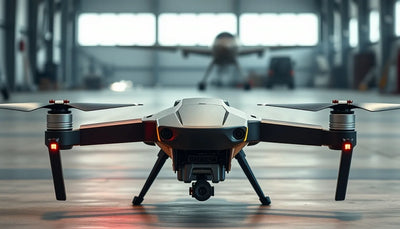
Archer Aviation's AI Platform Signals Shift in Aerial Tech – Implications for Drone
Archer Aviation’s stock surged after unveiling a next-generation AI aircraft platform. For commercial drone operators, this signals a market shift toward onboard autonomy. Learn how this affects fleet planning, pre-owned DJI values, and repair service priorities.

Archer Aviation (NYSE: ACHR) saw its stock price jump this week after the company unveiled a next-generation AI aircraft platform designed to power advanced urban air mobility operations. The announcement, reported by Yahoo Finance, highlights a growing industry conviction that artificial intelligence will become the central nervous system of aerial vehicles — not just for passenger eVTOLs but eventually for commercial unmanned aircraft systems. For drone buyers, fleet operators, and participants in the pre-owned DJI market, this event reinforces a critical trend: the value of onboard autonomy is rising, and the technology race is accelerating beyond basic flight controllers.
The Archer announcement did not include technical specifications for the new AI platform, nor did it disclose compatibility with existing aircraft. However, the market reaction — a sharp move upward in ACHR shares — suggests that investors see AI-driven aerial platforms as a key differentiator in the coming decade. For the commercial UAV sector, where DJI dominates firmware and flight intelligence, Archer's move signals that AI competition is moving from R&D labs into product roadmaps. This has direct implications for how fleet managers evaluate both new and pre-owned DJI drones, and for how repair services adapt to increasingly software-defined aircraft.
What the Archer AI platform tells us about market direction
Archer's announcement was framed as a next-generation AI aircraft platform, not merely a software update. The company explicitly linked the platform to "unprecedented levels of safety and autonomy" in its press materials. While the source article does not detail specific algorithms, sensor suites, or processing hardware, the strategic emphasis is clear: autonomy is no longer an optional upgrade — it is becoming the foundation on which new aerial systems are built.
Market context
Turn market news into a buy, repair, or trade-in decision.
Compare pre-owned availability, resale timing, and repair economics before the market moves again.

For commercial UAV operators, this mirrors the evolution seen in DJI's product line, where intelligent flight modes, obstacle avoidance, and automated inspection paths have progressively become standard. Archer's platform suggests that the broader aviation industry is adopting similar philosophies, but at a higher level of integration. The implication for drone buyers is that future DJI models — and competitors like Autel, Skydio, or new entrants — will likely embed deeper AI capabilities directly into the aircraft's core architecture, rather than offering them as add-on apps.
From a fleet planning perspective, this trend accelerates the obsolescence of older drones that lack robust onboard processing. The pre-owned DJI market, which thrives on models like the Matrice 300 RTK, Mavic 3 Enterprise, and Phantom 4 RTK, may see a shift in valuation as buyers begin to prioritize drones with stronger AI-ready hardware. Operators who delay upgrading may find themselves at a competitive disadvantage when bidding for contracts that require autonomous workflows, such as corridor mapping, live debris detection, or multi-sensor fusion.
What this means for drone buyers
If Archer's AI platform signals the direction of aerial technology, drone buyers should adjust their purchasing criteria accordingly. Rather than focusing solely on camera resolution, flight time, or range — though these remain important — buyers should evaluate the drone's ability to run advanced AI workloads locally. This means looking at onboard processor specs, SDK capabilities, and the manufacturer's commitment to firmware updates for autonomous features.
For those considering entry into the commercial drone market, the second-hand market offers a strategic entry point. Pre-owned DJI drones that were top-of-the-line a year ago are now available at reduced prices, providing a cost-effective way to build fleet capacity without betting on unproven AI claims. At Reboot Hub, inspected pre-owned DJI drones are sourced from fleets that upgraded to newer models, making them a practical option for operators who want tested hardware at a lower capital outlay.
However, buyers should also consider future-proofing. A drone purchased today for $8,000 may lose 30% of its resale value in two years if newer models ship with AI capabilities that make older drones uncompetitive for advanced missions. Therefore, purchasing decisions should include an assessment of how long the drone can remain productive before it becomes a liability in terms of capability and resale appeal. Reboot Hub's drone trade-in guide can help operators time their upgrades to maximize value recovery.
Repair and maintenance in an AI-centric ecosystem
As AI platforms become more deeply embedded in aircraft, repair services must evolve beyond swapping circuit boards and calibrating sensors. The Archer announcement underscores that future repairs will often involve software-level diagnostics, firmware reflashing, and AI algorithm validation. For independent repair shops and OEM service centers, this means investing in diagnostic tools that can interface with the aircraft's AI layer, not just its flight controller.
For owners of pre-owned DJI drones, the practical implication is more immediate. Many earlier DJI models, such as the Matrice 200 series or Inspire 2, lack the processing headroom to run sophisticated AI models onboard. When these drones require repair, the decision to invest in replacement parts should factor in the likely remaining service life. Installing new OEM-pulled parts on a platform that is technically obsolete may not be cost-effective. Reboot Hub's professional DJI repair services focus on extending the viability of current-generation platforms while advising customers on when to transition to newer hardware.
Reboot Hub analysis: Another consideration is the certification landscape. As AI takes on safety-critical roles — such as autonomous landing, collision avoidance, and dynamic rerouting — regulators may mandate stricter inspection intervals for AI-capable drones. This could create new opportunities for repair and calibration services that specialize in AI system verification. Operators who maintain a relationship with a trusted repair partner will be better positioned to comply with evolving standards and avoid downtime.
Fleet strategy and the pre-owned DJI market ripple effect
The Archer stock move and AI platform launch are part of a broader wave of investment in autonomous aerial technology. While Archer targets passenger air taxis, the underlying AI architectures — sensor fusion, real-time path planning, predictive maintenance — are directly transferable to commercial UAVs. This means that DJI and other drone OEMs will face pressure to differentiate their products on AI capability, potentially accelerating new product cycles and shortening the useful life of existing models.
For fleet managers, this creates a strategic tension. On one hand, buying pre-owned DJI drones now can deliver strong operational capability at a discount. On the other hand, committing capital to older platforms could leave the fleet behind when contract requirements evolve. The smart approach is to adopt a phased fleet lifecycle: use pre-owned DJI drones for stable, low-risk missions (like regular inspection or surveillance) while reserving budget for future AI-enabled platforms for high-value, autonomous tasks. Reboot Hub's inventory of pre-owned DJI drones offers operators the flexibility to build a diverse fleet without over-investing in any single generation of technology.
Additionally, the resale market will likely become more segmented. Drones with known AI capability — even if it is not yet exploited — will command higher prices on the secondary market. Conversely, drones that are purely manual or rely on ground-based processing will depreciate faster. Sellers in the pre-owned market should make AI-readiness a clear part of their listing, and buyers should ask about SDK access, processor specs, and available autopilot modes. The days of treating all used drones as interchangeable commodity hardware are ending.
One concrete action for drone operators: audit your current fleet for AI-readiness. If your drones cannot run even basic automated detection or tracking algorithms onboard, plan for their replacement within 18–24 months. Use the trade-in value from those older units to fund the transition to AI-capable platforms. Keeping a mix of pristine pre-owned DJI drones for routine work and newer AI models for complex jobs allows you to manage cash flow while staying competitive.
How does Archer Aviation's AI platform relate to commercial drones?
The platform is designed for passenger eVTOL aircraft, but the underlying AI architecture — including sensor fusion, autonomous decision-making, and predictive analysis — mirrors the direction of commercial UAV development. It validates the market's belief that onboard AI will become a core differentiator in all aerial vehicles.
Should I buy a pre-owned DJI drone now, or wait for AI-capable models?
It depends on your mission profile. For stable, routine tasks, a pre-owned DJI drone from a reputable source offers immediate value. For operators seeking to win contracts that require autonomous performance, waiting for AI-native models may be wise. A phased approach — buying inspected pre-owned units now and upgrading later — maintains operational capacity while controlling cost.
Will AI features affect the resale value of older DJI drones?
Yes. As AI becomes a standard expectation, drones without onboard AI processing will depreciate faster. The pre-owned market will increasingly demand evidence of AI-readiness. Sellers and buyers should document firmware version, SDK support, and any AI module compatibility to maximize transparency and value.
Sources consulted
- Yahoo Finance market report - primary source
- Archer Aviation investor relations - company investor information
Reboot Hub Editorial adds buyer, repair, resale, and operational analysis for drone owners. If you spot an error, contact us for correction review through our editorial policy.
This article is market commentary for drone operators and buyers, not investment advice. Reboot Hub does not provide financial advice or recommend securities transactions.