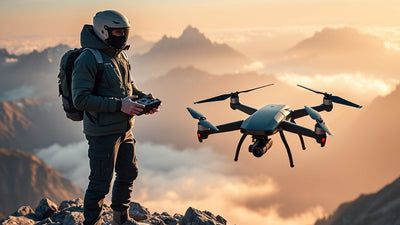
Red Cat Acquires Quaze: Wireless Power Unlocks Persistent Drone Operations
Red Cat Holdings has acquired Quaze Technologies to integrate wireless power into its drone ecosystem. This move removes a key bottleneck for persistent autonomous missions across air, land, and sea. We analyze what this means for defense contractors, commercial operators, and the second-hand drone market.

ملاحظات تحريرية
- تجمع هذه المقالة بين التقارير الخارجية المذكورة مع تحليل Reboot Hub's الخاص لمشتري الطائرات بدون طيار ومشغلي الأساطيل وعملاء الإصلاح ومراقبي السوق مستعمل DJI.
- يتم فصل حقائق المصدر عن التفسير. عندما يوفر تقرير بيانات محدودة، تنص المقالة على عرض القيود والإطارات Reboot Hub's كتحليل.
- لدى Reboot Hub روابط تجارية لمنتجات الطائرات بدون طيار وخدمات الإصلاح؛ هذه الروابط هي موارد للقراء ولا تحدد نتيجة المقال.
In a move that signals a paradigm shift for military drone logistics, Red Cat Holdings, Inc. (Nasdaq: RCAT) announced today-May 20, 2026-that it has completed the acquisition of Quaze Technologies Inc., a Quebec-based innovator in wireless power transmission. The deal, valued at an undisclosed sum, integrates Quaze's cutting-edge wireless charging technology directly into Red Cat's all-domain drone and robotic systems. For defense analysts and commercial UAV operators alike, this acquisition addresses one of the most persistent limitations of modern drone warfare and industrial inspection: battery life.
The press release, issued from Red Cat's headquarters in Salt Lake City, Utah, emphasizes that Quaze's technology removes a "critical bottleneck to persistent autonomous operations across air, land, and maritime environments." For a company whose portfolio already includes the Teal 2 (a small, tactical sUAS for defense), the Black Widow (a heavier-lift VTOL), and various maritime drones, the ability to recharge without human intervention or physical docking stations could redefine mission endurance. This is not merely an incremental upgrade; it is a foundational capability that enables true 24/7 drone operations in contested environments.
Why Wireless Power Is a Game-Changer for Defense Drone Programs
To understand the significance of this acquisition, one must first grasp the operational reality of current military drone deployments. The Teal 2, for instance, offers a flight time of approximately 30 minutes under standard conditions. While this is competitive for its class, it forces commanders to either land and swap batteries manually-a process that exposes personnel to enemy fire-or to deploy multiple drones in a "rotating" pattern, which increases logistical footprint and cost. Quaze's wireless power system changes this calculus entirely. By embedding resonant inductive charging pads into landing zones, rooftops, or even vehicle roofs, Red Cat drones can now land, recharge, and relaunch autonomously, with no human touch required.
Fleet readiness
Keep DJI hardware available without overbuying new units.
Use this news as a planning signal for inspected DJI aircraft, repair support, and trade-in timing.
This capability is particularly critical for the U.S. Department of Defense's Replicator initiative, which aims to field thousands of attritable autonomous systems by 2027. The Quaze acquisition aligns Red Cat directly with this vision. As noted by Red Cat CEO Jeff Thompson in the acquisition announcement, "Persistent autonomy is the holy grail of unmanned systems. With Quaze, we are not just adding a feature; we are eliminating the single greatest operational constraint." The technology is also platform-agnostic, meaning it can be retrofitted to existing Red Cat systems and potentially to third-party drones under government contracts.

From a regulatory perspective, this acquisition does not directly impact FAA Part 107 or Part 135 rules for commercial operators in the United States. However, it does raise interesting questions for military airspace integration. The ability to conduct persistent autonomous operations will likely accelerate the development of UAS Traffic Management (UTM) corridors and dynamic airspace segregation, particularly near military installations and forward operating bases. For defense contractors, this means that future Requests for Proposals (RFPs) will increasingly demand wireless charging as a standard requirement, not an optional upgrade.

What This Means for Commercial Drone Pilots and the Second-Hand Market
Ready to Upgrade Your Fleet?
Browse our collection of inspected pre-owned DJI drones - inspected, flight-tested, and backed by a 6-month warranty. Save up to 40% versus retail.
While the immediate impact of the Red Cat-Quaze deal is squarely in the defense sector, its ripple effects will be felt across the broader UAV industry-including the second-hand drone market. At Reboot Hub, we closely monitor how defense innovations trickle down to commercial applications. Historically, technologies like GPS-denied navigation, obstacle avoidance, and high-resolution thermal imaging all debuted in military systems before becoming standard on platforms like the DJI Matrice 350 RTK or the Autel EVO Max 4T.
Wireless power is likely to follow a similar trajectory. For commercial operators performing long-duration tasks-such as pipeline inspection, agricultural monitoring, or search and rescue-the ability to deploy a drone that can autonomously recharge at a designated "power pad" would dramatically reduce operational costs. Instead of hiring a second pilot to manage battery swaps or investing in expensive battery fleets, a single operator could oversee a multi-hour mission with minimal intervention. This efficiency gain will inevitably increase demand for drones that support wireless charging, which in turn will affect the used drone market. Older models that lack this capability may see a depreciation in value, while newer, compatible systems will hold their resale value better.
For drone pilots currently flying DJI Mavic 3 Enterprise or DJI Matrice 30T units, the Red Cat acquisition serves as a signal: the industry is moving toward contactless energy transfer. At Reboot Hub, we are already seeing early interest from commercial fleets looking to future-proof their operations. If you are considering upgrading your fleet, now is an excellent time to explore our collection of pre-owned DJI drones, which offer the latest technology at a fraction of retail cost. Our inventory includes models that are fully compatible with emerging charging standards and are backed by a 6-month warranty.
Ready to Upgrade Your Fleet?
Browse our collection of inspected pre-owned DJI drones - inspected, flight-tested, and backed by a 6-month warranty. Save up to 40% versus retail.
Technical Deep Dive: How Quaze's Wireless Power Works
Quaze Technologies, founded in 2021 by a team of engineers from McGill University and the University of Quebec, specializes in resonant inductive coupling for medium-power applications. Unlike conventional wireless charging systems that require precise alignment and short distances (e.g., Qi smartphone chargers), Quaze's technology uses a proprietary coil geometry and frequency modulation to achieve efficient power transfer over gaps of up to 30 centimeters, with tolerance for misalignment of up to 15 degrees. This is critical for drone applications, where landing accuracy is not always perfect-especially in gusty wind conditions or on moving platforms like naval vessels.
The system operates at a frequency of 6.78 MHz (an ISM band) and delivers up to 500 watts of power to the drone's onboard battery management system. This is sufficient to recharge a Teal 2 battery from 20% to 80% in under 15 minutes, which is comparable to the speed of a physical battery swap but without the need for human intervention. The ground-based transmitter can be embedded in a variety of form factors: a portable mat for field use, a permanent pad for fixed installations, or a ruggedized module for vehicle roofs. The drone-side receiver weighs just 45 grams and integrates seamlessly with the existing power distribution board, meaning no significant payload penalty.
From a cybersecurity standpoint, Quaze has implemented AES-256 encryption for the communication handshake between the drone and the charging pad, preventing unauthorized charging or data interception. This is a critical feature for defense applications, where adversaries might attempt to "spoof" a charging station to lure a drone into a trap. The system also includes a Foreign Object Detection (FOD) mechanism that automatically shuts off power if a metallic object-or a human hand-enters the charging field, ensuring safety during field operations.
Market Reactions and Competitive Landscape
Investor response to the acquisition has been cautiously optimistic. As of 2:00 PM EST on May 20, 2026, shares of Red Cat (RCAT) were trading at $11.45, up 4.3% from the previous close. Analysts at Canaccord Genuity issued a note stating that the deal "positions Red Cat as the leading provider of persistent autonomous systems for the DoD, ahead of competitors like Skydio and AeroVironment." The note also highlighted that Quaze's technology could be integrated into Red Cat's existing contract with the U.S. Army's Short Range Reconnaissance (SRR) program, which currently uses the Teal 2.
Competitors are not standing still. Skydio has been developing its own wireless charging solution, codenamed "Project Eternity," but has not yet announced a commercial product. AeroVironment has focused on solar-assisted extended flight for its Quantix Recon and Puma systems, but solar is less reliable in low-light or maritime conditions. Quaze's technology gives Red Cat a clear first-mover advantage in the defense wireless charging space, at least for the next 12-18 months.
For commercial operators, the competitive landscape is different. DJI has long offered the DJI Dock, a weatherproof ground station that uses a robotic arm to physically swap batteries. While effective, the DJI Dock is expensive (approximately $10,000 per unit) and requires significant site preparation. Wireless charging, by contrast, has fewer moving parts and lower maintenance costs. If Red Cat decides to license Quaze's technology to third-party manufacturers-or if a commercial version emerges-it could disrupt the drone-in-a-box market significantly.
Implications for the Used Drone Market and Fleet Upgrades
As we analyze the implications of this acquisition for the used drone market, a clear trend emerges: the value of drones that can be retrofitted with wireless charging will hold steady or even appreciate, while those that cannot may become obsolete more quickly. For example, a DJI Matrice 300 RTK-a popular platform for industrial inspection-can theoretically be retrofitted with an aftermarket wireless charging receiver, but only if the drone's firmware and battery management system support the necessary communication protocols. This is not yet a standard feature, so operators of older fleets may face a choice: invest in a retrofit kit (if one becomes available) or upgrade to a newer platform.
At Reboot Hub, we are already seeing increased demand for drones that are "future-ready"-specifically, models with open SDKs and modular payload architectures that allow for easy integration of new technologies. Our pre-owned DJI drones include many such models, such as the Matrice 350 RTK and the Mavic 3 Enterprise, which are fully compatible with third-party accessories. For operators who want to extend the life of their existing fleet, we also offer professional DJI repair services using genuine parts, ensuring that your drones remain airworthy and compliant with manufacturer specifications.
It is also worth noting that the second-hand market for defense-specific drones like the Red Cat Teal 2 is limited, as these systems are typically sold through government contracts and are not available for general commercial purchase. However, the technology transfer effect means that commercial equivalents-such as the Autel EVO Max 4T or the DJI Matrice 4E-will likely incorporate wireless charging in their next generation of products. Savvy operators who purchase these models now, even without wireless charging, will be better positioned to upgrade when the technology becomes mainstream.
Frequently Asked Questions
How does Quaze's wireless charging compare to DJI's Dock system?
DJI's Dock uses a robotic arm to physically swap batteries, which is reliable but mechanically complex and expensive (approx. $10,000 per unit). Quaze's wireless charging has no moving parts, reducing maintenance, and can be embedded in more flexible form factors. However, DJI's system is proven in the field and supports the entire DJI ecosystem. Quaze's solution is currently focused on defense applications but could be adapted for commercial use.
Will this acquisition affect the price of used Red Cat drones?
It is unlikely to have a direct impact on the second-hand market for Red Cat drones, as these are primarily sold through government contracts. However, the broader trend toward wireless charging may increase demand for commercial drones that support similar technology, potentially raising resale values for models like the DJI Matrice 350 RTK that are easily upgradable.
When can commercial operators expect to see wireless charging on non-military drones?
Based on typical technology transfer timelines, we estimate that wireless charging will appear on premium commercial drones (e.g., the DJI Matrice 5 series or Autel EVO Max 5) within 18-24 months. Early adopters can explore aftermarket solutions, but for now, the most reliable path is to purchase a drone with an open architecture that allows future retrofitting.
Disclaimer: This article is for informational purposes only and does not constitute financial advice. Always conduct your own due diligence before making investment or purchasing decisions.
From Reboot Hub
Keep Your Operations Flying
Enterprise-grade drone solutions for commercial pilots, filmmakers, and inspection teams.
Pre-owned Fleet
Fully inspected DJI drones with 6-month warranty. Save up to 40%.
Browse Inventory ->