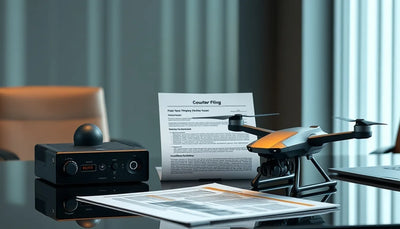
Apartment Defect Lawsuits Are Driving a Surge in Drone Inspection Work
A surge in apartment defect lawsuits is fueling demand for drone-based building inspections. This trend creates new revenue for service operators while reshaping what buyers should look for in a capable inspection drone. Pre-owned enterprise drones may offer a cost-efficient entry.

A wave of apartment defect litigation around the world is creating an unexpected revenue stream for drone service companies. Reports, including coverage from 조선일보, highlight how drone operators are cashing in on a surge in lawsuits over building construction flaws. Drones equipped with high-resolution cameras and accurate positioning systems can document cracks, water damage, insulation gaps, and structural misalignments far more efficiently than scaffolding-based inspections. This trend is not just a niche legal support service—it signals a structural shift in how the construction and real estate sectors use aerial data.
For commercial drone buyers, fleet operators, and even those in the pre-owned DJI market, this development carries practical implications. The demand for inspection flights opens up new contract opportunities, but it also raises the bar on the equipment required to perform credible, court-admissible work. Understanding how this lawsuit-driven market works can help operators make smarter purchasing, maintenance, and fleet upgrade decisions.
The rise of litigation-driven drone inspections
Apartment defect lawsuits have been on the rise in several markets, particularly in regions with dense high-rise living. According to the 조선일보 report, drone companies are increasingly contracted by law firms, homeowners’ associations, and construction firms to capture visual evidence of construction defects. These inspections need to be repeatable, geotagged, and date-stamped to hold up in legal proceedings. Unlike a quick real estate flyover, defect documentation demands precise flight paths, overlapping imagery, and often thermal or multispectral data to detect moisture or insulation failures.
Market context
Turn market news into a buy, repair, or trade-in decision.
Compare pre-owned availability, resale timing, and repair economics before the market moves again.

This is not a speculative trend—it is already generating revenue for drone service providers who can demonstrate reliability and data accuracy. For a fleet operator, entering this market requires drones that are stable in windy conditions near tall buildings and capable of hovering at precise altitudes. The work also tends to be recurring: once a lawsuit is filed, multiple inspections over months or years are common to track worsening defects.
For buyers looking at the second-hand market, this litigation-driven demand has an interesting side effect. Enterprise-grade drones that are frequently used for inspection—such as older models from DJI’s Matrice series—are being cycled out as service providers upgrade to newer sensors or redundancy features. That means more pre-owned DJI drones with high airframe hours may become available. But careful evaluation of flight logs, camera health, and gimbal condition is essential before purchasing a drone intended for legal evidence work.
What this means for drone buyers
If you are in the market for a drone to support litigation inspection work—or even if you are a general commercial operator who might pivot to this vertical—the key takeaway is that imaging quality and positioning accuracy matter more than raw flight time or speed. Buyers should prioritize models with mechanical shutters (for sharp images on moving targets), global shutter options for reduced rolling shutter distortion, and high-grade RTK or PPK modules for centimeter-level positioning. While the source does not name specific models, the operational need is clear: a drone that cannot consistently tag imagery with accurate coordinates will not serve in a legal context.
For those on a tighter budget, the pre-owned market offers a viable path. Many fleet operators upgrade their inspection drones every two to three years, putting well-maintained older models up for sale. When inspecting a used drone intended for defect documentation work, examine the gimbal for play, check the lens for scratches, and verify that the camera sensor is free of hot or dead pixels. A drone with factory-calibrated cameras and a clean maintenance history can perform just as well as a new unit for stationary facade photography.
Additionally, buyers should consider total cost of ownership. Frequent inspections near buildings expose drones to dust, debris, and occasional impacts. Professional DJI repair services become critical when gimbal ribbons or camera modules need replacement. It is wise to factor in the availability of OEM spare parts—especially for popular enterprise platforms—when choosing which pre-owned model to invest in.
Fleet planning and maintenance considerations
Operating a fleet dedicated to defect inspection requires planning beyond the initial purchase. Drones used for this work often fly close to structures, which increases the risk of collisions and prop wear. Fleet managers should rotate airframes to avoid overusing one unit, and they should maintain detailed logs of flight hours and maintenance. The surge in inspection contracts may strain repair turnaround times, making it sensible to keep a backup airframe or a pre-owned spare unit ready.
When a drone does need service, using genuine OEM parts is important for maintaining image quality and positioning accuracy. Aftermarket components can introduce calibration drift that undermines the legal defensibility of inspection data. For this reason, repair shops that specialize in professional DJI repair services using original parts are preferable. The upfront cost may be higher, but it preserves the evidentiary value of every inspection flight.
Another often-overlooked aspect is software and workflow. Defect inspection requires a photo-to-model pipeline that can deliver orthomosaics or 3D point clouds. Not all drones come with compatible software licenses, and upgrading could be expensive. When buying used, confirm that the drone works with the photogrammetry tools your operation relies on. Some DJI enterprise models bundle specific software that may not transfer with a second-hand purchase—so check licensing terms before committing.
The pre-owned DJI market and the inspection opportunity
Reboot Hub analysis: The growing demand for inspection drones is likely to increase turnover in the enterprise segment of the pre-owned market. Larger service providers often upgrade to newer models with redundant IMUs or improved obstacle avoidance, while smaller operators or new entrants can pick up capable platforms at a fraction of retail price. This mirrors what we have seen in the broader commercial drone space: as a vertical matures, the secondary market becomes richer with well-documented airframes.
However, buyers should be cautious. A drone that flew many inspection sorties near concrete structures may have accumulated micro-vibrations that affect imaging consistency. Requesting a test flight to compare images with a known baseline is a prudent step. Sellers who provide detailed flight logs and maintenance records command a premium for good reason. For anyone considering entering the inspection business, reading a drone trade-in guide can clarify how to evaluate an existing fleet and whether trading up makes financial sense.
It is also worth noting that the lawsuit-driven inspection boom may not be uniform geographically. Markets with dense apartment towers and active construction defect litigation—such as parts of Asia, the Middle East, and North America—appear to lead. Prospective buyers should research local demand before investing heavily in a dedicated inspection platform. The same drone that earns revenue in one city may sit idle in another.
Frequently asked questions
What types of drones are best for building defect inspections in lawsuits?
Drones with high-resolution cameras, mechanical shutters, and RTK or PPK GPS modules are preferred because they produce images with consistent geometry and precise geotagging. Enterprise platforms that allow payload swapping and provide stable hover near structures are ideal. The source does not name a specific model, but operationally these features are essential for evidence-grade data.
How can a drone operator break into the litigation inspection market?
Operators need to demonstrate reliability, repeatable flight patterns, and proper data handling. Building a portfolio of sample defect documentation, obtaining liability insurance, and networking with property lawyers and construction consultants are practical steps. Having a drone that logs all flight and camera parameters is a baseline requirement.
Is buying a pre-owned enterprise drone a smart choice for inspection work?
It can be, provided the drone’s camera and gimbal are in good condition, positioning modules are functional, and software licenses are transferable. Pre-owned units from operators who upgraded their fleets often offer good value. Always request flight logs and test the image quality before purchasing. A lower upfront cost can offset repair expenses later, but only if the drone was well-maintained.
تمت استشارة المصادر
- Chosun apartment defect drone evidence report - primary reporting source
- ASCE drone-based building defect recognition research - academic technical source
- ResearchGate housing defect classification reference - academic context source
تضيف افتتاحية Reboot Hub المشتري والإصلاح وإعادة البيع والتحليل التشغيلي لأصحاب الطائرات بدون طيار. إذا اكتشفت خطأ، فاتصل بنا لمراجعة التصحيح من خلال سياستنا التحريرية.