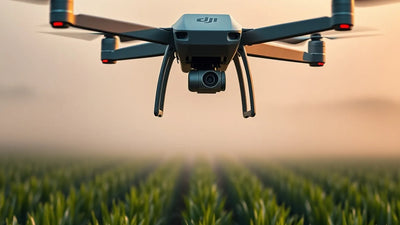
The DJI Security Theater: Why Your "Audited" Drone Is Still a National Security Risk
A deep-dive into DJI's Trust Center reveals a critical flaw: their vaunted security audits are time-boxed penetration tests, not continuous guarantees. For commercial operators flying Part 107 BVLOS routes over critical infrastructure, or surveyors using RTK mapping for government contracts, this distinction means accepting a point-in-time snapshot as a permanent security badge. The gap between marketing spin and technical reality could ground your fleet, void compliance, or open you to massive liability.

Redaktionella noter
- Denna artikel kombinerar namngiven extern rapportering med Reboot Hub egen analys för drönarköpare, flottoperatörer, reparationskunder och bevakare av begagnade DJI-marknaden.
- Källfakta är åtskilda från tolkning. Om en rapport tillhandahåller begränsad data, anges detta i artikeln och Reboot Hub perspektiv presenteras som en analys.
- Reboot Hub har kommersiella länkar till drönarprodukter och reparationstjänster; dessa länkar är resurser för läsaren och avgör inte artikelns slutsats.
On June 1, 2026, the commercial drone industry is facing a reckoning that has been brewing for years. A new analytical breakdown of DJI's vaunted "Trust Center" and its associated security audits has revealed a massive, uncomfortable gap between the marketing narrative and the technical reality. For years, DJI has pointed to a suite of security certifications and penetration tests as a shield against bans and a badge of honor for enterprise clients. But a closer look at the methodology behind these audits shows they are narrow, time-boxed pinhole snapshots-not the sweeping, continuous guarantees of national security that the marketing spin suggests.
This revelation arrives at a critical moment. The FAA is tightening Part 107 waivers for BVLOS operations over critical infrastructure. The Department of Defense is actively purging Chinese-made drones from its supply chain. And commercial operators-from utility inspectors to public safety agencies-are caught in the crossfire, trying to balance operational efficiency with regulatory compliance. The question is no longer "Is DJI secure?" but rather "What exactly does a DJI security audit actually prove?"
The Anatomy of a Point-in-Time Snapshot
The core of the issue lies in the definition of a security audit. According to the analysis of the DJI Trust Center, the company relies heavily on penetration tests (pen tests) conducted by third-party firms. These tests are typically scoped to a specific software version, a limited hardware configuration, and a defined time window-often just a few weeks. The result is a "certificate" that declares the system passed the test at that exact moment.
Enterprise procurement
Turn this market signal into a fleet requirement.
Discuss mission profile, quantities, configuration, delivery, and lifecycle support with Reboot Hub.
This is standard industry practice for product security. However, DJI's marketing leverages these point-in-time results as if they are a standing guarantee of national security. The distinction is critical. A pen test from 2024 that found no backdoors in the DJI Matrice 350 RTK's flight controller firmware does not account for the 17 firmware updates released since then. It does not account for the new exploits discovered in the wild. It does not account for supply chain attacks on components manufactured in the same facilities as consumer drones.
For a commercial operator flying a refurbishment-labeled DJI drone on a Part 107 BVLOS route over a power substation, relying on a two-year-old security audit is like trusting a single weather report from last summer to plan today's flight. The operational risk is massive.
The "Time-Boxed" Trap
The analysis highlights that these audits are "time-boxed." A penetration tester has a finite number of hours-often 40 to 80-to find vulnerabilities. They are incentivized to find the low-hanging fruit, not to conduct a deep, forensic analysis of the entire system. A sophisticated state-level actor, by contrast, has infinite time, resources, and access to the hardware. The gap between a 40-hour pen test and a nation-state's multi-year reverse engineering effort is not a gap; it's a chasm.
For the used drone market, this creates a perverse incentive. Older, unpatched models that passed a security audit years ago may be sold as "compliant" or "audited" on the secondary market, even though their firmware is now riddled with known exploits. Buyers must be hyper-vigilant.
What This Means for Commercial Operators and Public Safety
This is not just an academic debate. The real-world implications for drone pilots are severe. Agencies like the FAA and the Department of Homeland Security are increasingly requiring "continuous monitoring" and "supply chain transparency" as part of critical infrastructure waivers. A point-in-time audit does not satisfy these requirements.
Consider a public safety agency using a DJI M30T for search and rescue. The agency may have a letter from DJI stating the drone passed a security audit. However, if that audit was conducted before the drone was connected to a cellular network for live streaming, the entire threat model changes. The audit becomes irrelevant. The agency is now operating on a false sense of security.
For commercial surveyors using RTK mapping for government contracts, the stakes are equally high. A security audit that only tests the flight controller but ignores the RTK base station's data link is incomplete. A malicious actor could theoretically spoof the base station signal, injecting errors into the GSD (Ground Sample Distance) data, causing a multi-million dollar construction project to be built on inaccurate topography.
This analysis forces a fundamental question: What does [this event] mean for [the average commercial pilot]? It means you cannot simply trust a badge on a website. You must demand the raw audit report. You must understand the scope: What firmware version was tested? What network configuration? What data transmission protocols? If the scope doesn't match your operational environment, the audit is worthless.
Ready to Upgrade Your Fleet?
Browse our collection of inspected pre-owned DJI drones - inspected, flight-tested, and backed by a 6-month warranty. Save up to 40% versus retail.
The Marketing Spin vs. Technical Reality
The analysis accuses DJI of "systematically leveraging" these narrow audits to create a halo of security around their entire product line. The term "security audit" implies a comprehensive, holistic review. In reality, it is often a targeted test. DJI's Trust Center website lists certifications like "ISO 27001" and "SOC 2," which are information security management standards for an organization, not a specific drone model. A company can have an ISO 27001 certification for its internal data centers while the drone itself still has a critical vulnerability in its wireless communication stack.
This is the core of the marketing spin. DJI conflates organizational security with product security. A drone pilot does not care if DJI's internal HR database is secure; they care if the drone's telemetry can be intercepted mid-flight. The audits presented on the Trust Center often fail to address this specific, operationally relevant threat.
Furthermore, the analysis points out that the scope of these tests is often "narrow." A test might focus solely on the DJI Pilot 2 app running on an Android tablet, ignoring the drone's actual flight controller firmware or the data transmission protocol between the remote controller and the aircraft. This is like inspecting the lock on a front door while leaving the back door wide open.
Supply Chain and the Second-Hand Market
This revelation has a profound impact on the second-hand and refurbished drone market. As more commercial operators become aware of the limitations of these audits, the value of a drone with a "clean" audit trail will increase. Conversely, drones that are older or have been heavily modified will be seen as liabilities.
For the pilot looking to buy a used drone, the question shifts from "Does it have a security audit?" to "Which specific audit, on which firmware version, and is it still applicable?" This complexity creates a market advantage for sellers who can provide transparency. At Reboot Hub, we understand that compliance is a chain. Every link-from the flight controller to the battery-must be verified.
The secondary market is also where "zombie" drones live. Drones that passed a security audit in 2022 but are now running outdated firmware are being sold to unsuspecting small businesses. These businesses then fly these drones on BVLOS missions, assuming they are "compliant" because the listing said "audited." The analysis from the DJI Trust Center breakdown shows this assumption is dangerously flawed.
Navigating the New Compliance Landscape
So, what is a responsible operator to do? First, stop relying on marketing badges. Second, demand raw data. If you are flying a DJI Matrice 300 RTK on a critical infrastructure job, you need to know exactly what was tested and when. Third, consider the source. A security audit conducted by a firm with ties to the manufacturer is inherently less trustworthy than one conducted by an independent, government-accredited lab.
Finally, consider the hardware itself. The most secure drone is one that has been physically inspected and maintained. A drone that has been crashed and repaired with non-genuine parts is a security risk, regardless of what the software audit says. The physical integrity of the drone is the foundation upon which all software security is built.
For operators who need absolute confidence, the path forward involves a combination of rigorous software auditing and hardware verification. This is where professional DJI repair services become a critical part of the security chain. A drone that has been serviced by a certified technician, using genuine parts, and with a documented firmware history, provides a level of assurance that a point-in-time software audit simply cannot match.
The market is moving toward a "zero trust" model. Do not assume a drone is secure because of a sticker. Assume it is compromised until proven otherwise, and verify every component.
FAQ: The DJI Security Audit Reality Check
Does the DJI Trust Center guarantee my drone is safe from hackers?
No. The audits published on the DJI Trust Center are point-in-time snapshots. They do not guarantee safety against current or future exploits. They are a marketing tool, not a real-time security system. You must treat them as a starting point for your own risk assessment, not as a final guarantee.
Should I stop buying DJI drones for government contracts?
Not necessarily, but you must perform due diligence. Demand the full scope of the security audit for the specific model and firmware you intend to use. If the audit does not cover the data transmission protocols or network configurations you will use, it is insufficient. For high-security contracts, consider air-gapped operations or alternative hardware.
How can I verify the security of a used or refurbished DJI drone?
Request the full firmware update history and the original security audit report. Verify that the drone has been repaired with genuine parts by a certified service center. A drone with a broken tamper-evident seal or non-genuine components should be treated as a security risk. At Reboot Hub, every refurbishment-labeled DJI drone comes with a documented service history and a firmware audit trail.
--
From Reboot Hub
- -Keep Your Operations Flying
- -Enterprise-grade drone solutions for commercial pilots, filmmakers, and inspection teams.
- -Pre-owned Fleet
- - - -Fully inspected DJI drones with 6-month warranty. Save up to 40%.
- - - - Browse Inventory -> - - -Expert Repair
- - - -Professional diagnostics with genuine OEM parts. Same-day estimates.
- - - - Book a Repair -> - - -Spare Parts
- - - -Batteries, propellers, gimbals -- premium OEM components, fast shipping.
- - - - Shop Parts -> - - -