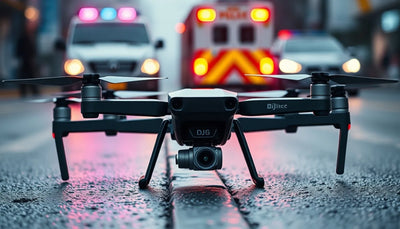
Jiangxi Nankang Expands Low-Altitude Economy Drone Applications
Jiangxi Nankang is broadening commercial drone applications as part of a regional low-altitude economy push tied to the 90th anniversary of the Long March victory. The development signals growing public-sector demand for drone services and infrastructure in inland China, with implications for fleet operators and repair supply chains.

Quick answer
Jiangxi Nankang is cultivating and expanding its low-altitude economy by broadening commercial drone application scenarios around the 90th anniversary of the Long March victory.
- The initiative is reported by Sina News as a regional low-altitude economy development in Jiangxi, China.
- It focuses on expanding real-world drone application scenarios rather than announcing a single product or regulation.
- The development points to growing public-sector and regional demand for commercial drone operations.
- For drone owners and fleet operators, it signals more service opportunities and support infrastructure in inland China.
Evidence: DJI ROMO official robot vacuum page · DJI Support ROMO beginner guide
Market context
Turn market news into a buy, repair, or trade-in decision.
Compare pre-owned availability, resale timing, and repair economics before the market moves again.

Jiangxi Nankang is working to cultivate and expand its low-altitude economy by broadening commercial drone application scenarios, according to a report published by Sina News. The development is framed around the 90th anniversary of the victory of the Long March, a regional milestone that local authorities are using to showcase practical drone use cases beyond demonstration flights.
The report does not specify individual drone models, manufacturers, or procurement figures. What it does indicate is a structured regional effort to move low-altitude activity from pilot projects into broader operational use. For commercial operators, buyers, and repair providers watching China's inland drone market, that shift matters because it points to where future demand for flight services, maintenance, and spare parts may concentrate.
What the Nankang low-altitude push signals
The Sina News report describes Nankang's effort as a deliberate cultivation of the low-altitude economy, with application scenarios being broadened rather than limited to a single use case. In China's policy language, the low-altitude economy typically spans logistics, agricultural monitoring, emergency response, inspection, mapping, and public service flights. The report does not confirm which specific scenarios Nankang is prioritizing, but the framing suggests a portfolio approach rather than a narrow pilot.
Reboot Hub analysis: regional governments in China have increasingly treated low-altitude infrastructure as an economic development tool, not just an aviation policy question. When a district like Nankang announces broader application scenarios, the practical consequence is usually more routine flight activity, more ground support requirements, and more pressure on local maintenance capacity. That is the kind of environment where spare parts availability and repair turnaround time become operational constraints rather than afterthoughts.
Why regional application expansion matters commercially
Reboot Hub analysis: A single district-level announcement may seem small, but the commercial signal is larger than the geography. Nankang is part of Ganzhou in Jiangxi province, an inland region where drone services can substitute for ground logistics and inspection labor across difficult terrain. The report's timing around the Long March anniversary suggests the applications are being tied to public events, historical site coverage, or regional promotion, but the underlying infrastructure push is likely to outlast any single commemoration.
For fleet operators and service providers, the key question is whether regional low-altitude programs generate repeatable work or one-off demonstration contracts. The Nankang report uses the phrase "cultivates and expands," which implies a sustained policy direction rather than a temporary event. Operators who already serve agricultural, logistics, or inspection clients in southern China should read this as a signal that inland districts are competing for low-altitude investment and may become more active buyers of drone services.
What this means for drone owners and the market
For individual drone owners and small commercial operators, the Nankang development is not an immediate product announcement, but it does affect how they should think about regional demand. Public-sector and quasi-public drone programs tend to create secondary markets for pre-owned DJI drones, OEM-pulled parts, and professional repair services, because operators running government-adjacent work often need backup aircraft and fast component replacement. The Drone Wiki offers context on how maintenance and parts decisions fit into broader market shifts like this one. For owners evaluating service and lifecycle risk, Drone Wiki explains the relevant repair, parts, resale, or operational path.
Buyers evaluating pre-owned DJI equipment should note that regional low-altitude programs in China rarely publish the exact models they deploy. That means the safest procurement assumption is not to chase a specific airframe, but to focus on condition, service history, and parts availability. A district expanding application scenarios will eventually need more batteries, more propellers, more gimbal repairs, and more airframes than a one-off demo program. That sustained demand is what supports resale value and repair economics over time.
Fleet managers should also consider the geographic pattern. Coastal drone hubs in Shenzhen and Guangzhou already have dense service networks. Inland districts like Nankang are newer to scaled drone operations, which means local repair capacity may lag demand. Operators who can plan maintenance intervals, hold critical spares, or work with repair providers that ship quickly will be better positioned than those who treat downtime as an afterthought.
What operators should watch next
The Nankang report is source-limited in detail, so operators should avoid overreading it as a confirmed procurement program. What can be watched is whether follow-up reporting names specific application scenarios, such as rural logistics routes, agricultural spraying contracts, or emergency response deployments. Each scenario has different equipment and maintenance implications.
For now, the practical takeaway is to treat regional low-altitude economy announcements as leading indicators of service demand. When a district says it is broadening application scenarios, the next step is usually operational deployment, and operational deployment is where repair, parts, and backup aircraft decisions get made. Operators who monitor these regional signals early can position their fleets and maintenance budgets before local demand tightens.
FAQ
Frequently asked questions
What is the low-altitude economy in China?
The low-altitude economy refers to commercial and public-service drone activity conducted at low altitudes, including logistics, inspection, agriculture, mapping, and emergency response. Chinese regional governments have been promoting it as an economic development sector.
Is Jiangxi Nankang buying specific drone models?
The Sina News report does not identify specific drone models or manufacturers. It describes a regional effort to broaden application scenarios, so procurement details remain unconfirmed.
Should drone owners change their buying or repair plans because of this news?
Not immediately. The development is a market signal rather than a product announcement. Operators serving or planning to serve inland China should monitor whether Nankang's application expansion leads to sustained service demand, which would support parts availability and repair economics.
Which sources support this update?
The visible evidence links identify DJI ROMO official robot vacuum page and DJI Support ROMO beginner guide; each source is used only for the claim it directly supports.
What remains subject to change?
Retail pricing, availability, product bundles and regulatory timelines can change. Readers should verify the latest terms with the named retailer, manufacturer or regulator before acting.
How should buyers or operators use this analysis?
Use the verified facts as a starting point, then compare mission fit, lifecycle support, maintenance needs and current procurement terms before making a purchase or fleet decision.
Konsulterade källor
- Source material - primary source
- DJI ROMO official robot vacuum page - official product page
- DJI Support ROMO beginner guide - official support guide
Reboot Hub Editorial tillför analys gällande köp, reparation, andrahandsvärde och drift för drönarägare. Om du upptäcker ett fel, kontakta oss för granskning av rättelse via vår redaktionella policy.