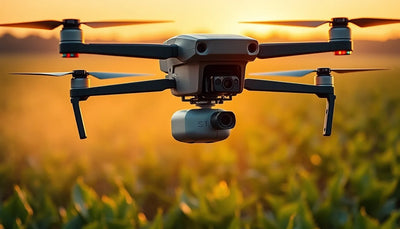
Can the U.S. match DJI drone capability? The cost hurdle remains
A new industry report from Sohu examines whether the United States can build a drone comparable to DJI's. The capability exists, but one structural cost obstacle remains difficult to overcome for commercial buyers and fleet operators.

Quick answer
A Sohu industry report concludes the United States has the technical capability to build a DJI-class drone, but faces one major cost hurdle that is very hard to overcome.
- The U.S. has the engineering capability to match DJI-class drone performance
- The central obstacle is a cost hurdle that remains difficult to overcome
- The report does not specify a timeline or specific U.S. manufacturer
- Commercial buyers should watch how this cost gap affects procurement and pre-owned DJI drone pricing
A new industry report from Sohu examines a question that has followed the commercial drone market for years: can the United States really build a drone like DJI's? The report's central conclusion is that the U.S. can, but there is one hurdle that is very difficult to overcome. That hurdle is not engineering capability or manufacturing know-how. It is cost.
DJI buying context
Match product news to hardware you can actually deploy.
Check inspected DJI aircraft, repair support, and trade-in timing before deciding whether to upgrade, repair, or wait.

The report, published through Sohu, frames the issue around the structural economics of drone production rather than a simple technology gap. For commercial operators, fleet managers, and procurement teams, that distinction matters. A drone that matches DJI's performance but costs significantly more to build and buy changes the entire calculation for businesses that depend on predictable hardware budgets and spare parts availability.
The capability exists, but the economics do not align
According to the Sohu report, the United States has the technical and manufacturing capacity to produce a drone comparable to DJI's. The report does not identify a specific U.S. manufacturer or model that has already achieved this, but it states plainly that the capability is there. The difficult hurdle is not whether American engineers can design the airframe, flight controller, camera gimbal, or transmission system. It is whether the resulting product can be built at a cost that makes sense in the commercial market.
This is a familiar pattern in hardware industries. A country can possess the talent, the components, and the assembly capacity to build a competitive product, yet still struggle to match the unit economics of an established high-volume producer. DJI has spent years building scale, supply chain density, and manufacturing efficiency. A new entrant, even a well-funded one, faces the challenge of replicating that cost structure without the same volume to spread fixed costs across.
Why the cost hurdle is hard to overcome
The Sohu report describes the cost obstacle as one that is very hard to overcome, not merely a temporary pricing disadvantage. That framing points to a structural issue rather than a short-term supply chain disruption. Commercial drone production involves precision components, sensor modules, battery systems, and software integration. Each of these carries cost, and each benefits from the kind of scale that DJI has accumulated over many product generations.
For fleet operators, this has direct consequences. If U.S.-built alternatives arrive at a higher price point, the total cost of ownership shifts. Procurement teams must weigh not only the initial purchase price but also the long-term availability of spare parts, repair service networks, and the resale value of the equipment. A higher-priced platform can still be viable if it delivers lower downtime or longer service life, but the Sohu report suggests the cost gap is not easily closed by design choices alone.
What this means for drone owners and the market
The Sohu report's conclusion reinforces why pre-owned DJI drones remain relevant in the commercial market. If U.S.-built alternatives face a persistent cost hurdle, then existing DJI hardware holds its value for operators who need capable equipment without paying a premium for a domestic alternative that may not yet exist at scale. Buyers who need to expand a fleet or replace a damaged unit often look at the total cost of ownership, and a pre-owned DJI platform can offer a practical middle path between new DJI pricing and the uncertainty of unproven alternatives.
For drone owners and fleet managers, the practical takeaway is to monitor how this cost gap evolves rather than assume a domestic DJI rival is imminent. The report does not announce a specific U.S. product launch, a government procurement program, or a regulatory mandate. It is an industry analysis of a structural economic problem. Operators should continue to plan around the hardware that is actually available today, including inspected pre-owned DJI drones and genuine OEM spare parts, while watching for signs that U.S. manufacturers are closing the cost gap. For readers evaluating repair, resale, or fleet expansion options, the Drone Wiki provides a useful reference for understanding how current DJI platforms fit into a broader ownership and maintenance strategy. For owners evaluating service and lifecycle risk, Drone Wiki explains the relevant repair, parts, resale, or operational path.
The pre-owned DJI market is particularly sensitive to this dynamic. If new domestic alternatives were to arrive at competitive prices, pre-owned DJI values could face downward pressure. But as long as the cost hurdle described in the Sohu report remains unresolved, the existing DJI ecosystem continues to offer a known quantity: proven performance, established repair channels, and predictable parts availability. That is a meaningful advantage for commercial operators who cannot afford to experiment with unproven hardware.
The broader commercial outlook
The Sohu report does not offer a timeline for when or whether the United States will overcome the cost hurdle. It frames the issue as a long-term structural challenge rather than a near-term engineering problem. That leaves commercial drone buyers in a familiar position: planning around the equipment that is available and supported today, while keeping an eye on how the domestic manufacturing landscape develops.
For repair customers and fleet managers, the report is a reminder that hardware decisions are rarely about capability alone. Cost, parts availability, service infrastructure, and resale value all shape the real-world economics of drone ownership. A drone that is technically impressive but expensive to buy and maintain can be less useful to a working operator than a proven platform with a mature support ecosystem. The Sohu report's central insight is that the United States can build the drone. The harder question is whether it can build it at a price the market will accept.
FAQ
Frequently asked questions
What is the main finding of the Sohu report?
The report concludes that the United States has the capability to build a drone comparable to DJI's, but faces one cost hurdle that is very hard to overcome.
Does the report name a specific U.S. drone manufacturer?
No. The Sohu report does not identify a specific U.S. manufacturer or model that has already matched DJI's capabilities. It discusses the issue at an industry level.
How should drone buyers respond to this analysis?
Buyers and fleet managers should continue planning around currently available and supported hardware, including pre-owned DJI drones and genuine OEM spare parts, while monitoring whether U.S. manufacturers can close the cost gap over time.
Which sources support this update?
The article distinguishes reported information from analysis and does not present an unverified source as official confirmation.
What remains subject to change?
Retail pricing, availability, product bundles and regulatory timelines can change. Readers should verify the latest terms with the named retailer, manufacturer or regulator before acting.
How should buyers or operators use this analysis?
Use the verified facts as a starting point, then compare mission fit, lifecycle support, maintenance needs and current procurement terms before making a purchase or fleet decision.
Konsulterade källor
- Sohu - primary source
Ytterligare officiell dokumentation var inte tillgänglig vid publiceringstillfället.
Reboot Hub Editorial tillför analys gällande köp, reparation, andrahandsvärde och drift för drönarägare. Om du upptäcker ett fel, kontakta oss för granskning av rättelse via vår redaktionella policy.