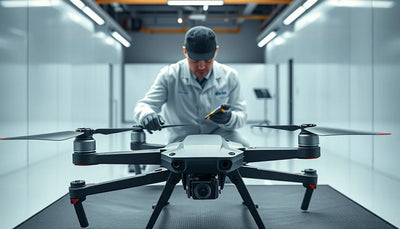
US Readies Tariffs Up to 100% on Imported Drones and Components
The United States is preparing tariffs of up to 100 percent on imported drones and components, a move that could reshape commercial procurement, repair costs, and the pre-owned DJI market for operators and fleet buyers.

Quick answer
The United States is preparing tariffs of up to 100 percent on imported drones and components, according to a Cailianshe morning report.
- The reported tariff ceiling applies to imported drones and drone components.
- US storage stocks strengthened collectively in the same reporting window.
- Crude oil and gold both declined in the reported session.
- The development may raise landed costs for new imported drone hardware and OEM parts.
Verified facts
Market context
Turn market news into a buy, repair, or trade-in decision.
Compare pre-owned availability, resale timing, and repair economics before the market moves again.

What the available evidence confirms
| Market signal | Reported direction |
|---|---|
| US imported drone and component tariffs | Up to 100% |
| US storage stocks | Strengthened collectively |
| Crude oil | Declined |
| Gold | Declined |
A morning report from Cailianshe, a Chinese financial news service, says the United States is preparing to impose tariffs of up to 100 percent on imported drones and drone components. The report frames the move as a market-moving development alongside a collective strengthening in US storage stocks and declines in both crude oil and gold.
For commercial drone buyers, fleet operators, and repair customers, the headline matters less as a political signal and more as a cost input. Tariffs at that ceiling would directly affect the landed price of imported airframes, batteries, gimbals, and OEM spare parts. The report does not specify timing, product categories, or country-of-origin exclusions, so the practical scope remains source-limited. What is clear is that procurement teams should begin modeling a higher-cost scenario for imported hardware.
The reported tariff signal and what it covers
According to the Cailianshe report, the United States will impose tariffs on imported drones and components at a rate of up to 100 percent. The phrase "up to" is important. It suggests a ceiling rather than a flat rate across every product category. Without a published tariff schedule, operators should treat the figure as a planning assumption rather than a confirmed line-item cost.
The same report notes that US storage stocks strengthened collectively during the session. That detail is relevant because storage and data infrastructure demand often tracks enterprise technology spending, including drone data pipelines. Crude oil and gold both declined, which the report presents as part of the same macro snapshot. Reboot Hub analysis would caution against reading too much into a single session, but the combination points to a market environment where trade policy and technology hardware are being repriced at the same time.
For commercial operators, the most concrete implication is straightforward: if imported drone components face a 100 percent tariff, repair economics change. A gimbal assembly, ESC module, or flight controller sourced from outside the US could become materially more expensive to replace. That shifts the calculation for fleet maintenance, warranty decisions, and the timing of spare parts purchases.
What this means for drone owners and the market
A 100 percent tariff on imported components would push repair and replacement costs higher for operators who depend on OEM parts sourced through international supply chains. Even if the final rate lands below the ceiling, any meaningful tariff creates a price floor that did not exist before. Fleet managers should review their parts inventory now, because the cost of waiting may exceed the cost of holding a modest buffer of high-wear components.
Reboot Hub analysis: The pre-owned DJI market is likely to feel this through two channels. First, higher new-unit prices make inspected pre-owned aircraft more attractive on a total-cost basis. Second, operators who delay fleet expansion may extend the service life of existing airframes, which increases demand for genuine OEM spare parts and professional repair. For buyers evaluating pristine pre-owned DJI drones or OEM-pulled parts, the tariff report is a reason to compare total landed cost rather than sticker price alone. Reboot Hub maintains a Drone Wiki that can help operators understand model-specific repair and maintenance considerations before making a purchase decision. For owners evaluating service and lifecycle risk, Drone Wiki explains the relevant repair, parts, resale, or operational path.
The report does not identify which drone manufacturers or component categories would be affected first. That uncertainty is itself a planning factor. Operators with mixed fleets should map their parts exposure by origin and lead time. If a critical component is imported and has no domestic substitute, the tariff risk is concentrated. If the same component is available as a tested OEM-pulled part, the effective cost may be lower even in a tariff environment.
Repair, spare parts, and the pre-owned DJI angle
Repair shops and self-maintaining fleets buy components continuously. A tariff shock on imported parts would compress margins for service providers and raise quotes for customers. The report does not provide a parts list, so Reboot Hub cannot say which specific DJI modules would be affected. However, the general principle holds: imported components are the most exposed category, and repair pricing tends to follow parts pricing with a short lag.
For pre-owned DJI aircraft, the tariff environment may support resale values. If new imported units become more expensive, the gap between new and pre-owned widens. That makes inspected pre-owned inventory more compelling for operators who need capability without absorbing the full tariff-adjusted price. It also makes professional repair more economically rational, because extending the life of an existing airframe becomes cheaper relative to replacement.
Operators should not assume that pre-owned inventory is insulated from tariffs. Pre-owned aircraft still require batteries, propellers, arms, and electronic modules over time. If those parts are imported, the cost of ownership rises even when the initial purchase price does not. The practical response is to evaluate the full lifecycle cost, including parts availability and repair lead time, before committing to any platform.
Market context and what operators should watch next
The Cailianshe report places the tariff news inside a broader market session where US storage stocks strengthened and crude oil and gold declined. For drone operators, the storage stock detail is a reminder that drone data increasingly flows into enterprise storage and cloud infrastructure. If storage equities are repricing upward, it may reflect expectations for continued data growth, including from commercial drone programs.
The declines in crude oil and gold do not have a direct mechanical effect on drone economics, but they do signal shifting risk appetite. Lower gold prices can indicate reduced demand for defensive assets, while lower crude prices can reduce logistics and energy costs across supply chains. Neither signal is strong enough on its own to change a fleet plan, but together they suggest a market that is repricing trade and technology exposure simultaneously.
For a buyer, pilot, repair customer, or fleet manager, the immediate action is to audit parts exposure and compare new versus pre-owned total cost under a higher-tariff scenario. If a planned purchase depends on imported components, it may be prudent to accelerate or defer based on inventory and budget. If the goal is to keep an existing fleet flying, securing genuine OEM spare parts and professional repair capacity before tariff-adjusted pricing takes hold is a reasonable step.
This article is market commentary for drone operators and buyers, not investment advice. Reboot Hub does not recommend securities transactions.
FAQ
Frequently asked questions
What exactly did the report say about drone tariffs?
The Cailianshe morning report said the United States will impose tariffs of up to 100 percent on imported drones and components. It did not specify a date, product list, or country exclusions.
How could these tariffs affect drone repair costs?
If imported components face higher tariffs, replacement parts such as gimbals, flight controllers, and electronic modules could become more expensive. Repair quotes tend to follow parts pricing, so operators may see higher service costs.
Should I buy a pre-owned DJI drone before tariffs take effect?
Higher new-unit prices can make inspected pre-owned DJI drones more attractive on total cost. However, pre-owned aircraft still need consumable parts, so buyers should evaluate full lifecycle cost rather than purchase price alone.
Which sources support this update?
The article distinguishes reported information from analysis and does not present an unverified source as official confirmation.
What remains subject to change?
Retail pricing, availability, product bundles and regulatory timelines can change. Readers should verify the latest terms with the named retailer, manufacturer or regulator before acting.
How should buyers or operators use this analysis?
Use the verified facts as a starting point, then compare mission fit, lifecycle support, maintenance needs and current procurement terms before making a purchase or fleet decision.
Использованные источники
- Source material - primary source
На момент публикации дополнительная официальная документация отсутствовала.
Редакция Reboot Hub предоставляет анализ по вопросам покупки, ремонта, перепродажи и эксплуатации БПЛА для их владельцев. Если вы заметили ошибку, свяжитесь с нами для ее исправления в соответствии с нашей редакционной политикой.