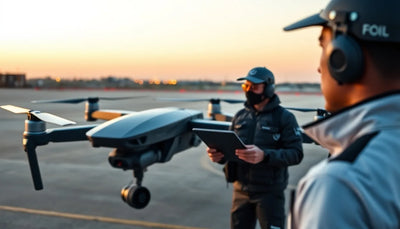
Taiwan's Drone Industry Faces Bottleneck as Low-Altitude Economy Stalls
Taiwan's drone sector is hitting a development bottleneck as the low-altitude economy struggles to gain traction, according to China Review. The report points to structural constraints that could delay commercial drone adoption, fleet expansion, and aftermarket service growth across the region.

Quick answer
China Review reports that Taiwan's drone industry has hit a development bottleneck while the low-altitude economy awaits a breakthrough.
- The report identifies structural constraints limiting Taiwan's commercial drone sector growth
- Low-altitude economy development remains stalled pending policy or market breakthroughs
- Commercial operators and fleet buyers may face delayed expansion or service uncertainty
Taiwan's drone industry has reached a development bottleneck, and the broader low-altitude economy is still waiting for a meaningful breakthrough, according to a report published by China Review. The analysis, authored by Zhang Yang, frames the situation as a structural slowdown rather than a short-term dip, with implications for manufacturers, commercial operators, and the service ecosystem that supports drone fleets.
Market context
Turn market news into a buy, repair, or trade-in decision.
Compare pre-owned availability, resale timing, and repair economics before the market moves again.

For drone buyers and fleet operators watching the Asia-Pacific market, the report matters because Taiwan has positioned itself as a potential hub for commercial UAV development and component supply. A prolonged bottleneck in that market could ripple through procurement timelines, parts availability, and the pace at which low-altitude logistics and inspection services scale up.
What the report says about Taiwan's drone sector
The China Review piece describes a drone industry that has lost forward momentum. Zhang Yang's assessment points to a mismatch between the sector's ambitions and the conditions needed to support sustained growth. The low-altitude economy, a term used to describe commercial drone operations in controlled airspace below traditional aviation corridors, has not yet produced the breakthrough that industry participants have been anticipating.
This is not framed as a single regulatory failure or a lack of technical capability. Instead, the report suggests a broader set of constraints that together are holding back progress. For commercial readers, that distinction matters: a bottleneck caused by multiple overlapping factors is harder to resolve quickly than a single policy change or a new product launch. Operators planning multi-year fleet investments should treat the Taiwan market's trajectory as uncertain rather than assuming a smooth expansion curve.
Reboot Hub analysis: the absence of a clear breakthrough timeline in the report suggests that drone service providers and parts suppliers with exposure to Taiwan should model conservative growth scenarios. The bottleneck language implies that even well-positioned companies may face slower order flows and delayed infrastructure buildout.
Low-altitude economy: why the breakthrough has not arrived
The concept of a low-altitude economy depends on more than drone hardware. It requires airspace management systems, ground infrastructure, clear operational rules, insurance frameworks, and enough commercial demand to justify fleet deployment. The China Review report indicates that these enabling layers have not matured in Taiwan at the pace needed to unlock large-scale operations.
For fleet managers, this is a familiar problem. A drone platform can be technically ready while the surrounding ecosystem remains incomplete. Delivery routes, beyond-visual-line-of-sight approvals, charging or landing infrastructure, and maintenance networks all need to align before a low-altitude economy becomes commercially viable. When any of these layers stalls, the entire market slows down, even if individual drone models perform well.
The report's framing suggests that Taiwan's drone sector is experiencing exactly this kind of ecosystem-level friction. Without a breakthrough in policy coordination or infrastructure investment, commercial operators may continue to run limited pilot programs rather than full-scale deployments. That has direct consequences for how buyers should think about fleet sizing, spare parts inventory, and repair capacity planning.
What this means for drone owners and the market
For drone owners, repair customers, and fleet operators, a stalled regional market is not an abstract policy story. It affects the practical economics of owning and operating commercial UAVs. When a market's growth slows, several things tend to happen: service providers consolidate, parts distribution becomes less predictable, and buyers become more cautious about committing to new platforms or large fleet expansions. For owners evaluating service and lifecycle risk, Drone Wiki explains the relevant repair, parts, resale, or operational path.
Operators who depend on a steady supply of genuine OEM spare parts should pay attention to how Taiwan's drone ecosystem evolves. Taiwan has been a meaningful player in electronics and precision manufacturing, and any prolonged slowdown in its drone sector could influence component availability or lead times for certain UAV systems. Buyers evaluating pre-owned DJI drones or planning professional DJI repair work should factor regional supply chain conditions into their decisions. For those researching maintenance options and parts sourcing, Reboot Hub's Drone Wiki provides reference material on drone ownership and repair considerations.
The most practical takeaway for a buyer or fleet manager is to avoid overcommitting to growth assumptions tied to a single regional market. If Taiwan's low-altitude economy remains bottlenecked, operators with exposure to that market should prioritize flexibility: shorter fleet commitments, diversified parts sourcing, and maintenance plans that do not depend on rapid local service expansion.
Broader signals for the commercial UAV sector
Taiwan's situation is worth watching because it reflects challenges that other markets are also navigating. The gap between drone technology readiness and commercial deployment readiness is a global issue, not a uniquely Taiwanese one. Airspace integration, regulatory clarity, and infrastructure investment are recurring constraints in many jurisdictions.
The China Review report does not provide specific data points on fleet counts, investment figures, or regulatory filings. That limits how precisely operators can quantify the slowdown. However, the qualitative signal is clear enough: the low-altitude economy in Taiwan is not yet delivering the commercial scale that industry participants expected, and the drone sector is feeling the strain.
For companies that buy, sell, or service commercial drones, this reinforces the value of conservative planning. Pre-owned equipment markets often become more attractive during periods of uncertainty, as operators look for inspected pre-owned options rather than committing to new fleet purchases. Repair and maintenance demand can also shift, with more operators extending the life of existing airframes instead of replacing them.
The report does not suggest that Taiwan's drone industry is collapsing. It describes a bottleneck, which implies constrained movement rather than a full stop. The question is how long the constraint lasts and whether the low-altitude economy can generate the breakthrough needed to relieve it. Until that happens, commercial operators should treat the market as range-bound and plan accordingly.
FAQ
Frequently asked questions
What is the main finding of the China Review report on Taiwan's drone industry?
The report, authored by Zhang Yang, states that Taiwan's drone industry has hit a development bottleneck and that the low-altitude economy is still waiting for a breakthrough. It describes structural constraints rather than a single isolated problem.
How could Taiwan's drone bottleneck affect commercial drone operators?
Operators with exposure to Taiwan or its component supply chain may face slower market growth, less predictable parts availability, and delayed expansion of low-altitude services. Fleet managers should plan conservatively and prioritize flexible sourcing and maintenance arrangements.
What should drone buyers do differently after reading this report?
Buyers should avoid assuming rapid growth in Taiwan's commercial drone market and consider inspected pre-owned equipment, diversified parts sourcing, and repair plans that do not depend on fast local service expansion.
Which sources support this update?
The article distinguishes reported information from analysis and does not present an unverified source as official confirmation.
What remains subject to change?
Retail pricing, availability, product bundles and regulatory timelines can change. Readers should verify the latest terms with the named retailer, manufacturer or regulator before acting.
How should buyers or operators use this analysis?
Use the verified facts as a starting point, then compare mission fit, lifecycle support, maintenance needs and current procurement terms before making a purchase or fleet decision.
Использованные источники
- Source material - primary source
На момент публикации дополнительная официальная документация отсутствовала.
Редакция Reboot Hub предоставляет анализ по вопросам покупки, ремонта, перепродажи и эксплуатации БПЛА для их владельцев. Если вы заметили ошибку, свяжитесь с нами для ее исправления в соответствии с нашей редакционной политикой.