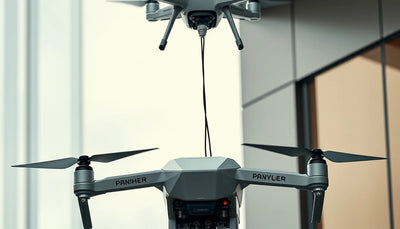
How Intrinsic's AI Robot Cell Could Simplify Drone Manufacturing and Repair
Alphabet’s Intrinsic unveiled an AI-powered Intelligence Cell that eliminates manual robot coding. For drone fleet operators and repair customers, this signals lower automation costs that could reshape manufacturing economies and repair pricing in the coming years.

Alphabet’s Intrinsic has introduced its "Intelligence Cell," an AI-driven system designed to automate factory tasks without requiring engineers to write complex robot code. Announced on The Robot Report, the system represents a shift toward making industrial robotics accessible to smaller manufacturers and service centers. For drone professionals—whether they operate fleets, repair platforms, or buy pre-owned equipment—this development matters because it quietly changes the cost structure of building and maintaining unmanned aircraft.
Industrial automation has traditionally demanded deep programming skills and lengthy integration time. Intrinsic’s Intelligence Cell aims to reduce those barriers by letting operators teach robots through demonstration and natural interaction, rather than scripting every motion. While the immediate application is in general manufacturing, the technology’s implications for the drone industry are worth examining today.
What Intrinsic’s Intelligence Cell Actually Does

The core promise of the Intelligence Cell is that it “eliminates manual robot coding.” According to The Robot Report, the system uses AI to understand tasks shown by a human operator and then replicates them autonomously. This is not a theoretical prototype; Intrinsic has already deployed the cell in real factory environments. The system handles tasks like picking, placing, and assembly—exactly the kind of repetitive precision work found in drone production lines and repair benches.
Market context
Turn market news into a buy, repair, or trade-in decision.
Compare pre-owned availability, resale timing, and repair economics before the market moves again.
Intrinsic, a subsidiary of Alphabet, has been developing its AI platform for years. The Intelligence Cell appears to be the first commercial-grade product to emerge from that effort. For drone manufacturers, this could mean lower entry costs for automated assembly. Instead of hiring a team of robot programmers to set up a production line for a new drone model, a small team of technicians could train the cell by showing it a few examples. The practical implication for fleet operators is that future drone prices may reflect cheaper manufacturing, especially for mid-range and high-volume models.
What this means for drone buyers

Drone buyers—whether they purchase new units or buy pre-owned DJI drones—should pay attention to the automation trend because it affects both pricing and product availability. If manufacturing becomes less expensive due to AI-driven robotics, manufacturers may pass some savings to customers. However, the effect is likely to be gradual and model-dependent. High-end enterprise drones with complex sensors and airframes may see smaller cost reductions because their production still involves specialized manual labor.
For buyers in the pre-owned market, a drop in new-drone prices would pressure resale values downward. That is not necessarily a bad thing: it could make pristine pre-owned units more affordable for operators who need multiple platforms for fleet work. The key is timing. If automation scales rapidly in 2027–2028, today’s premium pre-owned inventory might depreciate faster than historical trends suggest. Buyers should factor this into their purchasing decisions, perhaps opting for inspected pre-owned models that have already absorbed some depreciation rather than paying close to new prices.
There is also a quality angle. Automated assembly, when done well, can improve consistency and reduce defects. Fleet operators who rely on platforms built with AI-guided robots might experience lower failure rates in the field. That would reduce downtime and repair costs over the lifecycle of the aircraft.
How Automation Could Reshape the Repair Market

The repair sector stands to benefit just as much from Intrinsic’s Intelligence Cell as manufacturing does. Currently, professional DJI repair services rely on skilled technicians to disassemble, diagnose, and reassemble drones. Some of these steps are repetitive—soldering connectors, aligning camera modules, swapping motors. An AI-taught robot could handle those standardized tasks, freeing human technicians for complex troubleshooting and quality checks.
According to The Robot Report, Intrinsic’s system is designed for tasks that require precision and adaptability. In a repair context, a robot cell could be trained to replace a broken gimbal ribbon cable or reattach a landing gear leg after one demonstration. Over time, repair shops could deploy multiple cells to handle common failure modes across popular DJI models. That would lower labor costs per repair and reduce turnaround times. For fleet operators with dozens of drones, faster repairs mean less downtime and more revenue.
However, the transition will not happen overnight. Repair automation requires upfront investment in the cell itself, which Intrinsic likely prices for industrial customers, not small shops. But as the technology matures and possibly becomes available as a service, even medium-sized repair centers could adopt it. For customers, this could mean that a few years from now, professional repair services become more affordable and more consistent.
The implication for the pre-owned market is straightforward: cheaper repairs extend the economic life of a drone. A five-year-old platform that can be repaired for half the cost of a new unit becomes a more attractive buy. That dynamic could support demand for well-maintained, inspected pre-owned drones and reduce the landfill rate for repairable units.
Strategic Takeaways for Fleet Managers and Buyers

Fleet managers and individual buyers should treat Intrinsic’s Intelligence Cell as an early signal, not a disruption that demands immediate action. The technology needs time to diffuse across industries. But several tactical moves are worth considering now.
First, monitor announcements from drone manufacturers about their adoption of AI-driven robotics. Companies that invest in Intrinsic-like automation may gain cost advantages and quality improvements. When choosing between a new model from a manufacturer that uses manual assembly and one that uses AI-guided cells, the latter may offer better long-term value.
Second, before making a large fleet purchase, evaluate the total cost of ownership including potential repair costs. If automation is likely to reduce repair labor costs in the next two years, it may be more economical to buy a pre-owned fleet today and plan to repair it later, rather than buying new and facing steeper depreciation.
Third, consider the drone trade-in guide when upgrading. If automation drives new drone prices down, timing a trade-in to coincide with market adjustments could maximize the value of your current equipment. A careful buyer sells before the resale market softens, not after.
Finally, for operators who manage their own basic repairs, Intrinsic’s system points to a future where even small workshops can automate common tasks. While that future is not here today, it is worth planning for a shift in skill requirements. Technicians may need less robot programming knowledge and more teaching-and-oversight skills.
What is Intrinsic’s Intelligence Cell?
It is an AI-powered system from Alphabet’s Intrinsic subsidiary that automates factory tasks without requiring manual robot coding. The cell learns from human demonstration and replicates actions such as picking, placing, and assembly.
How could this affect drone repair costs?
If repair centers adopt similar automation, the labor cost for common repairs could drop. That would make drone repair more affordable and extend the useful life of existing aircraft, benefiting both fleet operators and buyers of pre-owned drones.
What should a drone buyer do differently because of this?
Stay informed about manufacturing automation trends. If new drones become cheaper to produce, resale prices may soften. Buyers may want to delay large new purchases or invest in inspected pre-owned models that already reflect lower depreciation expectations.