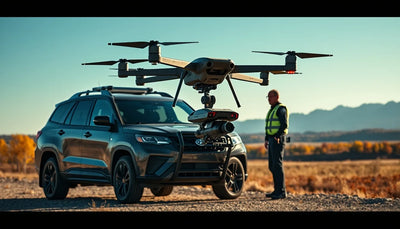
After 700 Drone Seizures, What the World Cup Really Proved About C-UAS
The FIFA World Cup saw 700 drone seizures, proving layered counter-drone security works at scale. For commercial operators and buyers, the next challenge is preventing incidents before they happen.

After months of preparation and more than 700 drone seizures across venues, the FIFA World Cup has provided the most concrete real-world proof yet that layered counter-drone security can function at scale. For commercial operators who watched from the sidelines, the tournament’s security outcome raises a pressing question: what happens to legitimate drone operations when enforcement becomes this sharp?
The DRONELIFE report confirms that agencies coordinated across dozens of venues and that local law enforcement was deeply involved in detecting, intercepting, and confiscating drones that entered restricted airspace. The volume of seizures—700 confirmed events—is unprecedented for a single multi-venue event. Yet the report also flags that the next challenge is no longer whether counter-drone technology works, but how to prevent unnecessary incidents before they happen.
The evidence of layered security
The World Cup security apparatus was not a single solution but a series of overlapping layers: radar detection, radio-frequency triangulation, optical tracking, and on‑the‑ground interdiction teams. Each venue had its own coordination cell, and the tournament’s centralized command structure allowed for rapid information sharing across cities. The result was a demonstrated capability to identify, track, and remove drones that posed a risk or violated temporary flight restrictions (TFRs).
Fleet readiness
Keep DJI hardware available without overbuying new units.
Use defense and fleet news as a planning signal for repair support, inspected pre-owned aircraft, and replacement timing.

For the commercial drone industry, the implication is clear. Future large‑scale events—Olympics, Super Bowls, political summits—will likely adopt similar layered models. That means operators flying near major events should expect consistent, real‑time enforcement rather than occasional, after‑the‑fact warnings. The 700 seizures were not random; they reflect a systematic application of airspace control that will only become more routine.
Fleet managers must now factor in the cost of potential confiscation and operational downtime near event zones. For those who fly mapping, inspection, or delivery missions in cities that host such events, the risk calculus has changed. The era of treating TFRs as polite suggestions is over.
Operational constraints for fleet operators
Fleet operators who rely on drones for time‑sensitive tasks—real‑estate surveys, construction progress monitoring, critical infrastructure inspection—need to adjust their planning. The World Cup demonstrated that no‑fly zones around venues can extend for miles and last for days. Even drones that are legally registered and compliant with Remote ID may still be subject to geofencing, manual interdiction, or seizure if they approach the boundary.
The report does not detail how many of the seized drones were operated by commercial pilots, but the volume suggests that at least some were likely unintentional incursions. Operators flying near event cities should check temporary airspace restrictions on a daily basis, ensure their drone’s firmware includes the latest geofencing data, and carry proof of registration and Part 107 (or equivalent) credentials at all times. For those who operate under a waiver or COA, direct coordination with local law enforcement or the FAA’s event office is now a best practice rather than an afterthought.
From a fleet lifecycle perspective, the financial impact of a single seizure can be significant—loss of the aircraft, missed mission deadlines, and potential legal fees. Operators who already rely on pre-owned DJI drones may find it more cost‑effective to purchase additional backup units rather than risk downtime during high‑stakes events. In that context, a well‑maintained, inspected pre‑owned drone offers a predictable cost structure and immediate availability.
What this means for drone buyers
Reboot Hub analysis: The World Cup security performance has ripple effects for anyone purchasing drones, especially in the pre‑owned market. Buyers are likely to become more discriminating about compliance features. Drones that lack Remote ID capability, updated geofencing logic, or traceable ownership history may command lower resale values. Conversely, well‑documented, firmware‑current pre‑owned units from responsible operators will hold their value better.
For buyers considering a pre‑owned DJI drone, the tournament proves that enforcement agencies are increasingly able to identify and seize non‑compliant aircraft. A drone with a clean registration history, updated firmware, and no prior geofencing violations is a lower‑risk asset. The secondary market may see a premium for units that come with proof of maintenance logs and software compliance.
Repair decisions also carry new weight. A drone that has been returned from a repair shop with non‑genuine parts or outdated firmware could become a liability if it triggers a geofence alert or fails Remote ID checks. Operators should insist on professional DJI repair services that use OEM-pulled parts to maintain the aircraft’s compliance profile. A repair that saves money in the short term but introduces firmware incompatibility can cost far more in a confiscation scenario.
The broader lesson for drone buyers is that the regulatory environment is hardening, not softening. Every dollar spent on a drone should include an assessment of how that aircraft will perform under increased scrutiny. Pre‑owned DJI drones that are pristine, fully updated, and traceable represent a smart procurement choice for operators who want to avoid surprises.
The next challenge: preventing unnecessary incidents before they happen
The DRONELIFE report suggests that the success of the World Cup security operation is not the end of the story. The next challenge agencies face is reducing the number of non‑malicious incursions—the pilot who did not check the NOTAM, the operator who ignored a geofence warning, or the hobbyist who assumed they would not be caught. Preventing such incidents before they happen requires better education, more intuitive airspace awareness tools, and perhaps automated authorization systems that allow legitimate commercial flights to proceed without manual intervention.
Reboot Hub analysis: For the commercial community, this is an opportunity to collaborate with regulators and security planners. Demonstrating that professional operators can self‑regulate and that their flights pose minimal risk could lead to streamlined, pre‑approved access during events. That would benefit everyone: fewer confiscations, less wasted enforcement resources, and more reliable mission completion for operators.
Fleet managers should consider participating in public‑private working groups or submitting feedback to the FAA on temporary flight restrictions. The World Cup proved that layered security can work. The next step is to make it work with the industry, not just against it.
How can drone operators prepare for events like the World Cup?
Check NOTAMs and TFRs daily before flying near event venues. Ensure your drone has the latest firmware and Remote ID compliance. Carry proof of registration and your pilot certificate. Consider coordinating directly with local law enforcement if you have an approved waiver or COA.
Does the 700 seizures figure mean drones are a security threat?
It shows that many drones entered restricted airspace, but not all were malicious. The majority were likely unaware or careless operators. The seizures prove that security systems are effective at detection and interdiction, but they also highlight the need for better pre‑flight education and automated authorization.
Should I upgrade my drone after this demonstration?
If your current drone lacks Remote ID, updated geofencing, or a clean compliance record, upgrading to a compliant, well‑maintained pre‑owned DJI drone is a prudent move. A drone trade-in guide can help you assess the value of your existing aircraft before purchasing a replacement. The cost of non-compliance could be far higher than the upgrade price.
Использованные источники
- FIFA World Cup Drone Security: What 700 Seizures Proved - DRONELIFE - primary source
- AeroVironment unmanned systems solutions - official company source
- FAA UAS official guidance - official regulator source
- DIU Blue UAS - official government source
Редакция Reboot Hub предоставляет анализ по вопросам покупки, ремонта, перепродажи и эксплуатации БПЛА для их владельцев. Если вы заметили ошибку, свяжитесь с нами для ее исправления в соответствии с нашей редакционной политикой.