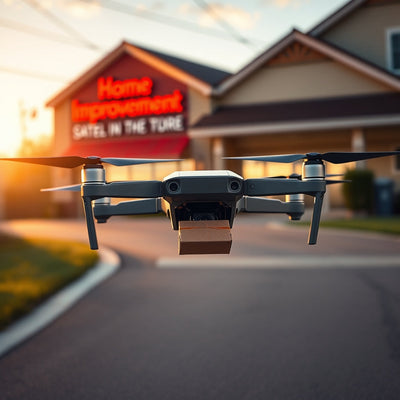
Matternet M3 targets daily drone delivery scale with new dock
Matternet has unveiled its M3 delivery drone and an automated dock, signaling a shift from pilot programs toward high-volume logistics. The move raises practical questions for fleet operators, maintenance planners, and anyone watching the commercial drone supply chain.

Quick answer
Matternet has announced the M3 delivery drone with an 11-pound payload and 10-mile range, paired with an automated dock designed to support high-volume daily operations.
- Matternet unveiled the M3 drone with an 11-pound payload and 10-mile range.
- The announcement includes an automated dock aimed at scaling beyond pilot programs.
- The system targets thousands of daily deliveries with reduced human involvement.
- Reporting comes from DroneDJ, with no independent manufacturer confirmation available.
Evidence: DroneDJ
Market context
Turn market news into a buy, repair, or trade-in decision.
Compare pre-owned availability, resale timing, and repair economics before the market moves again.

Verified facts
What the available evidence confirms
| Attribute | Matternet M3 (reported) |
|---|---|
| Payload | 11 pounds |
| Range | 10 miles |
| Automation focus | Automated dock for high-volume delivery |
| Source | DroneDJ primary reporting |
Drone delivery has spent years trying to answer a deceptively simple question: What happens when you want to move from a handful of pilot programs to thousands of deliveries every day? According to a report published by DroneDJ on September 28, 2026, Matternet believes the answer starts with taking people out of the loop. The company has reportedly unveiled a new M3 drone with an 11-pound payload and a 10-mile range, paired with an automated dock designed to support continuous, high-volume operations.
The announcement matters less for its headline specifications than for what it signals about the commercial drone sector's next phase. For years, delivery drone programs have been defined by constrained routes, manual battery swaps, and human supervisors standing by at every launch and landing. A system built around automated docking and reduced human intervention suggests the economics of drone logistics are being tested against a much harder benchmark: whether the technology can run reliably without a technician hovering nearby.
What the M3 announcement actually tells us
DroneDJ reports that the Matternet M3 is designed around an 11-pound payload capacity and a 10-mile operating range. Those figures place the aircraft in the middle of the commercial delivery segment, where the practical constraints are less about raw performance and more about duty cycles, maintenance intervals, and the cost of keeping aircraft in the air. The reported automated dock is the more significant part of the announcement, because it addresses the operational bottleneck that has limited most delivery programs to date: the need for a person to receive, secure, recharge, and relaunch each aircraft.
Matternet has not, based on the available reporting, published detailed specifications for the dock itself, its power requirements, or its maintenance schedule. Reboot Hub analysis should treat those operational details as unresolved until the company or a verified technical source releases them. What the announcement does establish is a clear directional signal: the company is positioning its hardware for repetitive, scheduled logistics rather than occasional demonstration flights.
Fleet economics and maintenance implications
For fleet operators and logistics buyers, the most important question is not whether the M3 can carry 11 pounds, but what happens to total cost per delivery when aircraft cycle through a dock without manual intervention. Automated ground infrastructure shifts the cost structure from labor-intensive handling toward capital-intensive hardware that must be maintained, inspected, and eventually repaired. Every dock becomes a small piece of fixed infrastructure with its own failure modes, wear items, and downtime risk.
That has direct implications for how commercial drone fleets are budgeted. A delivery network built around automated docks will need spare parts planning for ground equipment as well as aircraft. Operators who have spent years optimizing aircraft maintenance may find that dock actuators, charging contacts, and weather sealing become equally important to uptime. The reporting does not yet clarify Matternet's approach to service, parts availability, or third-party maintenance, but those questions will determine how quickly the system can scale beyond tightly controlled pilot environments.
What this means for drone owners and the market
The Matternet announcement is not directly about DJI hardware, but it lands in a commercial drone market where DJI remains the dominant platform for camera, inspection, and light enterprise work. When a well-funded delivery company pushes toward automated, high-volume operations, it validates the broader argument that commercial drones are moving from pilot projects to production logistics. That shift tends to raise expectations for reliability, serviceability, and parts availability across the entire sector, including the pre-owned market.
For individual drone buyers and small fleet operators, the practical takeaway is that the commercial market is bifurcating. High-volume delivery systems like the reported Matternet M3 are engineered around infrastructure, automation, and fleet-level economics. Most independent operators, by contrast, still buy aircraft for inspection, mapping, or media work where payload flexibility and camera quality matter more than dock compatibility. Those buyers should watch how the delivery segment matures, because the supply chains, repair networks, and component standards that emerge from high-volume logistics often influence the broader parts ecosystem. For operators managing pre-owned DJI fleets, the relevant question is simpler: does your maintenance and repair strategy keep aircraft in service long enough to justify their capital cost? Resources like the Drone Wiki can help owners understand the service and parts landscape as commercial expectations rise. For owners evaluating service and lifecycle risk, Drone Wiki explains the relevant repair, parts, resale, or operational path.
There is also a resale angle. If automated delivery proves commercially viable, enterprise buyers may shift procurement toward purpose-built logistics aircraft rather than adapting general-purpose platforms. That could soften demand for some enterprise-class DJI models in logistics roles while strengthening demand for inspection and mapping platforms that remain outside the delivery niche. The pre-owned market tends to reflect those shifts with a lag, but fleet managers who track enterprise procurement patterns early can make better decisions about when to hold, service, or rotate aircraft.
What operators should watch next
The Matternet M3 announcement, as reported by DroneDJ, leaves several commercial questions unanswered. There is no verified information yet on pricing, availability, regulatory approvals, or the geographic markets where the system will first operate. Those details will determine whether the M3 becomes a meaningful logistics platform or another well-engineered system waiting for a regulatory and economic window that has not fully opened.
Operators and buyers should watch for three signals. First, any announcement of a commercial deployment partner or a named logistics customer would suggest the system has moved beyond demonstration. Second, published maintenance intervals or service documentation would reveal how Matternet expects the dock and aircraft to be supported in the field. Third, any regulatory milestone, such as beyond-visual-line-of-sight approval or type certification progress, would indicate whether the system can operate at the scale the company appears to be targeting.
For now, the M3 is best understood as a statement of intent. Matternet is betting that the next phase of drone delivery will be won by companies that solve the ground-side automation problem, not just the aircraft performance problem. That is a useful signal for anyone planning a commercial drone budget, whether they are buying a single inspection aircraft or managing a multi-aircraft fleet.
FAQ
Frequently asked questions
What did Matternet announce?
According to DroneDJ, Matternet unveiled the M3 delivery drone with an 11-pound payload and a 10-mile range, along with an automated dock intended to support high-volume daily delivery operations.
Is the Matternet M3 available for purchase?
The available reporting does not include pricing, availability, or confirmed launch markets. Buyers should treat the announcement as a product reveal rather than a commercially available system until Matternet publishes procurement details.
How does this affect pre-owned DJI drone owners?
The announcement does not directly change DJI hardware values, but it reinforces the commercial market's shift toward automation and fleet-level economics. Pre-owned DJI owners should focus on maintenance and parts planning to keep aircraft competitive as enterprise expectations rise.
Which sources support this update?
The visible evidence links identify DroneDJ; each source is used only for the claim it directly supports.
What remains subject to change?
Retail pricing, availability, product bundles and regulatory timelines can change. Readers should verify the latest terms with the named retailer, manufacturer or regulator before acting.
How should buyers or operators use this analysis?
Use the verified facts as a starting point, then compare mission fit, lifecycle support, maintenance needs and current procurement terms before making a purchase or fleet decision.
Fontes consultadas
- DroneDJ - primary source
Não estava disponível documentação oficial adicional no momento da publicação.
O Editorial Reboot Hub acrescenta análises de compra, reparação, revenda e operacionais para proprietários de drones. Se detetar um erro, contacte-nos para a revisão da correção através da nossa política editorial.