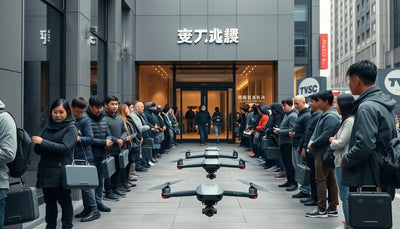
2026 China Simulated Drone Racing Series Opens in Shenzhen Nanshan
The 2026 China Simulated Drone Racing Series launched its national first stop in Shenzhen's Nanshan district, signaling growing commercial interest in simulation training and competitive drone skill development across China's operator ecosystem.

Quick answer
The 2026 China Simulated Drone Racing Series held its national first stop in Shenzhen's Nanshan district, as reported by Sohu.
- The event marks the opening round of a national simulated drone racing series in China.
- Shenzhen's Nanshan district hosted the first stop of the 2026 season.
- The development highlights growing commercial and competitive interest in drone simulation training.
The 2026 China Simulated Drone Racing Series has officially taken off, with its national first stop held in Shenzhen's Nanshan district. According to a report published by Sohu, the Shenzhen stop marks the opening round of a broader national competition circuit focused on simulated drone racing, a discipline that has been gaining traction among Chinese drone enthusiasts, training academies, and commercial operators looking to sharpen flight skills without the cost and risk of physical aircraft.
Market context
Turn market news into a buy, repair, or trade-in decision.
Compare pre-owned availability, resale timing, and repair economics before the market moves again.

For the commercial drone sector, the event matters less as a spectator sport and more as a signal of where operator training and skill verification may be heading. Simulated racing environments allow pilots to practice high-speed maneuvering, obstacle navigation, and precision control in a repeatable, low-cost setting. As fleet operators and service providers face pressure to reduce training downtime and equipment damage, simulation-based skill development is becoming a practical operational tool rather than a niche hobby.
What the Shenzhen event signals about simulation training
Sohu's coverage identifies the Shenzhen stop as the national first stop of the 2026 series, which suggests a structured, multi-city calendar rather than a one-off local competition. The choice of Nanshan as the opening venue is notable from a commercial standpoint. Nanshan is a technology and innovation hub within Shenzhen, home to a dense cluster of hardware, software, and robotics companies. Hosting a simulated drone racing event there places the activity close to the industrial ecosystem that develops the underlying simulation platforms, flight controllers, and training curricula.
From a Reboot Hub analysis perspective, the event reflects a broader shift toward software-first drone training. Physical flight hours remain essential, but simulation reduces the cost of early-stage skill acquisition and allows operators to rehearse high-risk scenarios without exposing airframes to damage. For repair-conscious fleet managers, this has a direct implication: fewer training-related crashes can mean fewer component replacements and lower maintenance overhead over the life of a fleet.
Commercial relevance for training, fleets, and service providers
The simulated racing format emphasizes speed, obstacle avoidance, and control precision under time pressure. Those are not purely recreational skills. Commercial pilots operating in confined inspection environments, dense urban corridors, or emergency response scenarios benefit from the same muscle memory and decision-making speed that competitive simulation builds. The existence of a national series suggests that simulation is being formalized as a competitive and potentially credentialing pathway in China's drone ecosystem.
For drone service companies, the development points to a possible evolution in how pilot proficiency is demonstrated. If simulated racing competitions become a recognized benchmark, hiring managers and procurement officers may begin to treat strong simulation performance as one signal of operator capability. That would be a meaningful shift from today's reliance on logged flight hours and basic certification alone. The Shenzhen event is one data point, but it aligns with a pattern of growing investment in structured, repeatable training infrastructure across the Chinese drone market.
What this means for drone owners and the market
For individual drone owners and small commercial operators, the rise of simulated racing and simulation-based training carries a practical lesson: skill development does not have to begin with expensive hardware or high-risk physical flights. Pilots who invest time in simulation before flying physical aircraft tend to make fewer early mistakes, which reduces crash frequency and the associated repair burden. That is especially relevant for operators of pre-owned DJI drones, where keeping the aircraft in good condition protects resale value and extends the interval between major component replacements. For buyers evaluating the second-hand market, a drone that has been flown by a simulation-trained pilot may present differently than one used for unstructured trial-and-error learning. For readers tracking the broader commercial drone landscape, the Drone Wiki offers additional context on how training practices, repair economics, and equipment choices intersect. For owners evaluating service and lifecycle risk, Drone Wiki explains the relevant repair, parts, resale, or operational path.
The Shenzhen event also reinforces the commercial logic of simulation as a cost-control mechanism. Every avoided crash is a avoided repair bill, a avoided part order, and a avoided day of aircraft downtime. For fleet operators managing multiple airframes, the compounding effect of simulation-based training can be substantial. While the Sohu report does not provide participation figures or sponsorship details, the existence of a national series itself indicates that organizers and backers see enough demand to support a multi-stop calendar.
What to watch next in China's drone training market
The 2026 China Simulated Drone Racing Series is worth monitoring as a leading indicator of how simulation technology is being commercialized beyond entertainment. If subsequent stops draw consistent participation and attract partnerships with hardware manufacturers or training institutions, it would strengthen the case that simulation is becoming a standard layer in China's drone operator pipeline. For international observers, China's approach to simulation-based skill development may offer a preview of practices that eventually spread to other major drone markets.
Buyers, pilots, and fleet managers should treat this news as a prompt to evaluate their own training workflows. If simulation is not yet part of the onboarding or recurrent training process, the Shenzhen event suggests that the gap between simulation-first operators and traditional training approaches may widen over the coming season. The commercial advantage will likely accrue to operators who can develop pilot skill faster, at lower cost, and with fewer equipment losses along the way.
FAQ
Frequently asked questions
What is the 2026 China Simulated Drone Racing Series?
It is a national simulated drone racing competition series in China. The 2026 season opened with its first stop in Shenzhen's Nanshan district, as reported by Sohu.
Why does simulated drone racing matter for commercial drone operators?
Simulation training builds high-speed control and obstacle avoidance skills without risking physical aircraft. This can reduce training-related crashes, lower repair costs, and shorten the learning curve for new pilots.
Should drone buyers or fleet managers change anything after this news?
Fleet managers and individual pilots should consider adding simulation to their training workflow. Operators who train in simulation environments may experience fewer early mistakes, which helps protect aircraft condition and resale value over time.
Which sources support this update?
The article distinguishes reported information from analysis and does not present an unverified source as official confirmation.
What remains subject to change?
Retail pricing, availability, product bundles and regulatory timelines can change. Readers should verify the latest terms with the named retailer, manufacturer or regulator before acting.
How should buyers or operators use this analysis?
Use the verified facts as a starting point, then compare mission fit, lifecycle support, maintenance needs and current procurement terms before making a purchase or fleet decision.
Fontes consultadas
- Sohu - primary source
Não estava disponível documentação oficial adicional no momento da publicação.
O Editorial Reboot Hub acrescenta análises de compra, reparação, revenda e operacionais para proprietários de drones. Se detetar um erro, contacte-nos para a revisão da correção através da nossa política editorial.