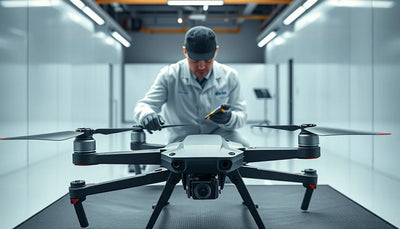
Wudi Drone Production Runs Through Holiday to Meet Order Backlog
A Shandong low-altitude economy hub kept drone production running through China's National Day holiday to clear order backlogs. The report signals sustained commercial UAV demand and tighter delivery timelines that fleet buyers and repair customers should watch closely.

Quick answer
Drone production in Wudi continued without pause during China's National Day holiday as the local low-altitude economy sector raced to fulfill existing orders, according to Qilu Network.
- Production lines remained active during the National Day holiday period
- The Wudi low-altitude economy sector is working through an order backlog
- The report points to sustained commercial UAV demand in the region
- Buyers and fleet operators should monitor delivery timelines
Drone production in Wudi did not stop for China's National Day holiday. According to a report from Qilu Network, the county's low-altitude economy sector kept manufacturing lines running through the holiday period as teams worked to fulfill an existing order backlog. The reporting, which Reboot Hub is treating as source-limited because no independent verification was available at the time of publication, points to a commercial UAV supply chain under active delivery pressure.
Market context
Turn market news into a buy, repair, or trade-in decision.
Compare pre-owned availability, resale timing, and repair economics before the market moves again.

The development matters beyond Wudi. When a regional production hub sacrifices holiday downtime to clear orders, it usually reflects two things: demand is outpacing normal capacity, and buyers downstream are waiting on hardware. For commercial operators, procurement teams, and repair customers who depend on predictable parts availability, that combination deserves attention.
What the Wudi report actually says
Qilu Network's reporting describes production continuing without pause during the National Day holiday, with the Wudi low-altitude economy sector described as racing to fulfill orders. The report does not specify which manufacturers were involved, what airframe categories were being produced, or how many units were in the backlog. Reboot Hub is not adding those operational details because they are not present in the source material.
What the report does establish is a clear signal: the local low-altitude economy cluster in Wudi is operating at a pace that required holiday production continuity. In commercial UAV markets, that kind of sustained output typically indicates either a surge in new orders, a compressed delivery schedule, or both. The practical implication for buyers is straightforward: regional production capacity is not sitting idle, and lead times may be under more pressure than standard seasonal planning would suggest.
Why holiday production signals matter in commercial UAV markets
Holiday production decisions are rarely casual. In China's manufacturing ecosystem, National Day is a major pause point for logistics, component supply, and labor. A facility that keeps lines running through that window is making a deliberate trade-off: higher labor costs and disrupted component flows in exchange for faster order completion.
For commercial drone buyers, that trade-off is informative. It suggests that the companies behind the Wudi production push believe the cost of delayed delivery is higher than the cost of holiday operations. That kind of calculation usually traces back to customer contracts, delivery commitments, or competitive pressure to capture market share while demand is active. Reboot Hub analysis, based on the limited source data, reads this as a demand-side signal rather than a routine production note.
What this means for drone owners and the market
The most immediate consequence for operators is lead time uncertainty. If a regional production cluster is running through a major holiday to clear backlog, buyers placing new orders should not assume standard delivery windows will hold. Fleet managers planning seasonal expansions or replacements may want to build additional buffer into procurement timelines, especially for airframes or components sourced from the same regional supply chain. For repair customers, the same logic applies: if manufacturing capacity is stretched, OEM-pulled parts and genuine OEM spare parts may face longer restocking cycles, and repair scheduling should account for that.
There is also a secondary market angle. When new-unit supply tightens, demand often shifts toward inspected pre-owned DJI drones as a faster path to operational readiness. Buyers who need airframes immediately may find that the pre-owned market offers more predictable availability than waiting on backordered new production. For operators weighing that decision, the Drone Wiki provides a useful reference point for understanding how pre-owned DJI hardware fits into fleet planning and repair decisions. For owners evaluating service and lifecycle risk, Drone Wiki explains the relevant repair, parts, resale, or operational path.
The Wudi report does not name DJI or any specific manufacturer, so Reboot Hub is not drawing a direct line between this production surge and DJI inventory. However, the broader commercial UAV supply chain in China is interconnected, and sustained production pressure in one low-altitude economy hub can ripple through component availability, logistics capacity, and regional pricing. Operators should treat this as an early indicator rather than a confirmed supply disruption.
What buyers and fleet managers should watch next
The source report is a single data point, not a trend. Reboot Hub would want to see follow-up reporting on whether Wudi production remains elevated after the holiday, whether specific manufacturers acknowledge extended lead times, and whether component suppliers in the region report similar pressure. Those follow-on signals would help confirm whether this is a localized backlog or a broader demand shift.
In the meantime, the operator-facing takeaway is simple: do not assume holiday calendars reset production capacity to normal. If you are planning a fleet purchase, a repair parts order, or a pre-owned acquisition in the coming quarter, build in extra time and confirm delivery commitments in writing. The Wudi report is a reminder that commercial UAV supply chains are still adjusting to demand patterns that do not always respect traditional production schedules.
FAQ
Frequently asked questions
What happened in Wudi during the National Day holiday?
According to Qilu Network, drone production in Wudi continued without pause during China's National Day holiday as the local low-altitude economy sector worked to fulfill existing orders.
Does this affect DJI drone availability?
The source report does not name DJI or any specific manufacturer. Reboot Hub is not drawing a direct link to DJI inventory, but sustained production pressure in a Chinese low-altitude economy hub could ripple through component and logistics capacity.
What should fleet buyers do after reading this report?
Fleet buyers should build additional buffer into procurement timelines and confirm delivery commitments in writing. If new-unit supply tightens, inspected pre-owned DJI drones may offer a faster path to operational readiness.
Which sources support this update?
The article distinguishes reported information from analysis and does not present an unverified source as official confirmation.
What remains subject to change?
Retail pricing, availability, product bundles and regulatory timelines can change. Readers should verify the latest terms with the named retailer, manufacturer or regulator before acting.
How should buyers or operators use this analysis?
Use the verified facts as a starting point, then compare mission fit, lifecycle support, maintenance needs and current procurement terms before making a purchase or fleet decision.
Sources consulted
- Source material - primary source
Additional official documentation was not available at publication time.
Reboot Hub Editorial adds buyer, repair, resale, and operational analysis for drone owners. If you spot an error, contact us for correction review through our editorial policy.