Navy’s Corsair Drone Boat Rescues Apache Crew – What It Means for Uncrewed Maritime Ops
A U.S. Navy Corsair uncrewed surface vessel just performed the first known combat search-and-rescue by a drone boat, plucking two downed Apache pilots from the Gulf of Oman. For commercial UAV operators, this breakthrough signals a new era of autonomous maritime surveillance, extending BVLOS rescue capabilities and challenging existing Part 107 waivers for over-water operations. Reboot Hub analyzes the multi-million-dollar implications for coastal drone service providers, SAR contractors, and the second-hand fleet market.

Editorial notes
- This article combines named outside reporting with Reboot Hub's own analysis for drone buyers, fleet operators, repair customers, and pre-owned DJI market watchers.
- Source facts are separated from interpretation. When a report provides limited data, the article states that limitation and frames Reboot Hub's view as analysis.
- Reboot Hub has commercial links to drone products and repair services; those links are reader resources and do not determine the article's conclusion.
On June 9, 2026, the U.S. Navy confirmed that a Corsair uncrewed surface vessel (USV) operating under the Task Force 59 umbrella successfully retrieved two downed AH-64 Apache helicopter aircrew from the Gulf of Oman. The event marks the first recorded combat search-and-rescue (CSAR) mission executed entirely by a drone boat. For the global uncrewed systems industry—especially those watching the commercial and second-hand drone markets—this operation is far more than a military headline. It is a validation of autonomous maritime platforms that could reshape coastal surveillance, oil-and-gas asset security, and even commercial SAR operations.

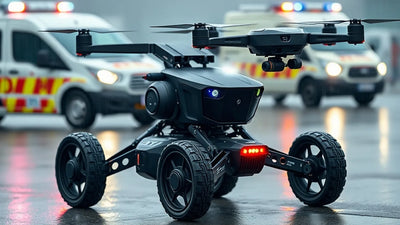
Task Force 59, the Navy's premier drone experimentation unit in the Middle East, began operational testing of the Corsair USV only three months ago. Built by the small defense firm Corsair USV LLC, the vessel is a 35-foot aluminum-hulled craft capable of speeds up to 35 knots and a 72-hour endurance. Its modular payload bay can carry electro-optical/infrared (EO/IR) cameras, radar, and even small recovery baskets. In this case, the Corsair reportedly located the pilots using onboard thermal sensors and then deployed a retrieval arm to hoist them aboard before rendezvousing with a manned support ship. The timeline from alert to extraction: under 40 minutes.
The Corsair USV: From Experimental Platform to Proven Asset
The Corsair’s rescue success sends a clear signal to the commercial sector: autonomous surface vessels have crossed the threshold from R&D curiosity to operationally reliable tools. For drone service providers operating under FAA Part 107 or similar international frameworks, the relevance is immediate. Maritime BVLOS (Beyond Visual Line of Sight) waivers have been the holy grail for offshore inspection companies, port security operators, and oil-spill monitoring firms. Military validation of a fully autonomous maritime drone performing time-critical decision-making on its own—without constant human teleoperation—pushes the regulatory needle.
Enterprise procurement
Turn this market signal into a fleet requirement.
Discuss mission profile, quantities, configuration, delivery, and lifecycle support with Reboot Hub.
“The Corsair demonstrated mission-level autonomy that far exceeds what most commercial USV platforms offer today,” says Dr. Helena Kwon, a former Naval Drone Program analyst now advising Reboot Hub’s defense-commercial transition desk. “The ability to conduct autonomous target recognition, path planning, and recovery of personnel in a contested maritime environment directly translates to commercial use cases like man-overboard response, infrastructure inspection, and environmental monitoring. The underlying AI and sensor fusion are identical.”
Commercial drone operators working in coastal areas, near offshore wind farms, or on large container ships will be watching how the Navy’s experience informs future FAA waivers for uncrewed maritime operations. The Corsair rescue provides concrete data on sensor reliability, communication latency management, and safe autonomous retrieval—all of which can be cited in waiver applications.
What This Rescue Means for the Commercial UAV Sector
For the drone service provider flying a DJI Matrice 300 or Autel EVO Max off a boat, the immediate takeaway is this: the market for maritime drone services is about to explode. Insurance companies, offshore energy operators, and search-and-rescue agencies will demand autonomous surface vehicles to supplement or replace manned boats. And that demand will cascade into the used equipment market.
As military USVs prove themselves in combat, surplus uncrewed systems will trickle down to the civilian sector—just as we saw with small quadcopters like the Raven and Puma after the Iraq war. While the Corsair itself is unlikely to appear on Reboot Hub anytime soon, the technology transfer will accelerate: more rugged sensors, better power management, and hardened communication links will soon appear in commercial offerings from the likes of SeaTrac, Saildrone, and L3Harris. For the commercial operator who needs a reliable, tested maritime drone, the secondary market will benefit from a flood of excess military gear and part-out components.
Ready to Upgrade Your Fleet?
Browse our collection of inspected pre-owned DJI drones — inspected, flight-tested, and backed by a 6-month warranty. Save up to 40% versus retail.
Technological Crossovers: From Military USVs to Commercial Drones
The Corsair’s technical architecture offers several direct crossovers to the commercial drone world. Its autonomy stack relies on a combination of GPS-denied navigation (using visual-inertial odometry and Doppler velocity log), thermal imaging for object detection, and a fail-safe recovery sequence that can operate without a constant satellite link. For a commercial operator flying a DJI Matrice 350 RTK over a dam wall or a port, those same technologies are now being validated at the extreme end of reliability.
BVLOS waivers for maritime operations have historically been difficult to obtain because of the risk of losing link and crashing into a ship or person at sea. The Corsair rescue demonstrates that a USV can autonomously loiter, identify a target, and execute a precise retrieval even in a high-clutter environment (floating debris, wave shadows, helicopter wreckage). That data will be gold for companies like Skydio, Autel, and DJI as they push their own BVLOS safety cases. Already, the FAA has cited several Navy test flights in its recent BVLOS rulemaking—and the Corsair operation will likely be referenced in future advisory circulars.
For drone repair and refurbishment shops like Reboot Hub, this development means increased demand for parts that match the military-grade durability now expected in commercial drones. Corrosion-resistant components, redundant motor drives, and advanced thermal management systems will become standard. Operators will want to retrofit their existing fleet with upgraded modules—and that’s where pre-owned DJI drones offer a cost-effective path to high performance without buying new.
Market Implications and Readiness for Drone Operators
Every drone operator should ask: how does the Corsair rescue affect my business? For maritime drone service providers, the window is opening fast. Coastal surveillance contracts worth $10–50 million annually are being rewritten to include autonomous USVs alongside aerial drones. The Navy demonstrated that a USV can respond faster and more reliably than a manned boat in certain scenarios—closing a key sales argument for commercial vendors. For aerial drone pilots flying shoreline surveys with a Mavic 3 Enterprise, the strategic insight is that integrated air-sea drone teams will become the new standard. Aerial drones provide the bird’s-eye view; USVs handle the on-water rescue or inspection.
In the second-hand and refurbished drone market, the ripple effect is twofold. First, demand for rugged maritime-rated platforms will increase, pushing up prices for used boats like the Saildrone Explorer or SeaTrac SP-48, as well as the aerial drones that accompany them. Second, military surplus from other USV programs may soon become available through government auctions—unlocking a wave of used drone market opportunities for savvy buyers who can refurbish and repurpose older hulls. At Reboot Hub, we are already seeing heightened interest in high-endurance DJI drones capable of flying miles offshore, and our professional DJI repair services are being booked for sonar and thermal payload integrations.
For the everyday Part 107 pilot, the most immediate impact may be regulatory. The Corsair rescue provides a real-world cases study for autonomous BVLOS flight over water, which the FAA will use to update its waiver criteria. Expect new guidance within 6–12 months that expands approved operating envelopes for maritime drones. The pilot who invests now in a refurbished DJI Matrice 300 or M350 with a ruggedized gimbal will be well-positioned to win those new contracts.
Frequently Asked Questions
How does the Corsair USV rescue affect commercial drone regulations?
The rescue provides the FAA and international authorities with operational data on autonomous decision-making over water, likely accelerating BVLOS waivers for search-and-rescue, offshore inspection, and port security missions. Expect updated advisory circulars and simplified waiver applications within the next year.
Can I buy a Corsair or similar USV for my business?
Not directly—the Corsair is currently exclusive to U.S. Navy testing. However, commercial equivalents from SeaTrac, Saildrone, and L3Harris are available starting at $50,000 for basic models. The military validation will boost confidence and sales volumes, potentially lowering costs over time. For aerial support, a refurbishment-labeled DJI drone can serve as a cost-effective tactical complement.
What should I do to prepare my drone business for maritime operations?
Invest in corrosion-resistant drones and spare parts, obtain your Part 107 BVLOS waiver ahead of the curve, and consider partnering with a USV provider. Build a fleet that includes at least one heavy-lift quadcopter (e.g., DJI M350) with EO/IR payload. Reboot Hub’s repair services can help harden your aircraft for saltwater environments.
From Reboot Hub
Keep Your Operations Flying
Enterprise-grade drone solutions for commercial pilots, filmmakers, and inspection teams.
Pre-owned Fleet
Fully inspected DJI drones with 6-month warranty. Save up to 40%.
Browse Inventory ->