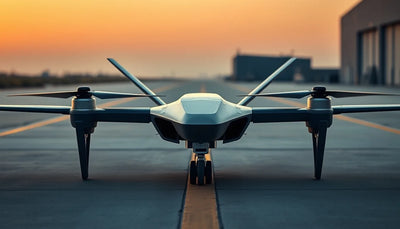
AutoFlight Claims World-First Five-Aircraft eVTOL Formation Flight
AutoFlight has completed what it describes as a world-first multi-model, cross-tonnage eVTOL formation flight involving five aircraft. The demonstration signals growing confidence in coordinated electric air mobility operations, with implications for logistics fleet planning and commercial deployment timelines.

Quick answer
AutoFlight completed a multi-model, cross-tonnage eVTOL formation flight involving five aircraft, which the company describes as a world first.
- Five eVTOL aircraft flew in coordinated formation
- The flight involved multiple models across different tonnage classes
- The demonstration was reported by Autohome in China
- It signals progress in coordinated electric air mobility operations
AutoFlight has completed a formation flight involving five electric vertical takeoff and landing aircraft, a demonstration the company describes as a world-first for multi-model, cross-tonnage eVTOL operations. The event was reported by Autohome, a Chinese automotive and technology publication, and marks a notable step in the evolution of coordinated electric air mobility testing.
Market context
Turn market news into a buy, repair, or trade-in decision.
Compare pre-owned availability, resale timing, and repair economics before the market moves again.

For commercial drone operators, fleet managers, and aviation procurement teams, the announcement carries weight beyond the spectacle. Coordinated multi-aircraft flight is a foundational capability for scaled logistics networks, emergency response operations, and regional air transport services. When a manufacturer demonstrates five aircraft flying together across different weight classes, it signals that the underlying flight control, communication, and safety systems are maturing toward real-world deployment.
What the formation flight actually demonstrates
According to the Autohome report, AutoFlight's demonstration involved five eVTOL aircraft operating in formation. The source describes the flight as multi-model and cross-tonnage, meaning the participating aircraft were not identical units of a single design but rather different models spanning more than one weight category. This is a meaningful distinction in aviation testing.
Coordinating a formation of identical aircraft is already a complex engineering challenge. Coordinating different airframes with different masses, aerodynamic profiles, and flight control characteristics adds another layer of difficulty. Each aircraft responds differently to throttle inputs, wind gusts, and altitude changes. A formation flight across tonnage classes suggests that AutoFlight has developed flight control logic capable of managing heterogeneous aircraft behavior in close proximity.
Reboot Hub analysis: while the source does not provide technical details on separation distances, communication protocols, or autonomous versus piloted operation, the fact that the company chose to publicize the event suggests it views the demonstration as commercially relevant. Formation flight capability is often framed as a precursor to dense airspace operations, where multiple eVTOL aircraft would need to operate safely in shared corridors.
Why coordinated eVTOL flight matters for commercial logistics
The commercial promise of eVTOL aircraft rests on their ability to operate at scale. A single aircraft flying a demonstration route is interesting. A fleet of aircraft operating in coordinated patterns is a business model. Logistics providers, medical supply networks, and regional cargo operators need to understand how multiple aircraft will behave when they share airspace, approach shared landing zones, or fly staggered delivery routes.
AutoFlight's demonstration does not by itself prove that commercial-scale operations are imminent. Certification timelines, airspace integration rules, and ground infrastructure remain significant hurdles in most markets. However, the test does provide a data point for fleet planners who are evaluating eVTOL platforms for future investment. A manufacturer that can demonstrate multi-aircraft coordination is signaling that its technology roadmap includes the operational realities of fleet deployment, not just single-aircraft performance.
The cross-tonnage aspect is particularly relevant for operators who may eventually run mixed fleets. A logistics network might use smaller eVTOL aircraft for last-mile deliveries while larger models handle regional hub-to-hub routes. If those aircraft can coordinate in shared airspace, the operational picture becomes more flexible and efficient.
What this means for drone owners and the market
For most commercial drone operators and DJI fleet owners today, eVTOL formation flights can feel distant from daily operations. A drone pilot inspecting a cell tower or mapping a construction site is not directly affected by a five-aircraft eVTOL test in China. But the market signals matter. Investment in advanced air mobility research tends to accelerate adjacent technologies, including battery systems, sense-and-avoid sensors, and autonomous flight software that eventually filter into smaller commercial drone platforms.
Buyers in the pre-owned DJI market should pay attention to how quickly the broader aerial mobility sector is advancing. When enterprise and logistics-focused eVTOL programs demonstrate new capabilities, they create pressure across the industry to improve reliability, redundancy, and coordination features in smaller aircraft as well. For operators who rely on inspected pre-owned DJI drones for commercial work, the pace of innovation in the wider market can influence upgrade cycles, resale values, and the availability of genuine OEM spare parts as manufacturers shift production priorities toward newer systems. Readers who want to understand how these market shifts affect maintenance and parts availability can consult the Drone Wiki for reference material on drone platforms and repair considerations. For owners evaluating service and lifecycle risk, Drone Wiki explains the relevant repair, parts, resale, or operational path.
The demonstration also reinforces a broader trend: aerial operations are moving toward coordinated, network-based models rather than isolated single-aircraft missions. For fleet managers, this means future procurement decisions may increasingly depend on how well a platform integrates with other aircraft, ground systems, and airspace management tools, not just how the individual unit performs in isolation.
Reading the announcement with appropriate skepticism
As with any manufacturer-announced milestone, there is reason to approach the details with care. The Autohome report is the primary source for this event, and Reboot Hub has not independently verified the flight parameters, the specific aircraft models involved, or the degree of autonomy used during the demonstration. The source does not specify whether the formation was flown autonomously, remotely piloted, or with onboard safety pilots.
These distinctions matter for assessing the commercial significance. A fully autonomous five-aircraft formation is a different achievement than a formation flown with multiple human pilots coordinating manually. The source does not provide enough detail to make that determination. Operators and investors should treat the announcement as a meaningful signal of progress while awaiting more detailed technical disclosures.
The broader eVTOL sector has seen its share of ambitious claims and delayed timelines. Formation flight demonstrations are valuable, but they are not the same as certified commercial operations. The gap between a test flight and revenue-generating service remains substantial in most regulatory environments. Still, the direction of travel is clear: manufacturers are investing in the capabilities that will be required for scaled operations, and that investment is worth monitoring.
FAQ
Frequently asked questions
What did AutoFlight announce?
AutoFlight announced the completion of a five-aircraft eVTOL formation flight involving multiple models across different tonnage classes, described as a world-first demonstration. The event was reported by Autohome.
Why does cross-tonnage formation flight matter?
Cross-tonnage formation flight suggests that the flight control systems can manage aircraft with different weights and aerodynamic characteristics in coordinated flight. This capability is relevant for future mixed-fleet logistics operations.
Should commercial drone operators change their plans based on this news?
Not immediately. The demonstration is a market signal rather than a regulatory milestone. Operators should monitor eVTOL progress for its influence on adjacent drone technologies, battery systems, and autonomy software, but current DJI fleet operations and repair decisions do not require changes based on this single announcement.
Which sources support this update?
The article distinguishes reported information from analysis and does not present an unverified source as official confirmation.
What remains subject to change?
Retail pricing, availability, product bundles and regulatory timelines can change. Readers should verify the latest terms with the named retailer, manufacturer or regulator before acting.
How should buyers or operators use this analysis?
Use the verified facts as a starting point, then compare mission fit, lifecycle support, maintenance needs and current procurement terms before making a purchase or fleet decision.
Sources consulted
- Source material - primary source
Additional official documentation was not available at publication time.
Reboot Hub Editorial adds buyer, repair, resale, and operational analysis for drone owners. If you spot an error, contact us for correction review through our editorial policy.