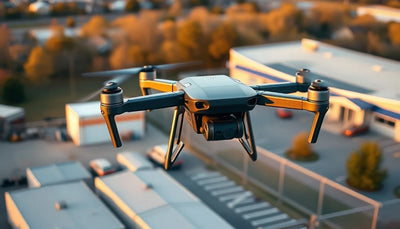
Commercial Drone Boom: Airspace Safety Questions Every Operator Should Consider
A new report highlights safety challenges from the rapid rise in commercial drone flights. Fleet operators and buyers must understand the implications for compliance, repair choices, and the pre-owned DJI market.

The commercial drone industry is expanding at a pace that few airspace systems were designed to handle. A widely circulated report from a major news outlet has placed the spotlight back on airspace safety, raising questions that every fleet operator, repair customer, and drone buyer should take seriously. The core message is straightforward: the convenience and efficiency gains of drones are colliding with a shared airspace that still lacks the infrastructure to manage them at scale.
For commercial UAV professionals this is not a distant regulatory debate but a practical reality that affects daily operations. As the number of active drones climbs, so do the stakes for responsible ownership, proactive maintenance, and informed purchasing. This analysis unpacks the key themes of that report and translates them into actionable insights for anyone involved in the drone ecosystem.
The growing density of commercial drone operations

The source report notes that the commercial drone boom is raising new questions about airspace safety, pointing to the sheer increase in flight hours and the variety of missions now being flown. From package delivery to infrastructure inspection and agricultural monitoring, drones are no longer niche tools but mainstream enterprise assets. This density creates a new kind of risk: not just the familiar collision between a drone and a manned aircraft, but also drone-to-drone incidents and near misses that strain the ability of existing detection systems to keep up.
Market context
Turn market news into a buy, repair, or trade-in decision.
Compare pre-owned availability, resale timing, and repair economics before the market moves again.
For fleet operators this means that basic situational awareness is no longer enough. Even a well-flown route can cross paths with an unannounced delivery drone or a public safety flight. The report implicitly challenges the assumption that current airspace paradigms—built around visual line-of-sight and a handful of manned aircraft—can accommodate thousands of autonomous and semi-autonomous machines without fundamental redesign. The practical implication for drone buyers is that drones equipped with robust safety features such as ADS-B receivers, 360-degree obstacle sensing, and redundant propulsion systems will hold their value and operational utility better than entry-level models lacking these capabilities.
Airspace integration challenges for fleet managers

While the report does not name specific regulatory bodies, the questions it raises align with long-running debates about how to integrate drone traffic into controlled and uncontrolled airspace. Fleet managers who operate multiple units across different regions must now navigate a patchwork of local rules, temporary flight restrictions, and ever-evolving remote identification requirements. The report’s subtext is clear: as commercial volumes grow, regulators will inevitably push for stricter compliance standards.
This has direct implications for repair and maintenance decisions. Drones that cannot be upgraded to meet new airspace mandates—either through firmware updates or hardware retrofits—will become liabilities. A fleet reliant on older, non-compliant airframes may face grounding or expensive retrofits. The wise fleet manager should already be planning a transition path. That path often involves trading in older units for newer, more compliant models. Reboot Hub’s drone trade-in guide offers a structured way to evaluate current equipment and plan upgrades without unnecessary capital expense.
Another operational answer from the report is the need for better pilot training and real-time airspace awareness tools. Operators should supplement manufacturer manuals with ongoing education on local airspace changes and invest in third-party risk assessment software. This is not about fear-mongering; it is about building a culture of safety that protects both the fleet and the public.
What this means for drone buyers

For anyone currently shopping for a commercial drone—whether new or pre-owned—the report’s safety focus translates into a few concrete buying criteria. First, choose platforms with strong upgradability. A drone that cannot accept future firmware for ADS-B In or enhanced geo-awareness is likely to depreciate faster as airspace rules tighten. Second, prioritize build quality and OEM spare availability. Drones that can be repaired with genuine OEM spare parts will have longer useful lives and better resale value, which matters especially in the pre-owned market.
The report also reinforces why buying from a source that offers documented inspection history matters. A pre-owned DJI drone from a reputable supplier, with a clear airframe log and verified component condition, becomes a safer investment than a bargain unit from an unverified seller. In a tightening regulatory environment, provenance and predictable performance are worth a premium.
One practical answer to the question “what should a buyer do differently?” is to factor airspace readiness into the purchase decision the same way one would factor camera specifications or flight time. Ask the seller: does this model support the latest remote ID standards? Can it be updated for future U-space requirements? If selling, be ready to provide that documentation. The trade-in guide mentioned earlier can help existing owners determine the optimal time to upgrade, balancing airspace compliance against current mission needs.
Implications for repair and the pre-owned market

The commercial drone boom does not just increase the number of active drones; it also increases the number of drones that will need repairs, parts replacements, and eventual resale. The report’s airspace safety angle adds urgency to having a reliable maintenance pipeline. Drones with unresolved navigation or communication faults pose a higher risk in dense airspace. This makes professional DJI repair services that use OEM-pulled parts essential for keeping fleets airworthy and compliant.
For the pre-owned DJI market, the safety conversation creates a bifurcation: well-maintained, documented pre-owned drones from trusted sources will command stronger demand, while unverified units with unknown repair histories will struggle. Sellers who can demonstrate a clean flight log and a recent professional inspection will find buyers more willing to pay a premium. Buyers, in turn, should insist on such documentation. The report implicitly warns that a cheap drone with hidden electronic faults could become an airspace liability, costing far more in fines or accident liability than the initial savings.
Ultimately, the report’s core message for the second-hand market is that transparency is no longer optional. Every transaction should include a clear statement of airframe condition, firmware version, and compliance status. Reboot Hub’s pre-owned inventory is built on this principle, with each unit inspected and certified for operational readiness, giving buyers confidence that their investment will not be grounded by the next regulatory update.
What specific airspace safety issues does the commercial drone boom create?
The primary issues include increased risk of mid-air collisions between drones and manned aircraft, drone-to-drone encounters, and near misses that overwhelm current detection and separation systems. The report highlights that existing airspace procedures were not designed for the volume of drone traffic now being witnessed, prompting calls for better integration technology and clearer operational guidelines.
How can fleet operators prepare for stricter airspace regulations?
Operators should prioritize drones that support firmware upgrades and remote identification standards, invest in pilot training that covers local airspace dynamics, and use third-party risk assessment tools to plan flights. Establishing a relationship with a repair service that uses genuine OEM parts ensures that any necessary hardware retrofits can be done efficiently. A proactive approach to trade-in planning also helps transition older airframes before they become non-compliant.
Is it safe to buy a pre-owned DJI drone given these new safety concerns?
Yes, provided the drone has a verifiable maintenance history, firmware currency, and a professional inspection. Buying from a source that documents these details significantly reduces risk. Pre-owned units that have been maintained with OEM-pulled parts and come with clear airframe logs are especially suitable for commercial operations that must maintain high safety standards. The key is transparency and proof of airworthiness.