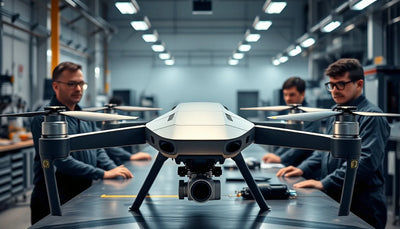
AEVEX and Divergent Team Up on Adaptive UAS Production
AEVEX and Divergent announced a collaboration to develop a next-generation autonomous platform using advanced manufacturing. The deal signals how defense-adjacent UAS production may shift toward faster, more scalable build methods, with potential downstream effects for commercial drone supply chains and fleet planning.

Quick answer
AEVEX and Divergent Technologies announced a strategic collaboration to develop a next-generation autonomous platform using advanced manufacturing, aiming to deliver operational capability at speed and scale.
- AEVEX brings fielded unmanned systems experience
- Divergent contributes advanced manufacturing capabilities
- The goal is faster, scalable production of adaptive UAS
- Announcement came via Yahoo Finance on September 2, 2026
Evidence: Source material
Market context
Turn market news into a buy, repair, or trade-in decision.
Compare pre-owned availability, resale timing, and repair economics before the market moves again.

Verified facts
What the available evidence confirms
| Company | Reported Role in Collaboration |
|---|---|
| AEVEX Corp. | Proven experience delivering operationally fielded unmanned systems |
| Divergent Technologies | Advanced manufacturing capabilities for scalable production |
AEVEX Corp. and Divergent Technologies, Inc. announced a strategic collaboration on September 2, 2026, focused on developing a next-generation autonomous platform. The announcement, reported by Yahoo Finance, frames the partnership as an effort to address emerging mission requirements while delivering advanced operational capability at speed and scale. For commercial drone operators and fleet buyers, the development matters less for any single product and more for what it signals about how unmanned systems may be designed, built, and procured in the years ahead.
The two companies bring distinct capabilities to the table. AEVEX is described in the source report as having proven experience delivering operationally fielded unmanned systems. Divergent Technologies contributes advanced manufacturing capabilities. The collaboration is explicitly aimed at demonstrating how future autonomous platforms can move from concept to scalable production more quickly than traditional aerospace manufacturing methods typically allow.
What the collaboration actually covers
According to the Yahoo Finance report, the partnership is centered on developing a next-generation autonomous platform designed to address emerging mission requirements. The source summary does not specify a model name, payload configuration, size class, or end customer. What is clear is the strategic intent: combining AEVEX's operational UAS background with Divergent's manufacturing approach to accelerate development and scalable production.
This is a meaningful distinction from a conventional defense contract announcement. The emphasis is not on a single procurement award but on a production methodology. Divergent's advanced manufacturing capabilities suggest a shift toward digital design and flexible fabrication processes that can adapt more quickly than fixed tooling. For readers tracking the UAS market, that signals where industry investment is heading: toward platforms that can be iterated rapidly and produced in variable volumes without the long lead times associated with traditional aerospace supply chains.
Why manufacturing speed is becoming a procurement priority
The source report frames the collaboration around delivering capability "at speed and scale," a phrase that has become central to defense and security procurement conversations. Traditional unmanned aircraft programs often face extended development cycles, certification bottlenecks, and supply chain constraints. A partnership explicitly built around scalable production suggests both companies see a market opportunity in shortening that timeline.
Reboot Hub analysis: this mirrors a broader commercial trend in which drone buyers and fleet operators increasingly evaluate not just a platform's specifications but the manufacturer's ability to sustain production, supply spare parts, and support iterative upgrades. A platform that can be produced more flexibly may also support more responsive repair and parts availability over time. That is a consideration commercial operators already weigh heavily when choosing between established DJI ecosystems and emerging enterprise platforms.
What this means for drone owners and the market
For most commercial drone operators, a defense-adjacent manufacturing partnership will not change tomorrow's flight schedule. But the underlying dynamics are worth watching. When advanced manufacturing techniques prove themselves in demanding UAS programs, those methods tend to filter into adjacent markets. Faster production cycles, more modular airframes, and digitally driven design changes can eventually influence how enterprise drones are priced, repaired, and resold.
The pre-owned DJI market offers a useful reference point. DJI's dominance in commercial and enterprise segments rests partly on consistent product availability and a mature parts ecosystem. If new manufacturing approaches enable other UAS makers to compete on production responsiveness, buyers may see more viable alternatives over time. That could pressure pricing, expand repair options, and shift how fleet managers think about platform longevity. For repair customers specifically, a market with more modular, digitally manufactured airframes could mean faster access to replacement components. Readers evaluating repair and parts strategies can track platform developments through resources like the Drone Wiki. For owners evaluating service and lifecycle risk, Drone Wiki explains the relevant repair, parts, resale, or operational path.
Fleet managers should treat this announcement as an early indicator rather than a near-term purchasing signal. The practical takeaway is to monitor whether advanced manufacturing partnerships begin producing fielded platforms with demonstrable reliability and parts support. Until that happens, established platforms with proven service networks remain the safer operational bet for most commercial missions.
What operators should watch next
The source report does not provide a development timeline, production volume target, or customer commitment. That leaves several open questions for market observers. Will the collaboration produce a specific airframe that enters operational service? Will the manufacturing approach demonstrate measurable cost or time advantages? Will any resulting platform be available to non-defense buyers? None of these questions can be answered from the available source material.
Still, the announcement is commercially relevant because it names two entities with complementary positions in the UAS value chain. AEVEX's fielded systems experience provides operational credibility. Divergent's manufacturing capability provides a potential path to scalable output. The combination is precisely the kind of signal procurement analysts and fleet planners track when assessing which companies may shape the next generation of autonomous platforms.
For drone buyers, repair customers, and fleet operators, the immediate action is simple: log this partnership as a development to follow, not a reason to change purchasing behavior. Watch for follow-on announcements that specify platform details, production milestones, or customer adoption. Those will be the signals that advanced UAS manufacturing is moving from concept to commercial reality.
FAQ
Frequently asked questions
What did AEVEX and Divergent announce?
AEVEX and Divergent Technologies announced a strategic collaboration to develop a next-generation autonomous platform, combining AEVEX's fielded UAS experience with Divergent's advanced manufacturing capabilities to enable faster, scalable production.
Does this announcement affect commercial drone buyers today?
No immediate product, pricing, or availability change affects commercial buyers. The announcement signals a manufacturing trend that could influence future platform development, parts availability, and competition in the enterprise UAS market.
Should fleet managers change procurement plans based on this news?
Not yet. Fleet managers should monitor whether the collaboration produces fielded platforms with proven reliability and parts support before adjusting procurement strategies. Established platforms with mature service networks remain the safer near-term choice.
Which sources support this update?
The visible evidence links identify Source material; each source is used only for the claim it directly supports.
What remains subject to change?
Retail pricing, availability, product bundles and regulatory timelines can change. Readers should verify the latest terms with the named retailer, manufacturer or regulator before acting.
How should buyers or operators use this analysis?
Use the verified facts as a starting point, then compare mission fit, lifecycle support, maintenance needs and current procurement terms before making a purchase or fleet decision.
This article is market commentary for drone operators and buyers, not investment advice. Reboot Hub does not recommend securities transactions.
참고 문헌
- Source material - primary source
발행 시점에 이용 가능한 추가 공식 문서는 없었습니다.
Reboot Hub 편집팀은 드론 소유자를 위해 구매, 수리, 재판매 및 운영 분석을 제공합니다. 오류를 발견하신 경우, 편집 정책에 따라 수정 검토를 요청해 주시기 바랍니다.