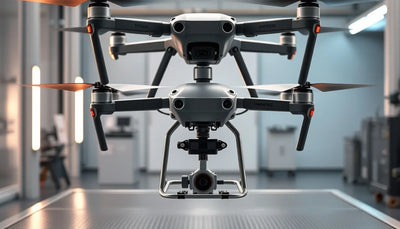
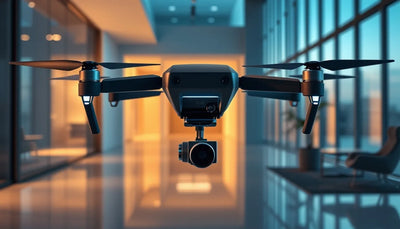
Brecourt Solutions Tests Drone Response to Active Shooter Threats
A drone security startup is developing a rapid-launch UAV system designed to give security personnel faster aerial awareness during active shooter incidents. The concept could reshape demand for specialized security drones and support infrastructure.

Quick answer
Brecourt Solutions is developing a drone security system that launches a UAV from an on-site nest to assist security personnel during active shooter incidents, as reported by DRONELIFE.
- The system is designed to provide rapid aerial awareness when an armed individual enters a school or office building.
- Security personnel often have only seconds to react during active shooter events.
- The concept focuses on automated launch from an on-site nest rather than manual deployment.
- The development signals growing commercial interest in security-focused drone infrastructure.
Evidence: DRONELIFE
Market context
Turn market news into a buy, repair, or trade-in decision.
Compare pre-owned availability, resale timing, and repair economics before the market moves again.

When an armed individual enters a school or office building, the window for meaningful response can be measured in seconds. Security teams often lack immediate visual awareness of where a threat is moving, how many people are involved, and which exits or corridors remain viable. Brecourt Solutions, a drone security startup, is working on a system that addresses that gap by launching an unmanned aerial vehicle from an on-site nest the moment an incident begins to unfold, according to reporting by DRONELIFE.
The concept, detailed by Dronelife Features Editor Jim Magill on November 11, 2026, centers on automation and speed. Rather than relying on a human operator to unpack, power up, and manually deploy a drone during a crisis, the system is designed to launch from a fixed nest located within the facility or on its exterior. That distinction matters for commercial operators and security integrators: the value proposition is not the drone alone, but the infrastructure that keeps it ready and the response protocol that gets it airborne without delay.
The reported concept and why timing matters
DRONELIFE describes Brecourt Solutions as a drone security startup developing a system that launches a UAV from a nest within the building or facility. The reporting emphasizes a core operational reality: security personnel frequently have only seconds to react in order to protect lives. In that compressed timeline, manual drone deployment is rarely practical. A pilot would need to retrieve the aircraft, establish a connection, and navigate toward the threat, all while the situation evolves unpredictably.
The Brecourt approach, as reported, shifts the burden from human reaction time to pre-positioned automation. A nest-mounted drone can theoretically be airborne within moments of an alert, providing overhead video that helps security teams understand the scene before making entry or evacuation decisions. For fleet operators and security providers, this reframes the drone from a tool that supports planned operations to one that must be continuously ready for unplanned emergencies. That has implications for battery maintenance, firmware readiness, sensor calibration, and the physical security of the nest itself.
Security drones as an infrastructure problem
The Brecourt concept highlights a broader shift in how commercial drone security is being evaluated. Historically, many security drone deployments have followed a familiar pattern: a pilot arrives on site, conducts a patrol, and leaves. The aircraft is a mobile asset, but not necessarily a persistent one. A nest-based system inverts that model. The drone remains on station, charged and connected, waiting for a trigger event.
That inversion creates new operational requirements. The nest must maintain the aircraft in a flight-ready state across temperature changes, power interruptions, and long idle periods. Batteries degrade when stored at full charge for extended periods, and connectors, propellers, and sensors can accumulate wear even without flight hours. For organizations considering this category of system, the maintenance burden shifts from flight-hour-based servicing to readiness-based servicing. A drone that has flown only a few hours in a year may still require regular inspection, battery health checks, and component replacement to remain dependable in an emergency.
This is where the pre-owned and parts market becomes relevant. Security integrators and facility managers who deploy nest-based systems will eventually need spare batteries, replacement propellers, and sensor modules. The economics of keeping a fleet of emergency-response drones ready may push some operators toward inspected pre-owned aircraft for training and redundancy, while reserving newer units for primary response roles. Genuine OEM spare parts become a procurement priority because emergency systems cannot tolerate compatibility uncertainty.
What this means for drone owners and the market
The Brecourt development, as reported by DRONELIFE, is still early-stage. There is no verified information in the source about pricing, production timelines, regulatory approvals, or specific hardware specifications. What the reporting does establish is that at least one startup is actively working on a drone system purpose-built for active shooter response, and that the concept is built around automated launch from an on-site nest. For commercial operators, that is a signal worth watching rather than a product to buy today.
The practical takeaway for buyers and fleet managers is to evaluate security drones through a readiness lens. A drone that performs well during a scheduled patrol may still be unsuitable for emergency response if its storage, charging, and launch workflow depends on manual steps. Organizations that are serious about rapid-response aerial awareness should be asking vendors how the aircraft is stored, how often it is tested, and what happens to the system during a power outage or network failure. Those questions matter more than flight time or camera resolution when the use case is measured in seconds.
For the broader commercial drone market, security remains one of the most durable demand drivers. Public safety agencies, school districts, corporate campuses, and logistics facilities all share a common interest in faster aerial situational awareness. If nest-based rapid-launch systems prove viable, they could expand the installed base of commercial drones beyond traditional inspection and mapping workflows. That expansion would, in turn, increase demand for maintenance, repair, and parts support. Operators who understand the readiness requirements of persistent security drones will be better positioned to service that demand. For readers tracking the commercial drone ecosystem, the Drone Wiki provides reference material on drone models, maintenance considerations, and ownership economics that can help frame these emerging use cases. For owners evaluating service and lifecycle risk, Drone Wiki explains the relevant repair, parts, resale, or operational path.
What to watch next
The most important next step for Brecourt Solutions, based on the limited reporting available, will be demonstrating that the system works reliably outside controlled conditions. Active shooter scenarios are chaotic, and a drone that launches successfully in a demonstration may behave differently when a building is being evacuated, doors are locked, and communication channels are congested. Prospective buyers should look for evidence of real-world testing, integration with existing security systems, and clear protocols for who controls the aircraft once it is airborne.
Regulatory considerations will also shape adoption. Indoor drone operations raise questions about obstacle avoidance, GPS denial, and airspace coordination that differ from outdoor patrols. A nest mounted inside a school hallway faces different constraints than one mounted on a rooftop. Until those operational details are clarified, the Brecourt concept should be understood as a promising direction rather than a deployable solution.
For now, the commercial significance is that security-focused drone infrastructure is attracting serious development attention. That attention tends to pull investment, engineering talent, and customer interest into adjacent markets, including drone maintenance, spare parts, and training. Operators who position themselves to support persistent, readiness-critical drone deployments may find themselves ahead of a meaningful market shift.
FAQ
Frequently asked questions
What is Brecourt Solutions developing?
According to DRONELIFE, Brecourt Solutions is developing a drone security system that launches a UAV from an on-site nest to assist security personnel during active shooter incidents at schools or office buildings.
Is the Brecourt drone system commercially available?
The source reporting does not confirm commercial availability, pricing, or production timelines. The system appears to be in development, and prospective buyers should treat it as an early-stage concept rather than a purchasable product.
How could nest-based security drones affect maintenance and parts demand?
Nest-based drones remain on station for long periods, which creates readiness-based maintenance requirements for batteries, propellers, and sensors. If the category grows, it could increase demand for genuine OEM spare parts and inspected pre-owned training aircraft.
Which sources support this update?
The visible evidence links identify DRONELIFE; each source is used only for the claim it directly supports.
What remains subject to change?
Retail pricing, availability, product bundles and regulatory timelines can change. Readers should verify the latest terms with the named retailer, manufacturer or regulator before acting.
How should buyers or operators use this analysis?
Use the verified facts as a starting point, then compare mission fit, lifecycle support, maintenance needs and current procurement terms before making a purchase or fleet decision.
Fonti consultate
- DRONELIFE - primary source
Al momento della pubblicazione non era disponibile ulteriore documentazione ufficiale.
Reboot Hub Editorial fornisce analisi sugli acquisti, le riparazioni, la rivendita e l'operatività per i proprietari di droni. In caso di errori, contattateci per una revisione della correzione in conformità con la nostra politica editoriale.