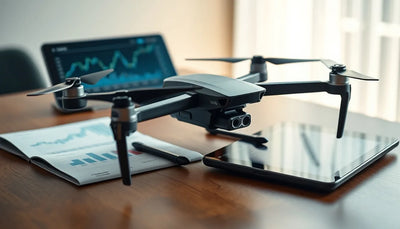
DJI Osmo Pocket 4P Review Positions Pocket Camera as Full Production Tool
A new standalone review of the DJI Osmo Pocket 4P argues the pocket camera now functions as a full production rig. For commercial operators, the assessment points to shifting expectations around compact imaging hardware, repair demand, and pre-owned value.

The DJI Osmo Pocket series has long occupied an awkward middle ground in commercial imaging: too capable to dismiss as a consumer toy, yet too compact for many operators to treat as a serious production asset. A new standalone review published by futr singapore and surfaced through Google News Mavic argues that the DJI Osmo Pocket 4P changes that calculation, describing the device as a pocket camera that finally feels like a full production rig.
The assessment, which Reboot Hub is treating as a source-limited industry report, does not include verified technical specifications, compatibility data, or firmware details. What it does provide is a positioning signal: reviewers and content producers are beginning to evaluate compact gimbal cameras against production workflow standards rather than handheld convenience benchmarks. That shift in framing matters for commercial operators who make purchasing, maintenance, and resale decisions based on how equipment performs under real field conditions.
The review's core claim and what it signals
The central assertion in the futr singapore review is that the DJI Osmo Pocket 4P has crossed a threshold where its output and handling characteristics justify treatment as a production tool. The report frames the device as capable of supporting full production workflows, a claim that would have been difficult to make about earlier Osmo Pocket generations without significant qualification.
DJI buying context
Match product news to hardware you can actually deploy.
Check inspected DJI aircraft, repair support, and trade-in timing before deciding whether to upgrade, repair, or wait.

For Reboot Hub readers, the important takeaway is not a single reviewer's enthusiasm. It is the direction of travel. Compact stabilized cameras have been absorbing features once reserved for larger rigs, and each generation narrows the operational gap. When a review outlet describes a pocket camera in production rig terms, it reflects a broader market conversation about what constitutes acceptable field equipment for commercial video work, inspections, documentation, and secondary capture alongside drone operations.
The source does not reference Insta360 Luna Ultra or any comparison between competing devices. Reboot Hub analysis should therefore treat this as a standalone product assessment rather than a competitive benchmark. Operators weighing the Osmo Pocket 4P against other compact cameras will need to consult additional primary sources before drawing comparative conclusions.
Why production framing changes the commercial conversation
Equipment classification drives purchasing behavior. A camera positioned as a consumer accessory competes on price and convenience. A camera positioned as a production tool competes on reliability, workflow integration, and total cost of ownership. The futr singapore review pushes the Osmo Pocket 4P into the second category, which has practical consequences for how fleet managers and independent operators evaluate the device.
Reboot Hub analysis: Production tools are expected to perform consistently across repeated use, tolerate transport and environmental stress, and integrate with existing post-production pipelines. They are also more likely to be repaired than replaced when components fail. If the Osmo Pocket 4P is genuinely being adopted for production work, demand for genuine OEM spare parts, gimbal calibration services, and professional repair support should follow. That is a meaningful shift from the disposable consumer electronics pattern that often applies to pocket cameras.
Reboot Hub analysis suggests operators should watch whether this production framing translates into sustained commercial adoption. A single review does not establish a market trend, but it can be an early indicator of how professional users are thinking about compact imaging hardware.
What this means for drone owners and the market
Drone operators frequently run mixed equipment kits. A drone captures aerial footage while a handheld stabilized camera covers ground-level shots, site documentation, or client-facing content. The Osmo Pocket 4P, if it performs as the review suggests, could reduce the need for larger handheld rigs in certain workflows. That has implications for equipment budgets, transport logistics, and the secondary market for bulkier camera gear.
For pre-owned DJI drone owners, the review also carries an indirect signal. DJI's product ecosystem spans aerial and handheld imaging, and the company's compact camera line often shares component philosophy, stabilization expertise, and accessory design language with its drone products. Strong reception for the Osmo Pocket 4P reinforces the broader value proposition of DJI's compact imaging portfolio, which can support resale confidence across the brand's product range. Operators evaluating drone fleet decisions or researching the Drone Wiki for maintenance and ownership guidance may find the Osmo Pocket 4P's reception relevant to their broader equipment strategy. For owners evaluating service and lifecycle risk, Drone Wiki explains the relevant repair, parts, resale, or operational path.
The practical question for buyers and fleet managers is straightforward: does the Osmo Pocket 4P's production positioning justify adding it to a commercial kit, and what does that decision mean for maintenance planning? If the device is treated as a production asset, operators should plan for professional repair access and spare parts availability from the outset, rather than assuming replacement is the default response to failure. That planning shift is one of the clearest operator-facing implications of the review's framing.
Source limitations and what remains unverified
Reboot Hub is publishing this analysis under source-limited reporting mode. The primary reporting source is futr singapore, surfaced through Google News Mavic. No official DJI confirmation, technical specification sheet, or independent verification was available at the time of publication. The review's claims about production capability should be understood as the assessment of a single outlet, not as manufacturer-confirmed performance data.
Operators should avoid drawing conclusions about battery life, sensor specifications, stabilization performance metrics, or compatibility with specific accessories based on this report. Those details were not present in the source data, and Reboot Hub does not invent technical claims. The responsible approach is to treat the review as a directional signal about market positioning while awaiting more detailed technical coverage before making procurement decisions.
The absence of comparative data is also notable. The source does not benchmark the Osmo Pocket 4P against competing compact cameras or against DJI's own drone cameras. For operators who need to justify equipment purchases to clients or finance teams, that gap means additional research is required before the Osmo Pocket 4P can be confidently positioned as a production-grade alternative to existing handheld or aerial capture tools.
What is the main finding of the DJI Osmo Pocket 4P review?
The review from futr singapore concludes that the DJI Osmo Pocket 4P now feels like a full production rig, marking a shift in how compact pocket cameras are evaluated for commercial work.
Should drone operators consider the Osmo Pocket 4P for their kits?
Operators who need ground-level capture alongside aerial work may find the production framing relevant, but they should wait for verified technical specifications and comparative testing before making procurement decisions.
Does this review include technical specifications or competitor comparisons?
No. The source does not include verified technical specifications, compatibility details, or comparisons with competing devices such as the Insta360 Luna Ultra.
Konzultált források
A közzététel időpontjában további hivatalos dokumentáció nem állt rendelkezésre.
A Reboot Hub szerkesztősége vásárlási, javítási, viszonteladási és üzemeltetési elemzéseket nyújt dróntulajdonosok számára. Ha hibát észlel, kérjük, jelezze nekünk a szerkesztői irányelvünknek megfelelően a javítás érdekében.