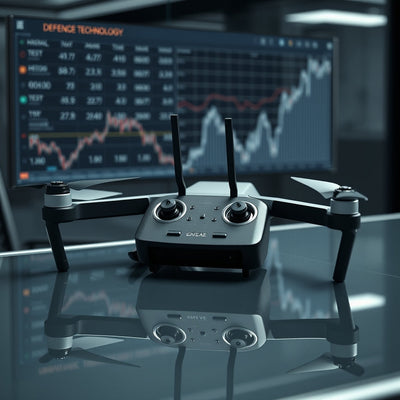
Remote Sensing UAV Market to Reach $3.9 Billion by 2032
A new global strategic report values the remote sensing UAV market at $2.9 billion in 2025, projecting $3.9 billion by 2032. The 4.1% CAGR reflects rising demand for sensor-equipped platforms, AI-driven data processing, and BVLOS operations across commercial sectors.

Quick answer
A global strategic business report published in November 2026 values the remote sensing UAV market at US$2.9 billion in 2025 and projects it to reach US$3.9 billion by 2032, a compound annual growth rate of 4.1%.
- The 2025 market value is US$2.9 billion.
- The 2032 projection is US$3.9 billion.
- The compound annual growth rate is 4.1%.
- Growth drivers include drone platforms, sensor technologies, AI, data processing, and BVLOS.
Evidence: Source material · AeroVironment unmanned systems solutions
Market context
Turn market news into a buy, repair, or trade-in decision.
Compare pre-owned availability, resale timing, and repair economics before the market moves again.

Verified facts
What the available evidence confirms
| Metric | 2025 Value | 2032 Projection |
|---|---|---|
| Remote sensing UAV market size | US$2.9 billion | US$3.9 billion |
| Compound annual growth rate | 4.1% | 4.1% |
A new global strategic business report on remote sensing UAVs, published through ResearchAndMarkets.com and reported by Yahoo Finance on November 24, 2026, values the market at US$2.9 billion in 2025 and projects it to reach US$3.9 billion by 2032. The report, titled "Remote Sensing UAVs - Global Strategic Business Report 2026," points to a compound annual growth rate of 4.1% over the forecast window.
The named companies in the report include AeroVironment, Boeing, Elbit Systems, and General Atomics. Those are established defense and aerospace players, but the report frames the growth story around broader commercial and industrial demand. Advances in drone platforms, sensor technologies, artificial intelligence, data processing, and beyond visual line of sight operations are cited as the core market drivers.
For commercial operators, fleet managers, and repair customers, the headline number matters less than what it implies: remote sensing is no longer a niche defense capability. It is becoming a sustained, multi-year commercial market with predictable demand for airframes, sensors, data pipelines, and maintenance support.
What the report actually says about market growth
The source data is specific. The global remote sensing UAV market was valued at US$2.9 billion in 2025. The projection for 2032 is US$3.9 billion. The compound annual growth rate is 4.1%. Those figures come directly from the ResearchAndMarkets.com offering as reported by Yahoo Finance, and they describe a market that is expanding steadily rather than explosively.
A 4.1% CAGR is meaningful in context. It suggests that remote sensing UAV demand is consolidating around repeatable commercial workflows: agricultural monitoring, infrastructure inspection, environmental mapping, and survey-grade data collection. The report does not break out regional or application-level detail in the source summary, so Reboot Hub analysis should treat the growth as broad-based rather than concentrated in one vertical.
The presence of defense-oriented companies such as AeroVironment, Boeing, Elbit Systems, and General Atomics in the report also signals that government and security procurement remains a structural pillar of the remote sensing market. Commercial operators should read that as a sign that sensor payload development, data security standards, and airframe durability will continue to be shaped by defense-grade expectations, even as civilian use cases expand.
Why sensor, AI, and BVLOS advances drive the market
The report identifies five growth drivers: drone platforms, sensor technologies, artificial intelligence, data processing, and beyond visual line of sight operations. Each of these has a direct operational consequence. Better platforms mean longer flight times and heavier payload capacity. Better sensors mean higher-resolution imagery, thermal capture, and multispectral data. AI and data processing turn raw captures into usable deliverables faster. BVLOS expands the geographic area a single crew can cover in one mission.
For a commercial operator, those drivers translate into a simple calculation. A remote sensing UAV that can fly beyond visual line of sight with an AI-assisted processing workflow can replace multiple manual inspection days or ground survey crews. That is why the market keeps growing even when drone hardware itself becomes more affordable: the value is shifting toward integrated sensing and data delivery, not just the aircraft.
Reboot Hub analysis sees a parallel here with the broader commercial drone market. As sensor and data capabilities improve, the useful life of a well-maintained airframe extends. Operators who keep their platforms in service longer, with reliable parts and repair support, can capture more value from each hardware investment before replacement becomes necessary.
What this means for drone owners and the market
The steady growth of the remote sensing segment has practical implications for anyone who owns, buys, or maintains commercial UAVs. First, demand for sensor-equipped platforms tends to increase demand for maintenance, calibration, and repair services. Remote sensing aircraft carry more expensive payloads than consumer camera drones, so downtime is costlier and preventive care matters more.
Second, the report's emphasis on AI and data processing suggests that the resale market will increasingly favor platforms that can integrate with modern software workflows. A pre-owned DJI drone that remains compatible with current mapping and inspection software holds more commercial value than an older airframe that cannot support updated sensor or data pipelines. Buyers in the second-hand market should evaluate software compatibility alongside physical condition.
Third, the presence of defense contractors in the report should remind commercial buyers that remote sensing technology is subject to export controls, data security requirements, and procurement scrutiny in many regions. That does not change day-to-day operation for most pilots, but it does affect fleet planning for enterprise customers and public-sector contractors.
For operators and buyers who want to keep remote sensing platforms in service longer, the practical step is to prioritize genuine OEM spare parts and professional repair support rather than waiting for failure. Reboot Hub's Drone Wiki provides reference material that can help owners understand maintenance and repair considerations for commercial UAV platforms. For owners evaluating service and lifecycle risk, Drone Wiki explains the relevant repair, parts, resale, or operational path.
The commercial outlook beyond 2032
The report's forecast window ends in 2032, but the drivers it identifies are unlikely to stop there. Remote sensing is becoming embedded in agriculture, utilities, construction, mining, and environmental compliance. Each of those sectors has recurring data collection needs that do not disappear after a single purchase. That recurring demand is what supports a multi-year growth curve rather than a one-time hardware spike.
For fleet operators, the implication is that remote sensing capacity should be planned as a service capability, not a capital expense with a fixed depreciation schedule. Aircraft will need sensor swaps, battery replacement, firmware updates, and periodic repair. The operators who budget for that support will keep their fleets mission-ready longer than those who treat maintenance as an afterthought.
The report does not provide model-level detail or regional breakdowns in the source summary, so Reboot Hub analysis stops short of recommending specific platforms. What the data does support is a clear directional signal: remote sensing UAV demand is durable, commercially relevant, and increasingly tied to data services rather than hardware alone.
FAQ
Frequently asked questions
What is the projected size of the remote sensing UAV market?
The remote sensing UAV market was valued at US$2.9 billion in 2025 and is projected to reach US$3.9 billion by 2032, according to the global strategic business report reported by Yahoo Finance on November 24, 2026.
What is driving growth in remote sensing UAVs?
The report cites advances in drone platforms, sensor technologies, artificial intelligence, data processing, and beyond visual line of sight operations as the primary growth drivers for the remote sensing UAV market.
Which companies are named in the remote sensing UAV report?
The report features AeroVironment, Boeing, Elbit Systems, and General Atomics, according to the source summary published through ResearchAndMarkets.com.
Which sources support this update?
The visible evidence links identify Source material and AeroVironment unmanned systems solutions; each source is used only for the claim it directly supports.
What remains subject to change?
Retail pricing, availability, product bundles and regulatory timelines can change. Readers should verify the latest terms with the named retailer, manufacturer or regulator before acting.
How should buyers or operators use this analysis?
Use the verified facts as a starting point, then compare mission fit, lifecycle support, maintenance needs and current procurement terms before making a purchase or fleet decision.
Käytetyt lähteet
- Source material - primary source
- AeroVironment unmanned systems solutions - official company source
Reboot Hub Editorial tarjoaa drone-omistajille ostaja-, huolto-, jälleenmyynti- ja toiminta-analyyseja. Jos huomaat virheen, ota meihin yhteyttä korjauspyynnön tekemiseksi toimituksellisen linjamme mukaisesti.