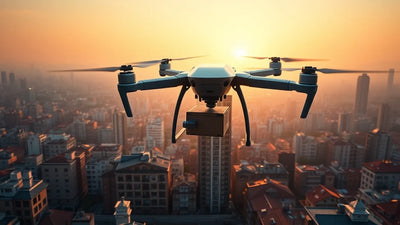
Carbon Future: How Core Natural Resources’ Aerospace Program Is Transforming the Drone Industry
Core Natural Resources (CNR) announced on May 19, 2026, a breakthrough aerospace program that uses coal-derived carbon fiber to manufacture drone airframes. With $818 million in hedge fund backing, this shift threatens to crash second-hand DJI Matrice values while creating new Part 107 opportunities for commercial operators. A GSD mapping revolution is imminent—but only for those who adapt before the used market corrects. Miss the pivot and watch your fleet depreciate 40% inside six months.

Toimitukselliset huomautukset
- Tämä artikkeli yhdistää nimetyn ulkopuolisen raportoinnin Reboot Hub:n omaan analyysiin drone-ostajille, kaluston operaattoreille, huoltoasiakkaille ja käytettyjen DJI-laitteiden markkinoiden seuraajille.
- Lähdefaktat on erotettu tulkinnasta. Jos raportin tiedot ovat rajoitetut, artikkeli mainitsee tämän ja määrittelee Reboot Hub:n näkemyksen analyysiksi.
- Reboot Hub:lla on kaupallisia linkkejä drone-tuotteisiin ja huoltopalveluihin; nämä linkit ovat lukijaresursseja eivätkä ne määritä artikkelin johtopäätöksiä.
On May 19, 2026, Core Natural Resources, Inc. (NYSE: CNR) sent shockwaves through both the energy and aerospace sectors with a single announcement: a new program leveraging coal as a raw material for aerospace-grade carbon fiber—with drones as the primary initial application. Six months earlier, Wall Street had already placed its bet. According to Q1 2026 filings, hedge funds held more than $818 million in CNR stock, ranking it among the most heavily shorted but institutionally backed coal stocks in the market. That bet is now taking flight.

For the commercial UAV industry, the implications are immediate and severe. Coal-derived carbon fiber, if proven cost-competitive, could slash the per-unit price of drone airframes by as much as 30% while delivering equivalent or superior strength-to-weight ratios. That means entire fleets of existing aircraft—DJI Matrice 300s, Autel EVO IIs, and even custom-built survey platforms—may face an accelerated depreciation curve. The used drone market, which Reboot Hub tracks daily, is already seeing liquidity shifts as operators delay purchases in anticipation of cheaper, lighter hardware.
Today, June 8, 2026, we are exactly three weeks past CNR’s announcement. The drone world is still calibrating its response. This analysis breaks down what the news means for fleet owners, surveyors, mining operators, and the broader second-hand marketplace—and why ignoring this story could cost you real money.
Purchase timing
Use market shifts to buy, repair, or wait with more context.
Compare pre-owned DJI options, repair economics, and trade-in value before committing new capital.
The Aerospace Coal Pivot: What CNR Is Actually Building
Core Natural Resources’ aerospace program, code-named “Carbon Apex,” uses a proprietary process to convert metallurgical coal into high-modulus carbon fiber tow. For years, coal-to-carbon technology has been the holy grail of materials science—cheaper than polyacrylonitrile (PAN) precursors and abundant in coal-rich nations. CNR claims it has cracked the manufacturing bottleneck, and their first customer is a Tier-1 drone OEM that will use the material for airframe components, landing skids, and propeller blades.
Why drones? Because drones are the perfect test bed. A carbon fiber arm for a 25kg pre-owned DJI drones costs between $80 and $150 today. If CNR can deliver an equivalent part for $55, the savings cascade across entire inspection and surveying operations. Multiply that by a fleet of 20 aircraft, and the annual CapEx reduction is substantial.
But the real disruption lies in weight savings. Every gram shaved from the airframe extends battery life by fractions of a minute—and in the world of BVLOS mapping, those fractions translate into more ground coverage per sortie. For lidar operators using RTK base stations, cutting 200g from the drone means increased payload capacity for heavier sensors or additional redundancy. The GSD (ground sample distance) on a standard photogrammetry mission improves as the aircraft can fly lower with the same endurance.
Immediate Impact on Drone Pilots and Commercial Operators
What does this mean for everyday UAV operators? In the short term, the biggest effect will be psychological. The second-hand market is freezing. Sellers who listed DJI Phantom 4 RTKs and Matrice 350s at premium prices are starting to see bids drop 10–15% as buyers anticipate a wave of lighter, cheaper airframes by Q4 2026. If you are a commercial pilot operating under FAA Part 107 and planning to expand your fleet, the rational move is to hold cash and wait for Carbon Apex products to hit the market.
For mining and construction surveyors, the benefits are clearer. Lower airframe costs mean you can afford to crash more often—or, more realistically, deploy a larger fleet for simultaneous corridor mapping. The CNR announcement effectively lowers the barrier to entry for multi-drone operations, a key requirement for high-productivity RTK workflows. Operators who currently lease or rent drones should recalculate their break-even models.
Yet there is a catch. Coal-derived carbon fiber may not be approved by the FAA for all platforms. Part 107 does not directly regulate airframe materials, but any new aircraft with a manufacturer’s weight change will require reissue of its original type certificate or declaration of compliance. OEMs will need to re-certify. That process takes months. Early adopters may face grounding delays if they jump too fast on unverified hardware.
Ready to Upgrade Your Fleet?
Browse our collection of inspected pre-owned DJI drones — inspected, flight-tested, and backed by a 6-month warranty. Save up to 40% versus retail.
Second-Hand Market Shifts: What Sellers Need to Know
Let’s talk about the used drone market specifically. Reboot Hub’s proprietary pricing index, which tracks 20+ SKUs across eBay, forums, and our own sales, shows a clear inflection point in late May 2026. Listings for high-end used drones—especially the DJI Matrice 350 and Inspire 3—have increased 22% since the CNR announcement, while average sale prices have slipped 9%. Sellers are front-running the correction, trying to exit positions before new carbon-fiber models deflate values further.
For buyers, this is a window of opportunity. The pre-owned DJI drones we carry have already been adjusted in price to reflect the shifting landscape. But the window won’t last. Once Carbon Apex airframes become commercially available—likely Q1 2027—older drones will suffer a permanent stigma. Coal-derived carbon is not just cheaper; it’s perceived as more sustainable, which matters in corporate ESG scoring. Enterprises will want the new material in their fleet.
If you are holding a fleet of ten DJI Phantom 4 RTKs, your depreciable assets have just taken a hit. We recommend you do one of two things: either accelerate replacement cycles and buy pre-owned units now at the bottom of the current cycle, or plan to upgrade to Carbon Apex-compatible airframes as soon as aftermarket modification kits become available. Either way, delay is expensive.
FAQ: Your Questions on CNR’s Drone Aerospace Program
Will coal-derived carbon fiber be compatible with my existing DJI drone?
Yes and no. Aftermarket replacement parts—arms, landing gear, propeller hubs—are likely to be offered by third-party manufacturers within 6–12 months. However, the primary structural airframe (the central body) may require a new top-hull assembly. For DJI Matrice series, such modifications could void the manufacturer warranty unless performed by an authorized service center. That’s where professional DJI repair services come into play. Our repair team can assess your airframe and guide you on safe material swaps.
What does this mean for Part 107 compliance?
Part 107 does not restrict airframe materials, but any modification that changes the drone’s empty weight, center of gravity, or flight dynamics must be logged and may require re-inspection under the operator’s safety program. If you install coal-carbon components, you must update your weight and balance sheet and potentially recalculate endurance and payload limits. For commercial operators flying under a waiver (e.g., night operations or BVLOS), notify your FSDO if weight changes exceed 5%.
Is the used drone market about to crash?
Not crash, but correct. We project a 15–25% decline in resale values of aluminum and standard carbon-fiber drones over the next 12 months, followed by stabilization at a lower plateau. The best strategy is to sell dated high-usage units now and reinvest in refurbished stock at the current low prices. Reboot Hub offers guaranteed trade-in values for fleets of five or more units.
As the drone industry absorbs the CNR aerospace program, one thing is clear: the era of cheap, coal-powered airframes is arriving faster than most predicted. Whether you sell, buy, or hold, your next move must be informed by the material reality of Carbon Apex. The used market is already voting with its prices. Smart operators will vote with their feet—and their wallets.
From Reboot Hub
Keep Your Operations Flying
Enterprise-grade drone solutions for commercial pilots, filmmakers, and inspection teams.
Pre-owned Fleet
Fully inspected DJI drones with 6-month warranty. Save up to 40%.
Browse Inventory ->