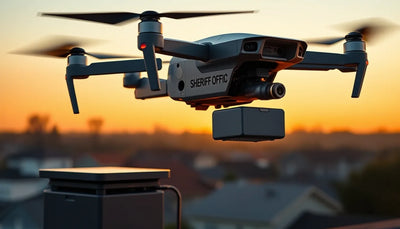
Amazon MK30 Drone Recovery Video Draws FAA Investigation
A video showing at least six people lowering an Amazon MK30 from a Michigan garage roof has drawn FAA scrutiny. The incident raises questions about delivery drone recovery procedures, operator training, and what unusual events mean for commercial drone fleet planning and repair decisions.

Quick answer
A video posted by the Detroit Free Press shows at least six people handing Amazon's MK30 delivery drone down from a garage roof in Huntington Woods, Michigan, and the FAA is investigating.
- The FAA is investigating the reported Amazon MK30 recovery in Michigan.
- The video shows at least six people lowering the drone from a garage roof.
- The incident raises questions about delivery drone recovery procedures and operator training.
- DroneXL.co reported the development on November 24, 2026.
Evidence: DroneXL.co · FAA UAS official guidance
Operator checklist
Turn policy news into a safer fleet decision.
Before changing aircraft, compare repair paths, available DJI inventory, and trade-in timing against the rule change.

DroneXL.co reported on November 24, 2026, that a video published by the Detroit Free Press shows at least six people handing an Amazon MK30 delivery drone down from a garage roof in Huntington Woods, Michigan. The Federal Aviation Administration is now investigating the incident, according to the reporting. The footage has circulated quickly among commercial drone operators because it captures an unusual recovery scenario that sits outside the routine delivery loop most fleet managers plan for.
The central question is not simply whether a drone landed on a roof. Delivery drones are designed to operate in dense residential environments, and unplanned landings are a known operational risk. The more important issue for commercial buyers and repair customers is what happens after a drone is stranded, who is authorized to handle it, and whether the recovery method shown in the video reflects a controlled procedure or an improvised response. Those questions matter because they shape how operators think about training, damage risk, and the cost of returning a fleet asset to service.
What the source actually shows
According to DroneXL.co, the video posted by the Detroit Free Press shows at least six people involved in lowering the MK30 from the garage roof. The reporting does not specify whether those individuals were Amazon employees, contractors, local responders, or residents. It also does not confirm whether the drone was damaged before or during the recovery. The FAA is investigating, but no official finding, penalty, or cause has been published in the source material.
For commercial operators, that gap in detail is instructive. When a drone ends up in an inaccessible or elevated position, the recovery method can introduce as much risk as the original landing. Hand-carrying a large delivery drone down from a roof involves weight distribution, grip points, and the potential for impact if the aircraft shifts. Even without confirmed damage, the video raises a practical question: does a fleet have a documented recovery procedure for a stranded aircraft, or does the response depend on whoever happens to be on site?
What this means for drone owners and the market
The incident is a reminder that delivery drone operations are still maturing, and that unusual events can become regulatory case studies even when no injury or property damage is confirmed. For fleet operators, the practical takeaway is to review recovery protocols before an incident occurs. A drone that is lowered by hand from a roof may need a full inspection before it returns to service, even if it looks intact. Landing gear, motor mounts, and sensor alignment can be affected by manual handling, and repair decisions should be based on inspection rather than appearance.
For buyers in the pre-owned DJI market, the story has a less direct but still relevant lesson: operational history matters. A drone that has been through an unusual recovery, a hard landing, or an improvised field repair may carry hidden stress that is not visible in listing photos. Buyers who want confidence in a used aircraft often look for inspected pre-owned inventory and genuine OEM spare parts rather than assuming that a clean exterior means a clean service history. The Reboot Hub team maintains a Drone Wiki that helps owners and buyers understand inspection points and repair considerations across common commercial platforms. For owners evaluating service and lifecycle risk, Drone Wiki explains the relevant repair, parts, resale, or operational path.
The regulatory angle also matters for enterprise procurement. If the FAA investigation leads to guidance or enforcement around recovery procedures, delivery drone operators may face new documentation or training requirements. That would raise operating costs and could push some smaller logistics programs to delay expansion. For larger fleets, the response may be more conservative maintenance intervals and stricter handling rules after any off-nominal landing. None of that is confirmed yet, but it is the kind of second-order effect that procurement teams watch closely.
Why recovery procedures are becoming a compliance issue
Delivery drone programs are built around controlled landings at designated points. When a drone lands somewhere else, the operator has to decide whether to attempt a remote recovery, send a ground team, or coordinate with local authorities. The Michigan video, as reported by DroneXL.co, shows a manual recovery involving multiple people. That is not necessarily a violation, but it is exactly the kind of event the FAA reviews when assessing whether an operator maintained control of the situation.
For repair customers, the compliance angle translates into documentation. If a drone is recovered by hand from a roof, the operator should log the event, note who handled the aircraft, and record any visible marks or unusual forces applied during the recovery. That log becomes important if a later failure occurs and the operator needs to show that the aircraft was properly inspected before returning to flight. Without that record, a warranty claim or insurance filing can become more difficult to support.
The broader signal for commercial drone planning
Amazon's MK30 is a purpose-built delivery aircraft, and the Michigan incident is not a product failure in the traditional sense. It is an operational event that shows how quickly a routine delivery can become a manual recovery problem. For commercial operators outside the delivery sector, the lesson is similar: a drone that cannot be recovered safely is a liability, regardless of how advanced its flight systems are. Planning for recovery is as important as planning for flight.
Fleet managers should consider whether their teams have clear guidance for roof landings, tree entanglements, water recoveries, and other off-nominal scenarios. They should also consider whether their maintenance provider can assess an aircraft after manual handling, and whether spare parts are available quickly if a recovery causes damage. The pre-owned market absorbs some of this risk, because operators who upgrade or downsize often sell aircraft that have been through field events. Buyers who ask about recovery history and inspection records are better positioned than those who focus only on price.
FAQ
Frequently asked questions
What happened in the Amazon MK30 video?
A video posted by the Detroit Free Press showed at least six people lowering an Amazon MK30 delivery drone from a garage roof in Huntington Woods, Michigan, according to DroneXL.co.
Is the FAA investigating the Amazon drone recovery?
Yes. DroneXL.co reported on November 24, 2026, that the FAA is investigating the incident. No official finding or enforcement action has been confirmed in the source material.
What should drone fleet operators do after seeing this incident?
Fleet operators should review their recovery procedures for stranded aircraft and ensure that any drone handled manually after an off-nominal landing receives a full inspection before returning to service.
Which sources support this update?
The visible evidence links identify DroneXL.co and FAA UAS official guidance; each source is used only for the claim it directly supports.
What remains subject to change?
Retail pricing, availability, product bundles and regulatory timelines can change. Readers should verify the latest terms with the named retailer, manufacturer or regulator before acting.
How should buyers or operators use this analysis?
Use the verified facts as a starting point, then compare mission fit, lifecycle support, maintenance needs and current procurement terms before making a purchase or fleet decision.
Fuentes consultadas
- DroneXL.co - primary source
- FAA UAS official guidance - official regulator source
Reboot Hub Editorial ofrece análisis de compra, reparación, reventa y operatividad para propietarios de drones. Si detecta algún error, contáctenos para solicitar una revisión de corrección conforme a nuestra política editorial.