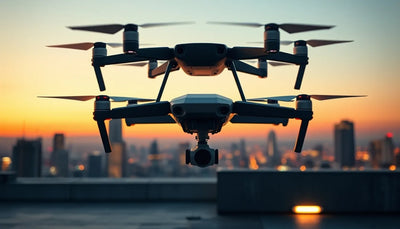
AI-Powered Vision Systems from Orbbec Signal New Capabilities for Drone Autonomy
Orbbec showcased AI-integrated 3D cameras at Automate 2026, highlighting how advanced vision is reshaping industrial automation. Drone buyers and fleet operators should note the implications for autonomous navigation, pre-owned drone values, and repair requirements.

At the Automate 2026 exhibition, Orbbec demonstrated what many industry observers see as the next logical step in robotic perception: industrial-grade 3D cameras paired with artificial intelligence. The event, covered by The Robot Report, placed Orbbec’s offerings squarely within the realm of challenging automation environments where depth accuracy and real-time decision-making matter most. For commercial UAV operators, this development carries more than academic interest. The same perception advances that help a robotic arm locate and orient parts on a fast-moving line are the very technologies that allow a drone to navigate under a bridge, track a moving vehicle, or inspect a power substation without GPS. Understanding how these systems evolve helps buyers and fleet managers make smarter decisions today.
The link between industrial robotics and drone perception has always been close. Both domains rely on stereo depth sensors, structured light, and time-of-flight cameras. Orbbec’s emphasis on AI integration at Automate 2026 suggests that raw sensor data is no longer sufficient; the interpretation layer—the software that turns a point cloud into a navigable map or a recognisable hazard—is now the differentiator. This shift has practical consequences for anyone who buys, operates, or repairs drones.
The shift toward AI-driven perception in industrial robotics
Orbbec presented systems specifically engineered for “challenging automation scenarios.” That phrase, drawn directly from the source coverage, covers conditions where lighting changes unpredictably, where reflective surfaces confuse conventional sensors, and where the margin for error is measured in millimetres. By embedding AI into the camera pipeline, Orbbec aims to let the hardware itself classify objects, estimate pose, and adapt to new environments without being explicitly reprogrammed for every edge case.
Market context
Turn market news into a buy, repair, or trade-in decision.
Compare pre-owned availability, resale timing, and repair economics before the market moves again.

For drone operators, the parallel is immediate. Aerial inspection tasks routinely present the same challenges: variable sunlight, dust, water droplets on the lens, and surfaces that confuse passive stereo vision. AI-assisted perception systems can compensate by learning to recognise a structural crack even when lighting is poor, or by distinguishing a tree branch from a power line in cluttered airspace. Fleet managers evaluating new drone platforms should pay close attention to whether the onboard vision system is merely capturing data or actively interpreting it. The difference influences both mission reliability and the total cost of ownership, because a drone that can handle non-ideal conditions reduces repeat flights and the risk of collision-related repairs.
Beyond pure capability, the industrial robotics sector’s movement toward AI-driven perception reinforces a broader trend: vision modules are becoming more specialised and more valuable. They are no longer commodity parts. This matters for the repair ecosystem. When a camera unit fails on an advanced drone, the replacement may involve not just a sensor board but a calibrated AI model that was trained on specific data. Repair centres that lack the ability to re-calibrate or reload those models will struggle to restore full performance. That is one reason why professional DJI repair services that use genuine OEM parts and follow manufacturer-level procedures are increasingly important for fleets that depend on high autonomy.
What this means for drone buyers
Buyers in the commercial UAV space should view the Orbbec showcase as a signal that perception hardware is entering a new pricing and performance tier. The industrial-grade 3D cameras shown at Automate 2026 are not destined exclusively for fixed automation; their design principles are already appearing in high-end drones and will migrate into mid-range platforms over the next product cycles. When comparing drones for tasks such as precision agriculture, structural inspection, or security patrol, the presence of an AI-capable vision system is becoming a genuine selection criterion, not a marketing bullet point.
For those purchasing new equipment, the implication is straightforward: allocate budget toward platforms that invest in perception software, not just mechanical specifications. A drone that can interpret its surroundings autonomously will save operator time and reduce the likelihood of expensive collisions. However, new equipment is not the only path. The pre-owned market for DJI drones now includes many units equipped with earlier-generation stereo cameras that lack dedicated AI processing. While these remain effective for well-lit, predictable missions, they may struggle in the same challenging scenarios that Orbbec’s systems address. Buyers shopping for pre-owned DJI drones should examine the vision system’s generation and ask whether the drone’s flight controller supports AI-based depth mapping. Some older models can be upgraded via third-party payloads, but integrated systems often require a full platform swap.
Fleet operators planning multi-year cycles should also consider that as AI vision becomes standard, trade-in values for drones without it may decline faster than expected. The drone trade-in guide from Reboot Hub offers a structured way to assess current fleet value and time upgrades to minimise depreciation. Waiting too long to sell older units could mean absorbing a steeper discount when perception technology shifts decisively.
Implications for fleet planning and repair operations
Orbbec’s focus on industrial-grade reliability—cameras that survive harsh conditions and deliver consistent data—has direct implications for how drone fleets are built and maintained. If perception modules are expected to last through thousands of cycles in dusty, wet, or vibrating environments, then the maintenance interval for those components may lengthen. Yet when failures do occur, the complexity of repair rises. An AI-enhanced camera is not a simple lens-and-imager assembly; it includes a system-on-module running inference firmware, often with calibration data unique to each unit.
Fleet managers should review their parts inventory strategy. Stocking generic replacements may no longer be sufficient. For drones with integrated AI vision, keeping a genuine OEM spare part on hand can reduce downtime. When a mission-critical camera fails, the ability to swap in a factory-calibrated module and re-run a short validation flight is faster than sending the entire drone to an unqualified repair shop. This is where professional DJI repair services become a strategic resource, especially for fleets operating across multiple sites. Centralised repair partners that understand the interplay between hardware and embedded AI can restore a drone to factory specification in one turn, avoiding the risk of mismatched calibration.
Training is another dimension. Technicians accustomed to swapping passive camera boards will need to learn how to handle modules that store neural network parameters. Firmware updates for vision systems are also becoming more frequent as AI models improve; repair workflows must include the ability to apply these updates without breaking integration with the flight controller. Fleets that internalise their own repair will need to invest in tooling and training. Those that outsource should verify that their repair partner uses the latest OEM diagnostic software and has access to the specific AI calibration profiles for each drone model.
Broader market trends and the pre-owned drone ecosystem
The coverage of Orbbec at Automate 2026 on The Robot Report underscores a larger movement: industrial automation is absorbing AI-driven perception at a pace that few predicted even two years ago. This trend ripples into the drone sector because the same sensor supply chains, the same AI chip vendors, and the same system integrators serve both markets. As volume production of industrial smart cameras increases, component costs tend to fall, making advanced vision more accessible to drone manufacturers. Conversely, if the robotics industry sets higher reliability standards, drone buyers can expect that future platforms will meet those standards as well.
For the pre-owned DJI market, the effect is twofold. First, drones equipped with cutting-edge AI vision systems today will hold their value longer because their capabilities will remain relevant even as software updates improve performance. Second, drones without such systems—even those in pristine mechanical condition—may see a softer resale demand as operators gravitate toward platforms that can handle unsupervised autonomous flight. Buyers in the second-hand market should therefore weigh the vision generation as heavily as flight time and battery health. A DJI Inspire or Matrice model with a modern downward-facing stereo pair that supports AI object detection may be a better long-term investment than a newer basic model that relies solely on ultrasonic and single-lobe visual sensors.
Smart fleet operators will also look at trade-in programs as a way to refresh capability without carrying aged inventory. The drone trade-in guide provides a transparent framework for evaluating current assets against emerging technology trends. Trading in older units while they still command meaningful value helps fund the transition to AI-equipped platforms. Waiting too long risks having inventory that only appeals to budget buyers who accept limited autonomy.
Fleet managers should also monitor whether their maintenance providers can recalibrate AI vision systems after repair or sensor replacement. The ability to restore factory-level depth accuracy directly affects mission safety and data quality. If a repair centre cannot validate the AI vision system’s performance, the drone may fly but produce erroneous obstacle maps or fail to recognise key inspection targets. Verifying that a repair partner offers post-repair calibration and test flights is becoming as important as checking the warranty on replaced parts.
How does AI vision in industrial robotics relate to drones?
Industrial 3D cameras and drone perception sensors share the same underlying technology—stereo depth, structured light, and time-of-flight. When companies like Orbbec integrate AI to handle challenging automation scenarios, the same principles apply to drones navigating low-light, cluttered, or GPS-denied environments. Advancements in the robotics sector often appear in drones one to two years later, so tracking industrial vision trends helps operators anticipate what the next generation of UAVs will offer.
Should I delay buying a drone until AI vision becomes standard?
There is no need to wait, but you should be deliberate about the vision system’s capability. For predictable, well-lit missions, current drones with stereo or ultrasonic sensors remain effective. If your work involves complex inspection, autonomous flight near obstacles, or poor lighting, prioritise a model with dedicated AI processing on the perception module. Buying a pre-owned DJI drone with an older vision system can still be cost-effective if you are willing to accept manual piloting or simple automated routes.
How will AI vision affect repair costs and spare parts availability?
AI-enhanced cameras are more complex than basic sensor boards, so replacement parts may be more expensive and require calibration after installation. However, as the industrial robotics market scales, component volume will increase, potentially easing cost and lead times. Fleet operators should stock one or two critical camera modules as spares and work with repair partners that can handle AI calibration. Genuine OEM parts remain essential for maintaining system integrity; using non-certified replacements can degrade perception performance and void safety guarantees.