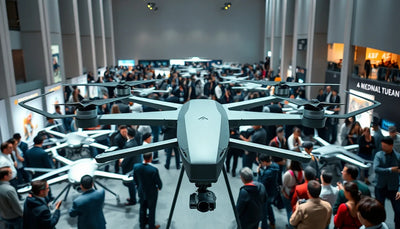
XAG Technology Files for Hong Kong IPO as Agricultural Drone Sales Grow
XAG Technology, a leading Chinese agricultural drone maker, has filed for a Hong Kong IPO after reporting annual revenue of 1.1 billion from agricultural drone sales. The filing signals intensifying competition in the commercial UAV sector and could reshape enterprise procurement and service economics for drone operators.

Quick answer
XAG Technology, a major Chinese agricultural drone manufacturer and DJI competitor, has filed for a Hong Kong IPO after reporting annual revenue of 1.1 billion from agricultural drone sales.
- The filing was reported by Autohome and positions XAG as a significant rival to DJI in the agricultural drone segment.
- The 1.1 billion annual revenue figure reflects growing commercial demand for agricultural spraying and field management drones.
- A successful IPO could fund expanded production, service networks, and product development, increasing competitive pressure on DJI.
- Commercial operators and fleet buyers should monitor how this capital raise affects pricing, parts availability, and service coverage.
Verified facts
Purchase timing
Use market shifts to buy, sell, repair, or wait with more context.
Compare trade-in timing, pre-owned DJI pricing, and repair economics before committing new capital.

What the available evidence confirms
| Company | Reported Annual Revenue | Market Position | IPO Status |
|---|---|---|---|
| XAG Technology | 1.1 billion (agricultural drones) | Described as DJI's strongest rival in agricultural drones | Filed for Hong Kong IPO |
| DJI | Not disclosed in source | Market leader referenced as competitive benchmark | Not addressed in source |
XAG Technology, one of China's most prominent agricultural drone manufacturers, has filed for a Hong Kong initial public offering after reporting annual revenue of 1.1 billion from agricultural drone sales, according to a report from Autohome. The filing positions the company as what the source describes as DJI's strongest rival in the agricultural drone segment, a development that carries meaningful implications for commercial UAV operators, fleet buyers, and the broader drone service economy.
The reported revenue figure reflects sustained demand for agricultural spraying, seeding, and field management drones across China's large farming regions and, increasingly, international markets. For commercial drone operators and procurement teams, the IPO filing is more than a financial event. It signals that a well-capitalized competitor to DJI is preparing to scale its production capacity, service infrastructure, and product development pipeline, which could shift competitive dynamics in the enterprise drone segment over the coming years.
The IPO filing and what it signals
XAG Technology's decision to pursue a Hong Kong listing follows years of expansion in the agricultural drone market, where the company has built a reputation for crop protection systems, precision spraying platforms, and farm management software. The Autohome report frames the company as a direct competitive threat to DJI, which has dominated the broader commercial and consumer drone landscape for more than a decade. While DJI maintains a strong presence in agricultural applications through its Agras line, XAG's focused approach to farming workflows has allowed it to capture a substantial share of the agricultural segment.
The 1.1 billion annual revenue figure reported in the source provides a concrete benchmark for the scale of XAG's operations. For investors and industry observers, the IPO represents a test of whether specialized agricultural drone companies can sustain profitability and growth in a market where hardware margins are under pressure and service-based revenue models are becoming more important. For operators, the capital raised through a successful listing could translate into broader parts availability, faster service response times, and more aggressive pricing on commercial platforms.
Competitive pressure on DJI and the commercial UAV market
The characterization of XAG as DJI's strongest rival in agricultural drones is significant because it highlights a segment where DJI does not enjoy the same overwhelming dominance it holds in consumer and prosumer camera drones. Agricultural operations demand specialized payloads, tank systems, flow control, and field mapping integration that differ substantially from camera drone workflows. XAG has invested heavily in these areas, and a successful IPO would provide additional capital to expand its engineering and support capabilities.
Reboot Hub analysis: For fleet managers and enterprise buyers, increased competition between XAG and DJI could lead to more favorable procurement terms, faster product iteration, and stronger after-sales support as both companies compete for agricultural service contracts. However, competition can also create fragmentation in service networks and parts ecosystems, which is a practical concern for operators who need reliable maintenance and repair options. Buyers evaluating agricultural drone platforms should weigh not only upfront hardware costs but also the maturity of each manufacturer's service infrastructure in their operating region.
What this means for drone owners and the market
The XAG IPO filing matters for commercial drone owners even if they never operate an agricultural platform. A stronger, better-funded XAG increases competitive pressure across the commercial UAV sector, which can influence DJI's pricing strategy, product release cadence, and investment in enterprise support. For operators running DJI fleets, this competition may accelerate improvements in DJI's own agricultural and enterprise offerings as the company responds to a credible challenger in a high-growth segment.
There is also a secondary effect on the pre-owned DJI market. When commercial operators upgrade fleets in response to new competitive offerings or pricing shifts, the supply of inspected pre-owned DJI drones and OEM-pulled parts often increases. Buyers who track these market movements can find better value windows for acquiring professional DJI repair services and genuine OEM spare parts. For those evaluating the broader drone ecosystem, resources like the Drone Wiki can help clarify platform differences, maintenance considerations, and ownership costs before committing to a new or pre-owned system. For owners evaluating service and lifecycle risk, Drone Wiki explains the relevant repair, parts, resale, or operational path.
Repair customers should also pay attention to how XAG's expansion affects parts availability and service competition. If XAG builds out a larger network of authorized service centers and parts distributors, it could pressure DJI and other manufacturers to improve their own repair turnaround times and parts pricing. For agricultural operators specifically, having multiple viable service channels reduces downtime risk during critical spraying seasons, which is a meaningful operational advantage.
What operators should watch next
The most immediate development to monitor is whether XAG's Hong Kong IPO proceeds and at what valuation. A strong debut would validate investor appetite for specialized drone manufacturers and could encourage further capital inflows into the commercial UAV sector. A weak reception, by contrast, might signal broader concerns about hardware margins and the sustainability of agricultural drone business models.
Operators and fleet managers should also watch for any post-IPO announcements about XAG's international expansion plans, service network investments, or new product launches. These signals will indicate how aggressively the company intends to compete outside China and whether DJI will respond with its own agricultural product updates or pricing adjustments. For buyers, the practical takeaway is to avoid locking into long-term platform commitments without evaluating how the competitive landscape may shift over the next 12 to 24 months.
FAQ
Frequently asked questions
What did XAG Technology announce?
XAG Technology filed for a Hong Kong IPO after reporting annual revenue of 1.1 billion from agricultural drone sales, according to a report from Autohome that describes the company as DJI's strongest rival in the agricultural drone segment.
How does this affect DJI drone owners?
Increased competition from a well-funded XAG could push DJI to improve its agricultural and enterprise offerings, adjust pricing, and strengthen service support. It may also influence the availability and pricing of pre-owned DJI drones and OEM-pulled parts as commercial operators upgrade fleets.
Should commercial operators change their procurement plans?
Operators should monitor XAG's IPO progress and post-listing expansion plans before making long-term platform commitments. Evaluating service network maturity, parts availability, and total ownership costs across both XAG and DJI platforms will become increasingly important as competition intensifies.
Which sources support this update?
The article distinguishes reported information from analysis and does not present an unverified source as official confirmation.
What remains subject to change?
Retail pricing, availability, product bundles and regulatory timelines can change. Readers should verify the latest terms with the named retailer, manufacturer or regulator before acting.
How should buyers or operators use this analysis?
Use the verified facts as a starting point, then compare mission fit, lifecycle support, maintenance needs and current procurement terms before making a purchase or fleet decision.
Konsultierte Quellen
- Source material - primary source
Zum Zeitpunkt der Veröffentlichung waren keine weiteren offiziellen Dokumentationen verfügbar.
Die Redaktion von Reboot Hub liefert Käufer-, Reparatur-, Wiederverkaufs- und Betriebsanalysen für Drohnenbesitzer. Sollten Sie einen Fehler finden, kontaktieren Sie uns für eine Korrekturprüfung gemäß unseren Redaktionsrichtlinien.
Dieser Artikel ist ein Marktkommentar für Drohnenbetreiber und -käufer und stellt keine Anlageberatung dar. Reboot Hub bietet keine Finanzberatung und empfiehlt keine Wertpapiertransaktionen.