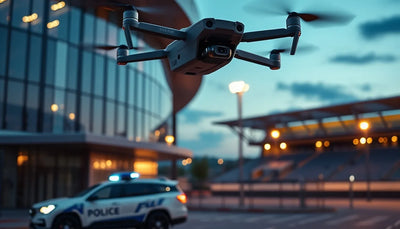
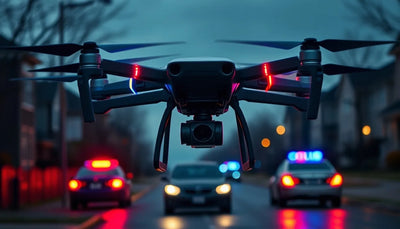
Pinehurst Approves Free BRINC Police Drone Year With Five-Year Renewal
Pinehurst, North Carolina, approved a free year of BRINC police drones, but Motorola's quote bills $159,998 annually for five more years unless the Village gives notice. The decision shows how public-safety drone procurement is shifting toward managed service models.

Quick answer
Pinehurst, North Carolina, approved a free year of BRINC police drones, with Motorola quoting $159,998 per year for five additional years unless the Village gives notice.
- The free first year is tied to a five-year renewal structure quoted at $799,990 total
- Motorola's quote requires the Village of Pinehurst to give notice to avoid the multi-year billing
- The arrangement reflects a managed-service procurement pattern in public-safety drone programs
- Commercial operators should watch how bundled police drone contracts influence service and support pricing
Evidence: DroneXL.co
Fleet readiness
Keep DJI hardware available without overbuying new units.
Use defense and fleet news as a planning signal for repair support, inspected pre-owned aircraft, and replacement timing.

Verified facts
What the available evidence confirms
| Contract element | Reported detail |
|---|---|
| Free first year | Approved by Pinehurst for BRINC police drones |
| Annual renewal quote | $159,998 per year |
| Five-year total quote | $799,990 |
| Notice requirement | Village must give notice to avoid the five-year renewal |
The Village of Pinehurst, North Carolina, has approved a free year of BRINC police drones, according to reporting from DroneXL.co. The decision places the municipality inside a procurement structure that extends well beyond the initial no-cost period, with Motorola quoting $159,998 per year for five additional years unless the Village gives notice.
The reported arrangement matters because it shows how public-safety drone acquisition is moving away from simple hardware purchases and toward recurring, service-backed contracts. For commercial operators, fleet buyers, and repair providers watching the defense and security segment, the Pinehurst decision offers a useful signal about where vendor pricing power is concentrating.
The reported Pinehurst contract structure
DroneXL.co reported that Pinehurst approved a free year of BRINC police drones. The same report states that Motorola's quote bills $159,998 a year for five more years unless the Village gives notice. That places the total quoted renewal value at $799,990 across the five-year window.
The key operational detail is the notice requirement. A municipality that does not actively terminate or decline the renewal could be positioned for a multi-year billing cycle rather than a simple annual hardware refresh. For any organization evaluating similar public-safety drone programs, the takeaway is that the headline "free" year is only one part of a longer contractual sequence.
Reboot Hub analysis: the structure resembles a managed-service or subscription-style procurement model, even though the source report does not confirm the exact service scope, hardware count, or support tiers included in the Motorola quote. Buyers should treat the reported figures as a pricing signal rather than a complete contract breakdown.
Why police drone procurement is shifting toward recurring contracts
Public-safety agencies increasingly need more than aircraft. They need data management, pilot training, maintenance, spare parts, and compliance support. Vendors have responded by bundling those elements into annual or multi-year agreements, which changes how budgets are approved and how long agencies remain tied to a specific ecosystem.
Pinehurst's reported approval of a free first year fits that pattern. A no-cost entry period lowers the initial budget barrier, while the renewal quote locks in a recurring line item. For fleet managers, the lesson is that the true cost of a drone program is rarely the aircraft price alone. It is the accumulated cost of software, service, repair, and replacement parts over the contract term.
The DroneXL.co report does not specify which BRINC drone models are covered, how many units are included, or whether the Motorola quote includes training and data services. Those details would determine whether $159,998 per year represents strong value or an expensive bundle. Without them, the reported figure should be read as a procurement benchmark rather than a confirmed per-unit cost.
What this means for drone owners and the market
For commercial drone owners and independent operators, the Pinehurst case highlights a broader market dynamic: public-safety contracts are becoming recurring revenue streams for hardware and communications vendors. When a company like Motorola positions itself around a police drone renewal quote, it signals that the defense and security segment is being treated as a long-term service market rather than a one-time equipment sale.
That shift can influence the wider drone economy. Vendors that build recurring public-safety revenue may prioritize enterprise and agency support over consumer or small-operator channels. Parts availability, repair turnaround, and software updates can follow the money. Operators who fly DJI platforms or other commercial airframes should pay attention to how service expectations set in the police market eventually shape support norms elsewhere. For owners evaluating pre-owned DJI drones or planning repair budgets, the relevant question is whether the broader industry is moving toward subscription-style maintenance and support models that change the cost of keeping a fleet airworthy. Reboot Hub maintains a Drone Wiki covering ownership, repair, and market planning topics for operators who need to track these shifts. For owners evaluating service and lifecycle risk, Drone Wiki explains the relevant repair, parts, resale, or operational path.
The reported Pinehurst structure also matters for second-hand market participants. If agencies increasingly lease or subscribe to drone capability rather than owning hardware outright, the flow of retired police or enterprise drones into the pre-owned market may change. Subscription models often keep hardware in vendor-controlled refresh cycles, which can delay or reduce the number of units that eventually reach resale channels.
For a buyer or fleet manager reading this report, the practical step is to model total contract cost before signing any drone program agreement. A free first year is not a discount if the renewal terms are unfavorable. Ask what happens at the end of the initial period, what notice is required to exit, and whether the annual fee covers repair, parts, training, and software.
Procurement lessons for small agencies and commercial buyers
Small municipalities and commercial buyers face similar pressure when vendors bundle hardware with recurring services. The Pinehurst report suggests that even a small Village can be presented with a five-year quote approaching $800,000, which is a meaningful budget commitment for a local government.
One practical implication is the importance of calendar discipline. The reported notice requirement means the Village must act before a deadline to avoid the five-year renewal billing. Fleet managers should apply the same logic to their own contracts: set renewal review dates, document performance, and compare alternative service providers before the automatic renewal window closes.
Another implication concerns vendor lock-in. If the Motorola quote covers BRINC drones and associated services, Pinehurst may be committing to a specific hardware and software ecosystem for the renewal period. Switching later could involve retraining pilots, replacing accessories, or rebuilding data workflows. That is a real cost that should be weighed against any initial savings.
DroneXL.co did not report whether Pinehurst considered competing bids or whether the Village has an existing relationship with Motorola. Those details would clarify whether the free first year was a competitive offer or an extension of an established vendor relationship. In the absence of that information, the report stands as a useful example of how public-safety drone procurement is being structured in 2026.
FAQ
Frequently asked questions
What did Pinehurst approve?
Pinehurst, North Carolina, approved a free year of BRINC police drones, according to DroneXL.co. The approval is tied to a reported Motorola renewal quote of $159,998 per year for five additional years unless the Village gives notice.
How much is the five-year Motorola renewal quote?
The reported five-year total is $799,990, based on $159,998 per year for five years. The source report states that the Village must give notice to avoid the renewal billing.
What should drone buyers learn from this contract?
Buyers should evaluate the full contract term, not just the free first year. Notice deadlines, service scope, repair coverage, and vendor lock-in all affect the real cost of a drone program over time.
Which sources support this update?
The visible evidence links identify DroneXL.co; each source is used only for the claim it directly supports.
What remains subject to change?
Retail pricing, availability, product bundles and regulatory timelines can change. Readers should verify the latest terms with the named retailer, manufacturer or regulator before acting.
How should buyers or operators use this analysis?
Use the verified facts as a starting point, then compare mission fit, lifecycle support, maintenance needs and current procurement terms before making a purchase or fleet decision.
Konsulterede kilder
- DroneXL.co - primary source
Yderligere officiel dokumentation var ikke tilgængelig på udgivelsestidspunktet.
Reboot Hub Editorial tilføjer analyse af køb, reparation, gensalg og drift for droneejere. Hvis du finder en fejl, bedes du kontakte os for en korrekturgennemgang i henhold til vores redaktionelle politik.