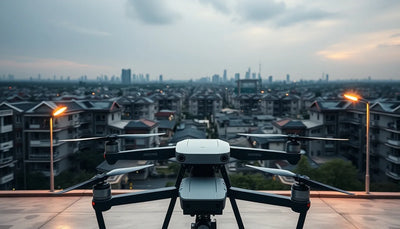
Amazon MK30 Drone Lands Beside Baton Rouge Road During Storm
An Amazon MK30 set itself down on a Florida Boulevard grass strip as storms crossed the parish. The company has not explained why, leaving fleet operators and drone buyers with fresh questions about autonomous landing behavior and commercial delivery reliability.

Quick answer
An Amazon MK30 delivery drone performed an unplanned landing on a Florida Boulevard grass strip in Baton Rouge on Thursday, with propellers intact, as storms moved through the parish. Amazon has not stated why the aircraft landed.
- The event was first reported by DroneXL.co on September 12, 2026
- The drone landed on a grass strip beside Florida Boulevard in Baton Rouge
- Propellers were intact and the aircraft appeared undamaged in the source report
- Amazon has not provided a reason for the landing
- The incident occurred roughly two months into the drone's deployment
Evidence: DroneXL.co
Market context
Turn market news into a buy, repair, or trade-in decision.
Compare pre-owned availability, resale timing, and repair economics before the market moves again.

An Amazon MK30 delivery drone set itself down on a grass strip beside Florida Boulevard in Baton Rouge on Thursday, according to a report published by DroneXL.co on September 12, 2026. The aircraft landed with its propellers intact as storm systems crossed the parish, and Amazon has not publicly explained why the unplanned landing occurred.
The event comes roughly two months into the MK30's operational deployment in the area, a detail that gives the incident added weight for commercial operators watching how autonomous delivery aircraft behave under real-world weather and traffic conditions. For fleet managers, repair customers, and second-hand drone market participants, an unexplained autonomous landing is not just a logistics story. It is a data point about how delivery-grade unmanned systems handle degraded conditions, and about how much information operators can expect from manufacturers after an anomaly.
What the source actually confirms
The central facts are narrow. DroneXL.co reported that an Amazon MK30 performed what the outlet described as a precautionary landing on a Florida Boulevard grass strip on Thursday. The propellers remained intact, and the aircraft was on the ground beside the roadway. Storms were crossing the parish at the time. Amazon has not said why the drone landed.
No official statement from Amazon is included in the source material, and no regulatory filing or incident report is cited. That matters for how this story should be read. The phrase "precautionary landing" appears in the source headline, but the report itself does not confirm that Amazon used that term. Reboot Hub analysis would treat the event as an unplanned autonomous landing with an undisclosed trigger, rather than as a confirmed safety system success or failure.
For commercial readers, the absence of a stated cause is itself the most operationally relevant fact. A delivery operator that cannot quickly explain why an aircraft diverted to a roadside landing leaves fleet customers, municipal stakeholders, and secondary market buyers without a clear signal about whether the event reflects a routine safety response, a weather-related decision, or a deeper system issue.
Why unexplained autonomous landings matter commercially
Autonomous delivery drones are designed to make landing decisions without direct human command. When a system chooses to set down outside a designated landing zone, the immediate questions are about sensor performance, weather tolerance, battery state, communication links, and airspace deconfliction. None of those answers are available in the DroneXL.co report, which is precisely why the event deserves careful attention rather than dismissal.
For commercial fleet operators, the practical takeaway is straightforward: an aircraft that can land itself beside a public road is an aircraft that may also land in less forgiving locations. A grass strip on Florida Boulevard is a relatively benign outcome. The same autonomous decision made over water, dense traffic, power lines, or private property would carry different consequences. Operators evaluating delivery platforms should be asking manufacturers how unplanned landing decisions are logged, how quickly root-cause findings are shared, and what telemetry is available to customers after an anomaly.
Repair and maintenance providers should also note the detail that the propellers were intact. In many unplanned landing events, rotor or landing gear damage drives repair volume. Here, the source suggests the aircraft was visually undamaged, which may limit immediate parts demand. But the event still raises questions about post-incident inspection requirements for delivery drones that land outside controlled areas, especially when the trigger is unknown. A clean exterior does not rule out stress on motor mounts, gimbal or sensor alignment, or battery health.
What this means for drone owners and the market
The second-hand drone market tends to price in reliability signals slowly, then all at once. A single unexplained landing by an Amazon MK30 does not directly reprice pre-owned DJI aircraft or other consumer and enterprise platforms. But the event contributes to a broader commercial narrative about autonomous flight maturity, and that narrative does eventually reach procurement decisions, insurance underwriting, and resale confidence. For owners evaluating service and lifecycle risk, Drone Wiki explains the relevant repair, parts, resale, or operational path.
Buyers of pre-owned DJI drones and enterprise platforms should not overreact to one logistics drone incident in Louisiana. The MK30 is a delivery-specific airframe, and its operational profile differs substantially from camera drones, mapping platforms, and inspection aircraft. Still, the event is a useful reminder that autonomous behavior under weather stress is a real variable in any drone's long-term reliability profile. Buyers evaluating inspected pre-owned aircraft should ask about flight logs, firmware history, and any recorded unplanned landing or return-to-home anomalies, even when the aircraft looks clean. For readers researching platform reliability and maintenance considerations, the Reboot Hub Drone Wiki provides background on how commercial drone systems are assessed and maintained.
Fleet managers should treat this event as a prompt to review their own unplanned landing procedures. Does your operation require a full post-incident inspection after any autonomous landing outside a designated zone? Do you have a clear channel for manufacturer root-cause updates? Do your pilots and remote operators know what to document when an aircraft lands itself? Those questions are cheap to answer now and expensive to confront after an incident.
The larger delivery drone reliability picture
Amazon's MK30 program is part of a broader push to scale drone delivery in suburban and semi-urban environments. The Baton Rouge area has been one of the visible test beds for that expansion, and the source notes the incident occurred roughly two months into the local deployment. That timing matters because early operational months are when fleets accumulate the kind of real-world data that lab testing cannot replicate.
For the commercial drone market, delivery logistics remains one of the highest-visibility use cases for autonomous flight. Every unplanned landing, diversion, or anomaly feeds into how regulators, insurers, and enterprise customers assess the technology. The fact that Amazon has not yet explained the Baton Rouge event is not evidence of a systemic problem. But it is a gap in the information flow that commercial operators have learned to watch closely. In mature aviation markets, unexplained events are investigated and explained. In a young drone delivery market, the speed and quality of those explanations will shape buyer confidence as much as the events themselves.
FAQ
Frequently asked questions
Has Amazon explained why the MK30 landed beside Florida Boulevard?
No. According to the DroneXL.co report, Amazon has not said why the aircraft landed. The source describes the event as a precautionary landing, but no official cause or statement from Amazon is included in the reporting.
Was the Amazon MK30 damaged in the Baton Rouge landing?
Based on the source report, the propellers were intact and the aircraft appeared to be on the ground without visible damage. No damage assessment from Amazon or a repair provider is cited in the source material.
Should this incident change how drone buyers evaluate aircraft reliability?
Not directly. The MK30 is a delivery-specific platform, and one unexplained landing does not establish a reliability trend. However, fleet operators and pre-owned drone buyers should use the event as a reminder to review unplanned landing procedures, flight log history, and manufacturer communication practices before purchasing or deploying aircraft.
Which sources support this update?
The visible evidence links identify DroneXL.co; each source is used only for the claim it directly supports.
What remains subject to change?
Retail pricing, availability, product bundles and regulatory timelines can change. Readers should verify the latest terms with the named retailer, manufacturer or regulator before acting.
How should buyers or operators use this analysis?
Use the verified facts as a starting point, then compare mission fit, lifecycle support, maintenance needs and current procurement terms before making a purchase or fleet decision.
Konsulterede kilder
- DroneXL.co - primary source
Yderligere officiel dokumentation var ikke tilgængelig på udgivelsestidspunktet.
Reboot Hub Editorial tilføjer analyse af køb, reparation, gensalg og drift for droneejere. Hvis du finder en fejl, bedes du kontakte os for en korrekturgennemgang i henhold til vores redaktionelle politik.