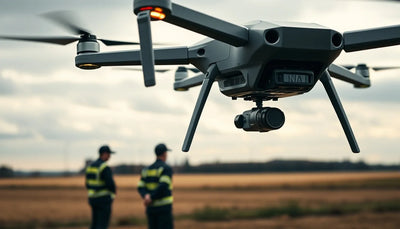
Ukraine Uses Large Drone for Battlefield Medical Evacuation
Defense News reports Ukraine is expanding large drone use for battlefield medical evacuations, with video showing a wounded soldier transported from a forward position to a field hospital. The shift signals growing demand for heavy-lift airframes and specialized payload systems.

Quick answer
Defense News reported on November 17, 2026, that Ukraine is expanding its use of large drones for battlefield medical evacuations, with video showing a wounded soldier transported from a forward position to a field hospital.
- The report documents a large aerial drone evacuating a wounded Ukrainian soldier from the front line.
- The operation moved the soldier from a forward position to a field hospital.
- Ukraine is expanding its use of large drones for medical evacuation missions.
- The development highlights increasing operational reliance on heavy-lift drone platforms in contested environments.
Evidence: Defense News
Market context
Turn market news into a buy, repair, or trade-in decision.
Compare pre-owned availability, resale timing, and repair economics before the market moves again.

Defense News reported on November 17, 2026, that Ukraine is expanding its use of large drones for battlefield medical evacuations, publishing video showing a Ukrainian team using an aerial drone to transport a wounded soldier from a forward position to a field hospital. The report, which Reboot Hub is treating as source-limited because no official Ukrainian military confirmation was included in the material, documents a shift in how rotary and multirotor platforms are being deployed in high-risk medical logistics roles.
The development matters beyond the battlefield. When a military customer validates a heavy-lift airframe for casualty transport, it creates a reference point for commercial operators evaluating cargo drones, inspection platforms, and agricultural sprayers. The same airframe durability, payload stability, and field-maintenance logic that supports a stretcher evacuation also applies to utility work, disaster response, and remote logistics. For drone buyers and fleet managers, the Ukrainian case is a real-world stress test of equipment that increasingly overlaps with civilian heavy-lift categories.
What the Defense News report actually shows
According to the Defense News video report, a Ukrainian team used a large aerial drone to move a wounded soldier from a forward position to a field hospital. The source describes the operation as part of Ukraine's expanding use of large drones for battlefield medical evacuations. The report does not identify the specific airframe model, manufacturer, payload weight, flight distance, or control system used in the evacuation, and Reboot Hub has not independently verified those operational details.
The absence of model-level detail is itself instructive. Military operators often withhold airframe identification for security reasons, but the pattern of use is the commercially relevant signal. Medical evacuation requires redundant lift capacity, stable hover performance under load, and the ability to operate from unprepared surfaces. Those are the same attributes that commercial heavy-lift buyers evaluate when selecting platforms for construction site logistics, powerline stringing, or agricultural payload delivery. A military medical evacuation mission is, in effect, a demanding field trial of payload stability and reliability.
Why heavy-lift reliability is becoming a procurement filter
The Ukrainian medical evacuation use case reinforces a trend Reboot Hub analysts have been tracking across commercial drone procurement: buyers are increasingly filtering heavy-lift platforms by field serviceability rather than by marketing specifications alone. A drone that can carry a stretcher in a contested environment must be repairable close to the operating area, with accessible motor mounts, replaceable arms, and modular payload attachment points. Those repair characteristics directly affect total cost of ownership for civilian fleets operating far from manufacturer service centers.
For operators running agricultural, inspection, or logistics drones, the lesson is practical. Before committing to a heavy-lift airframe, ask how the platform handles field-level maintenance. Can a technician replace a damaged arm without returning the unit to a regional depot? Are the payload rails standardized or proprietary? Does the manufacturer supply genuine OEM spare parts through accessible channels, or does every repair require factory authorization? The Ukrainian evacuation footage does not answer those questions, but it sharpens the reason to ask them.
What this means for drone owners and the market
The most immediate commercial implication is demand-side. When military programs prove that large drones can perform casualty evacuation, civilian logistics buyers gain confidence that heavy-lift platforms are maturing beyond demonstration projects. That confidence tends to flow into procurement budgets for cargo delivery, emergency response, and infrastructure inspection. For owners of existing heavy-lift equipment, the Ukrainian case may also support stronger resale values, because documented military-adjacent use cases help validate the operational category even when the specific airframe differs. For owners evaluating service and lifecycle risk, Drone Wiki explains the relevant repair, parts, resale, or operational path.
For pre-owned DJI drone owners and repair customers, the connection is less direct but still meaningful. DJI's enterprise line, including Matrice-series platforms, occupies the same broad heavy-lift and industrial inspection segment where military and civilian requirements overlap. While the Defense News report does not identify DJI equipment in the Ukrainian evacuation, the broader trend toward rugged, field-repairable multirotors affects how buyers evaluate used enterprise drones. A fleet manager considering a pre-owned DJI Matrice for utility inspection should weigh the availability of genuine OEM spare parts and professional repair support as heavily as flight time or camera specifications. Reboot Hub's Drone Wiki documents repair and maintenance considerations that become more relevant as heavy-lift use cases expand.
There is also a supply chain angle. Battlefield medical evacuation drones experience high stress on motors, electronic speed controllers, and battery systems. Military demand for replacement components can tighten availability of certain parts categories, particularly high-capacity batteries and heavy-lift propulsion components. Commercial operators who depend on those same component classes should monitor lead times and consider holding modest spare parts inventory. Reboot Hub analysis suggests that operators who wait until a component fails often face longer downtime than those who plan for wear items in advance.
What operators should watch next
The Defense News report is a single data point, but it arrives amid a broader pattern of military experimentation with uncrewed logistics. Reboot Hub analysts will be watching for three follow-on signals: formal procurement announcements from defense agencies, identification of specific airframe categories used in medical evacuation, and any civilian regulatory movement toward beyond-visual-line-of-sight medical delivery. Each of those signals would strengthen the commercial case for heavy-lift investment.
For now, the operator-facing takeaway is straightforward. If you fly or manage heavy-lift drones, treat the Ukrainian medical evacuation report as evidence that the category is moving from experimental to operational. That transition rewards platforms with accessible repair paths, standardized payload interfaces, and a supply of genuine OEM spare parts. Buyers evaluating new or pre-owned heavy-lift equipment should prioritize serviceability documentation and parts availability before purchase, not after the first field failure.
FAQ
Frequently asked questions
Was the drone model used in the Ukrainian evacuation identified?
No. The Defense News report does not identify the specific airframe, manufacturer, payload capacity, or control system used in the medical evacuation. Reboot Hub has not independently verified those operational details.
Does this report involve DJI equipment?
The source material does not mention DJI or any specific DJI model. The commercial relevance lies in the broader heavy-lift drone category, where DJI enterprise platforms compete and where repair and spare parts considerations are similar.
What should fleet managers do after reading this report?
Fleet managers operating heavy-lift or enterprise drones should review field repair procedures, confirm access to genuine OEM spare parts, and evaluate whether their platforms can be serviced without extended factory turnaround. The Ukrainian use case highlights the operational value of repairable, modular airframes.
Which sources support this update?
The visible evidence links identify Defense News; each source is used only for the claim it directly supports.
What remains subject to change?
Retail pricing, availability, product bundles and regulatory timelines can change. Readers should verify the latest terms with the named retailer, manufacturer or regulator before acting.
How should buyers or operators use this analysis?
Use the verified facts as a starting point, then compare mission fit, lifecycle support, maintenance needs and current procurement terms before making a purchase or fleet decision.
Konzultované zdroje
- Defense News - primary source
V době publikování nebyla k dispozici žádná další oficiální dokumentace.
Redakce Reboot Hub poskytuje vlastníkům dronů analýzy nákupů, oprav, prodejní hodnoty a provozu. Pokud narazíte na chybu, kontaktujte nás pro revizi opravy v souladu s našimi redakčními zásadami.