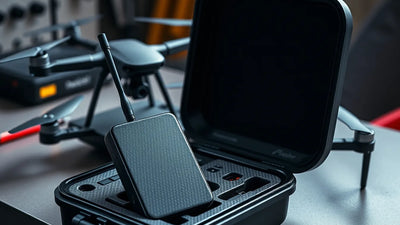
TOM 50 RE vs. Drones: AV’s Backpack UGV Redefines Recon and EOD
AeroVironment's new TOM 50 RE UGV challenges the hegemony of aerial drones for tactical reconnaissance. This backpackable, six-wheeled robot is engineered for a world beyond BVLOS waivers and visual-line-of-sight limits. For commercial operators and defense contractors, this signals a seismic shift in autonomous systems integration, threatening to reshape the used drone market as ground-based sensing platforms carve out their own mission-critical niche. Read on to discover how this hardware forces a fundamental reassessment of ground truth versus a bird’s-eye view.

Redakční poznámky
- Tento článek kombinuje konkrétní externí zprávy s vlastní analýzou Reboot Hub pro kupce dronů, provozovatele flotil, zákazníky servisů a sledovatele trhu s repasovanými zařízeními DJI.
- Fakta ze zdrojů jsou oddělena od interpretace. Pokud zpráva poskytuje omezená data, článek tuto omezenost uvádí a prezentuje pohled Reboot Hub jako analýzu.
- Reboot Hub má komerční vazby na produkty a servisní služby pro drony; tyto odkazy jsou zdroji pro čtenáře a neurčují závěr článku.
The ground war just got a new silent partner.

OSTFILDERN, Germany - June 14, 2026. In a move that redefines the tactical edge of small-unit operations, AeroVironment, Inc. (NASDAQ: AVAV) has announced the global launch of the TOM 50 RE, a backpackable uncrewed ground vehicle (UGV) developed by its wholly owned subsidiary, Telerob. This compact robot, designed for rapid reconnaissance and explosive ordnance disposal (EOD), marks a significant maturation of ground-based autonomy, directly challenging the ubiquity of small drones in the modern battlefield and specialist civilian sectors.
The TOM 50 RE is not merely a smaller UGV; it is a strategic weapon system compressed into a man-portable package. With a weight that allows a single soldier to carry it into the field, the system promises a new layer of persistent ground-truth data. While the commercial drone industry remains locked in debates over Remote ID compliance, beyond visual line of sight (BVLOS) waivers, and airspace integration, the TOM 50 RE operates in a physical realm where those rules do not apply. This is a ground-level asset designed for the harshest environments, fully capable of crawling into drain pipes, scaling rubble, and peering under vehicles, delivering high-definition situational awareness where a drone's camera simply cannot reach.
Fleet readiness
Keep DJI hardware available without overbuying new units.
Use this news as a planning signal for inspected DJI aircraft, repair support, and trade-in timing.
The TOM 50 RE: Technical Specifications and New Capabilities
The TOM 50 RE builds on Telerob's established expertise in EOD robotics but optimizes the design for dismounted reconnaissance. At its core is a ruggedized, six-wheel-drive chassis that utilizes flexible suspension for high traction over loose gravel, mud, and snow. The vehicle is designed to be rapidly deployed from a standard military backpack, ready for action within seconds of arrival on site.
Key features reported by AV include:
- Rapid Reconnaissance: Fitted with a suite of high-resolution daylight and thermal cameras, the UGV provides a real-time video feed to a handheld operator control unit (OCU). This allows for long-range reconnaissance without exposing personnel to direct line of sight or potential ambush positions.
- Manipulator Arm: The "RE" in the designation likely stands for REmote Explosive Ordnance Disposal. The UGV features a dedicated, articulated manipulator arm with a precision gripper, capable of lifting and manipulating suspicious objects, performing remote breaching, and placing charges or sensors. This is a critical upgrade over purely "look-only" reconnaissance UGVs.
- Backpackable Design: The entire system, including the UGV, batteries, and OCU, fits into a single standard-issue backpack. This represents a major logistical advantage over larger, vehicle-deployed counterparts and allows every squad or patrol to have organic robotic support.
- Communications: It uses a secure, low-latency digital datalink designed for obstructed environments, ensuring control remains stable even when the robot is operating inside buildings or behind large concrete barriers.
For defense analysts, the TOM 50 RE fills a critical capability gap between a static observation post and a flying drone. An aerial drone offers a wide-angle, top-down view that can be disrupted by foliage, weather, and defensive jamming. The TOM 50 RE offers a ground-level "mouse-eye" view, capable of examining the underside of a vehicle, the crawlspace of a structure, or the interior of a tunnel. This complementary sensor fusion-combining air and ground data-is exactly the kind of multi-domain intelligence that military doctrine is beginning to mandate.
Implications for the Drone Market and the Battlefield Ecosystem
Ready to Upgrade Your Fleet?
Browse our collection of inspected pre-owned DJI drones - inspected, flight-tested, and backed by a 6-month warranty. Save up to 40% versus retail.
While TOM 50 RE is a UGV, its launch directly impacts the commercial and defense drone ecosystem. For years, the small-drone market-dominated by platforms like DJI's Mavic and Matrice series-has been the default solution for tactical visual intelligence. The TOM 50 RE introduces a powerful argument for a hybrid approach: for missions requiring close-quarters inspection (CUI) or subsurface work, a UGV is demonstrably superior to a multirotor.
This development has profound implications for the commercial operators who serve alongside defense contractors. A UGV can operate in GPS-denied environments without any navigation signals, can endure physical contact with obstacles, and can be equipped with a manipulator for active threat neutralization-functions that a standard quadcopter cannot perform without expensive custom payloads and fragile landing gear.
From the perspective of Reboot Hub's analysis, the arrival of such purpose-built defense hardware forces a recalibration of the drone lifecycle. As military units begin to integrate both aerial drones and UGVs into their standard kit, the need for specialized, high-performance aerial platforms may shift. Reconnaissance budgets will be split. This could lead to a decrease in demand for high-end aerial systems for pure overwatch roles, replaced by cheaper, single-mission aerial assets supported by a UGV like the TOM 50 RE. For operators holding inventory of older model tactical quadcopters, this creates urgency to understand how their gear fits into a new, combined armed team.
What Does the TOM 50 RE Mean for International Defense Markets and Regulation?
Q: How does this UGV interact with current drone regulations like the FAA Part 107 or EASA regulations?
The TOM 50 RE operates in a different legal dimension. While a commercial drone operator searching for pre-owned DJI drones must navigate strict airspace rules, Remote ID mandates, and no-fly zones, a UGV is governed by ground-based operational rules. This gives defense users a massive agility advantage. They can deploy the TOM 50 RE into an urban environment, a factory floor, or a contaminated zone without needing a BVLOS waiver or a Visual Observer. This regulatory freedom makes ground robotics an increasingly attractive investment for law enforcement and military special forces over "air-only" solutions. For commercial organizations serving defense contracts, this implies a need to offer integrated UAS + UGS services.
Q: How does this impact the second-hand drone market?
The defense sector's adoption of UGVs like the TOM 50 RE can accelerate consolidation in the aerial drone market. As budgets are re-allocated, there may be a short-term surplus of "mid-range" tactical reconnaissance UAVs, such as the Raven or the Puma, which were the gold standard for dismounted recon. This influx could depress prices in the used drone market, creating a buyer's market for civil security firms, agricultural operators, and specialized inspection companies. However, it also means that the value proposition for cheaper, lower-fidelity UGVs may increase relative to drones. Commercial operators looking to expand their service offerings should begin evaluating how a UGV inspection system could augment their existing aerial fleet, potentially creating a "boots-on-the-ground" branch of their business. Reboot Hub anticipates a 20-30% price correction in ruggedized military surplus drones over the next 12 months, making this a prime time to acquire high-end hardware for civil applications.
Commercial Opportunities and a New Standard for Reconnaissance
For the average commercial drone pilot, the AeroVironment TOM 50 RE launch is a signal. It underscores that the demand for robust, ground-level intelligence is not a niche requirement; it is an operational imperative. As autonomous systems converge, the definition of a "drone pilot" is set to expand. Tomorrow's operator might control both a Matrice 30T for a high-level thermal survey and a TOM 50 RE to crawl into a storm drain or a hazardous spill zone for a close-up inspection.
This convergence is already visible in the repair and maintenance sector. As operators deploy more sophisticated multi-modal robots, the hardware must be more resilient. To ensure you are flying with mission-ready equipment, it is wise to invest in professional DJI repair services to keep your aerial fleet operational while exploring how UGV capabilities might complement your work. The end of the pure aerial gaze is near. The new standard is a coordinated, ground-to-air sensor net, and the TOM 50 RE is the first solid step toward that total awareness.
Our Take: AeroVironment Leads, But the Market Follows
AeroVironment's investment in the TOM 50 RE demonstrates a mature understanding of the modern battlefield and the commercial security sector. The company is not simply selling a drone; it is selling a tactical outcome-reconnaissance that persists, that penetrates, that acts physically. For competitors like DJI and FLIR, the gauntlet is thrown. Can their UGV offerings keep pace with this level of tactical integration? For the end-user-the warfighter, the public safety officer, the industrial inspector-the answer is a resounding yes, the future is multi-vehicular, multi-domain, and undeniably robotic.
The pressure is now on the second-hand market to adapt. As new hardware becomes available, old systems will be flushed out. Those looking to capitalize on high-end military or enterprise-grade robotics should watch this space closely. Demand for UGVs may soon exceed demand for pure reconnaissance drones. If you are considering refreshing your inventory, now is the time to evaluate the long-term viability of your current aerial platform.
FAQ: The TOM 50 RE and Its Impact on the Drone Industry
Can the TOM 50 RE be integrated with existing commercial drone systems?
Yes. Telerob designs its OCUs (Operator Control Units) with standard data output protocols. For defense contracts, it is expected that the TOM 50 RE's video feed can be fused into a common operating picture alongside feeds from Raven or Puma drones. For commercial operators, this means the control system could potentially interface with third-party ground control software, provided API integration is developed. AeroVironment has a strong history of ecosystem interoperability, but third-party integration will likely require a software development kit (SDK) or a custom clearance.
Is the TOM 50 RE a direct threat to the commercial drone market?
Not a direct threat, but a market shaper. The TOM 50 RE's primary competition is other UGVs, not aerial drones. Its introduction may, however, shift defense procurement budgets away from small tactical UAVs. For the commercial sector, it sets a new standard for what a "backpackable" reconnaissance asset looks like, pressuring drone manufacturers to innovate on endurance, ruggedness, and payload integration. It will not replace a $20,000 DJI Matrice series for large-area surveying, but it will replace the $15,000 EOD drone for specific close-quarters work.
What is the typical price point for the TOM 50 RE?
Given its defense-grade specifications and the cost of EOD-grade manipulator arms, a full TOM 50 RE system will likely be priced between $50,000 and $120,000, depending on sensor suite and battery configuration. This is significantly above the cost of a new recreational or commercial quadcopter. It positions the TOM 50 RE as a specialized tool for warfighters and elite security teams, not a general consumer product. Second-hand units may eventually filter into the civil market in 2-4 years.
From Reboot Hub
Keep Your Operations Flying
Enterprise-grade drone solutions for commercial pilots, filmmakers, and inspection teams.
Pre-owned Fleet
Fully inspected DJI drones with 6-month warranty. Save up to 40%.
Browse Inventory ->