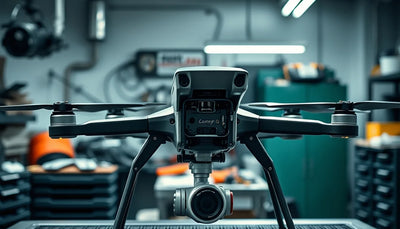
DJI Still Leads Drone Tests, But Rivals Are Gaining Fast
TechRadar's latest drone testing roundup shows DJI models still dominate top picks, but competing brands are earning stronger placements. For commercial operators and pre-owned DJI buyers, the shifting field signals a more competitive market ahead.

Quick answer
TechRadar's latest drone testing roundup found that DJI models still perform strongly, but several non-DJI drones also earned top placements in the publication's testing.
- DJI remains a leading performer in TechRadar's drone tests
- Non-DJI brands are appearing more frequently among top picks
- The competitive field is broadening for commercial and consumer buyers
- Pre-owned DJI demand may be influenced by stronger rival options
TechRadar's latest drone testing roundup, published through its Google News feed, confirms a quiet but meaningful shift in the commercial and consumer drone landscape: DJI models continue to perform well in hands-on evaluations, but they no longer stand alone at the top of the field. The publication's editors noted that several of the drones that "soared through" their tests are not from DJI, a framing that would have been unusual even a few years ago.
Market context
Turn market news into a buy, repair, or trade-in decision.
Compare pre-owned availability, resale timing, and repair economics before the market moves again.

The report, attributed to TechRadar's testing team, does not diminish DJI's position as a dominant manufacturer. Rather, it reflects a maturing market where competing brands are producing hardware capable of earning credible editorial recognition. For fleet operators, repair customers, and buyers evaluating pre-owned DJI equipment, this development matters because it suggests the competitive pressure on DJI's pricing, parts availability, and resale values is becoming more structural rather than anecdotal.
What the TechRadar testing roundup actually shows
According to the source summary, TechRadar's editors compiled a list of favorite new drones based on models that performed well in their testing process. The key editorial observation is that the top-performing group is no longer exclusively a DJI showcase. While the source data does not name specific rival models or provide technical scores, the publication's decision to emphasize non-DJI performers is itself a market signal.
For commercial operators, this type of editorial recognition carries weight beyond consumer enthusiasm. When independent testers begin placing competing hardware alongside DJI products in "favorite" categories, procurement teams and independent pilots gain a stronger basis for evaluating alternatives. That does not mean DJI's operational advantages in areas like ecosystem maturity, spare parts availability, and repair infrastructure have disappeared. It does mean that the gap in core flight performance and camera output is narrowing in ways that buyers should monitor.
Why broader competition changes repair and resale math
DJI's dominance has historically supported a relatively stable pre-owned market. Strong demand for used Mavic, Mini, and enterprise-series aircraft has kept resale values predictable, while the availability of genuine OEM spare parts and professional repair services has made older DJI platforms economically viable to maintain. A more competitive new-drone market introduces new variables into that equation. For owners evaluating service and lifecycle risk, Drone Wiki explains the relevant repair, parts, resale, or operational path.
Reboot Hub analysis: If rival manufacturers continue earning editorial and operational credibility, some buyers who might have purchased a new or pre-owned DJI unit will instead consider alternative platforms. That can soften demand in certain segments of the pre-owned DJI market, particularly for consumer and prosumer models where brand loyalty is less entrenched. Conversely, commercial operators with existing DJI fleets may respond by extending the service life of current aircraft rather than switching platforms, which would sustain demand for repair services and OEM-pulled parts. Reboot Hub analysis suggests the repair and maintenance side of the DJI ecosystem is likely to remain resilient even as new-drone competition intensifies, because fleet operators tend to optimize for continuity and parts availability over short-term hardware comparisons.
What this means for drone owners and the market
The most immediate implication for drone owners is that purchase decisions should account for a broader competitive set than they did two or three years ago. A buyer evaluating a new drone today should ask whether the DJI model's advantages in ecosystem maturity, repair access, and resale liquidity outweigh whatever performance or pricing benefits a competing model may offer. For many commercial users, the answer will still favor DJI, but the question is no longer rhetorical.
For repair customers and fleet managers, the practical takeaway is to maintain disciplined documentation and service schedules. Drones that are well-maintained with verifiable service histories will hold value more effectively in a market where buyers have more alternatives. Operators who plan to sell or trade aircraft should keep records of firmware updates, battery cycles, and any professional repairs, because those details increasingly influence pre-owned pricing. Readers tracking these shifts can consult the Drone Wiki for reference material on DJI platforms, parts considerations, and ownership documentation practices.
For the broader market, the TechRadar roundup reinforces a pattern that has been building across the drone industry: DJI remains the benchmark, but the benchmark is being tested more seriously. That is generally healthy for buyers, who benefit from competitive pressure on features and pricing. It also means that assumptions about resale value and long-term platform viability should be revisited periodically rather than treated as fixed.
What operators should watch next
The source data does not provide specific model names, pricing, or launch dates for the non-DJI drones that earned TechRadar's recognition. That limits the depth of any immediate procurement analysis. However, operators should watch for follow-up reporting that identifies which manufacturers are gaining editorial traction and whether that recognition translates into commercial adoption, enterprise certifications, or expanded service networks.
Fleet managers evaluating new acquisitions should also monitor whether competing brands are building out repair infrastructure and parts supply chains at a pace that reduces DJI's operational advantage. A drone that performs well in a test environment is not automatically a sound fleet asset unless it can be maintained, repaired, and resourced reliably over multiple operating cycles. Until rival service ecosystems mature, DJI's integrated hardware, parts, and repair network will continue to be a meaningful differentiator for commercial buyers.
FAQ
Frequently asked questions
Does this mean DJI is losing its market lead?
Not based on the available source data. TechRadar's roundup indicates DJI models still perform well, but the publication is highlighting strong non-DJI options more prominently than in the past. That suggests a narrowing competitive gap rather than a reversal of DJI's market position.
Should I delay buying a pre-owned DJI drone because of this news?
No. The report does not indicate any DJI product defect, recall, or regulatory change. Pre-owned DJI drones remain viable purchases, especially for operators who value parts availability and established repair networks. The news is about broader competition, not DJI underperformance.
What should a fleet manager do differently after reading this?
Fleet managers should document service histories and maintenance records more rigorously, because a more competitive new-drone market can influence pre-owned pricing. They should also evaluate any non-DJI alternatives against operational criteria like repair access and parts lead times, not just test performance.
Which sources support this update?
The article distinguishes reported information from analysis and does not present an unverified source as official confirmation.
What remains subject to change?
Retail pricing, availability, product bundles and regulatory timelines can change. Readers should verify the latest terms with the named retailer, manufacturer or regulator before acting.
How should buyers or operators use this analysis?
Use the verified facts as a starting point, then compare mission fit, lifecycle support, maintenance needs and current procurement terms before making a purchase or fleet decision.
Konzultované zdroje
- TechRadar via Google News - primary source
V době publikování nebyla k dispozici žádná další oficiální dokumentace.
Redakce Reboot Hub poskytuje vlastníkům dronů analýzy nákupů, oprav, prodejní hodnoty a provozu. Pokud narazíte na chybu, kontaktujte nás pro revizi opravy v souladu s našimi redakčními zásadami.